Showing posts with label manuscript. Show all posts

Thursday, October 8, 2015

What They Sound Like: Rune Songs and Joiks

The Voynich manuscript appears to contain some sort of chanting in the tradition of the joik and the
From "Women and  Death - Karelian Laments"
Nordic Women's Literature
charm rune. Certain characteristics point strongly to this conclusion:
  1. The text appears to be largely trochaic, which is the meter of choice for such purposes.
  2. Like joiks and chant songs, the Voynich text is alliterative and repetitious, playing with sound.
  3. Several pages depict nothing but women involved in some sort of ritual, dancing and shaking torcs and possibly beating the water, so the potential for chant songs to be included is very high.
 Runes of origins and other "loihtoluvut" (charm runes) were once common in the Finno-Baltic region. The following is excerpted from "Impact of The Kalevala on Finnish Arts and Nationalism" by K. Y. Hamilton:

The word ‘rune’ means ‘a secret thing’ and was thought to have magical overtones. Through the many magic charms in the rune songs, we are able to peek at the social life surrounding the peasant community. The charms themselves were, depending on the circumstance, short, humble, and prayer-like or long, fanciful, commanding charms. The charms regarding the creation of a thing (the ocean, the trees, etc.) are imaginative and poetic narratives. By singing a charm about the origin of a thing, the people were able to conquer that thing through the power of the spoken word.

Carelia was famous for its professional lament singers, men and women
who knew long laments, songs and epical verses by heart.
In 1920 The Kalevala Society (Kalevala Seura) still found wise men and women
who also could perform magical rituals.
This video is a compilation of magical rituals
found in "Reenactment of a Carelian Wedding" shot on location in 1920.
Recording from The Estonian Literary Museum (http://www.kirmus.ee/) 

...In addition to Bride Lamentations, there are magic charms for every nuance of Finnish life. There are exorcism charms, traveling charms, huntsman’s charms, charms for times of illness and times of prosperity, charms for animals and people and natural disasters.

Charm Runes/Rune

Above is the left side of a page in the Voynich. The lines are divided by a heading in the left margin. When transcribed using the alphabet in this blog, the words appear to derive from old Fenno-Norse roots along the lines of a dialect from the peoples inhabiting the coastline of the Gulf of Bothnia for thousands of years, and those eastward into the Baltic and Karelia.
The Kalevala meter was once the poetic code throughout much of the Balto-Finnic area: among the Estonians, Finns, Izori, Karelians, Livonians, and Votyans. The Balto-Finnic peoples were and continue to be a culturally diverse lot. Thus, rune-singing praxis—its institutional contexts, performing styles, performers, and their goals and poetic skills—varied, often in fundamental ways, according to the region and people in question. "Body, Performance, and Agency in Kalevala Rune-Singing" by Anna-Leena Siikala
A rune singer tradition in the north of Karelia is known to exist for ages, legends and songs were passed on from one generation to another, keeping connection between them. It was rune singers who made the Kalevala region famous: The runes performed by them were carefully recorded for the descendants by Elias Lyennrot who compiled the epos “Kalevala”.
A Karelian Rune Singer

Frans Laulainen contributed these insights:
In Finnic tradition music is the way that magic is conducted. In the Kalevala Väinämöinen uses his Kantele and sings Joukahainen into the mud. I find it interesting that in Finnic culture the women are the singers in chant groups (listen to some Värttinä for songs of Karelia, Ingria, Votia, ja niin edespain). The Saami Joik is sung by all (male and female). Music is power and wisdom.
In pre-Christian Finnic culture women perhaps had some social status as Shamen (or Shawomen) and musical status of singers of the folk songs and lore songs. It is not surprising to me that if the Voynich manuscript is Finnic (possibly Karelian) that it should be written by a woman. 

Rune Charms as opposed to Runes

In this post, we are talking solely about runes or rune charms as chant-songs. The Voynich manuscript handwriting has little to do with the written type of runes except for possibly its very strange "k" and the resemblance that some of its drawings bear to Icelandic magic staves. Karelian runic letters do exist, but they are not well studied at all. The rune song emerged some 2500-3000 years ago in the culture of the proto-Finnic groups living near the Gulf of Finland. Characteristic of this singing tradition is the use of four-footed trochaic verse, alliteration and parallelism (saying the same thing twice in successive verses but in different words). The melodies of rune songs consisted of one or two phrases, usually in 4/4 or 5/4 meter and with a melodic range of a perfect fifth. This singing style remained vital throughout Finland until the 16th century, after which it gradually disappeared, first in the south and west, and later elsewhere. https://www.erudit.org/fr/revues/is/2005-v25-n1-2-is0384/1013309ar.pdf

Other regions in northern Europe employed spells as the famous Merseburg charms evidence. Jacob Grimm in his Deutsche Mythologie, chapter 38, listed examples of what he saw as survivals of the Merseburg charm in popular traditions of his time: from Norway a prayer to Jesus for a horse's leg injury, and two spells from Sweden, one invoking Odin (for a horse suffering from a fit or equine distemper) and another invoking Frygg for a sheep's ailment. He also quoted one Dutch charm for fixing a horse's foot, and a Scottish one for the treatment of human sprains that was still practiced in his time in the 19th century. 

The Joik

A joik (also spelled yoik), luohti, vuolle, leu'dd, or juoiggus is a traditional Sami form of song that is also used in very spiritual contexts.
Through joik, noaiden (the shaman) could come into contact with the spiritual world. In the old Sami religion, it was thought that nature had a soul, and there were many gods and spiritual beings. ...Person joiks are still found to a large degree and are in living use. These are joiks which are made for a person or an animal. It is not the composer or the person who wrote the lyrics who owns the joik, but rather the one for whom the joik was made. It is not said that one joiks about someone, but that one joiks someone. A joik can therefore be connected to a person in the same way as a name is. More here.
The verb “to joik” is used in the transitive form—one does not joik about someone else; one simply joiks someone else (Sámi Instituttha 169). The joik is a unique form of cultural expression for the Sami people in Sápmi. Like the Sami people, it has been misunderstood, ridiculed, appropriated, and even threatened. According to music researchers, joik is one of the longest living music traditions in Europe, and is the folk music of the Sami people. Its sound is comparable to the traditional chanting of some Native American cultures. With the Christianization of the Sami, joiking was condemned as sinful. The traditional joik may be called the "mumbling" style, said to have resembled magic spells. Joiking’s function was both social and spiritual.  Joiks were used not only to communicate the quintessence of a person, place, or thing, to one’s audience, but were also used in the trance-inducing rituals of Saami shamans, or noadi. Lyrical joiks center around either nature (animals, plants, particular places or geographic formations) or people, the latter of which is especially common in North Sapmi.

This is Jan Ole Hermansen, winner of the Sami Grand Prix Yoik Competition.

Conclusion  

Folk wisdom has to do with the rhythms of nature, propitiousness, fertility, purification, and communication with the past or invisible. The more I read about older cultures, the more I am impressed by how central the concept of timeliness was, so that for warriors, as for farmers and priests, there was a due season, and a key to success in any venture was action at the most propitious time, whether it was to make war or sow seed or give a sacrifice. So many traditional patterns in various older cultures speak of rhythms, cycles, a sort of tempo of existence that we can hardly imagine how to appreciate (for more on the seasona``l calendar, click here). Interpreted through various manifestations, both male and female, the divine was witnessed mostly in the phenomenon of sacred timing: that is, rhythm. 

When we manipulate sound, we also affect the medium through which it passes. The ancients have used this fact to at least appear as if they were effecting change through magic.
 
The first historic use of written Finnish was 1450 and Mikael Agricola didn't translate the bible into Finnish until 1537. But that is history, and a lot never got into history. Certainly fact that the bible was translated into Finnish in 1537 would have made it into those annals. The fact that a group of women adopted a weird script in order to record their obviously non-Christian rituals would have been ignored. It is not part of the canon. A fantastic treatise on how our truths have been formed for us can be found in the works of Michel Foucault. Or you could ask any people whose traditions and language have been systematically oppressed, for example the Sami.

Facebook Page

Sunday, June 28, 2015

The Handwriting

The Old Permic or Abur alphabet was created in the 14th century by the Russian missionary Stepan Khrap (1373- 1395), who become St Stephen of Perm. It was modeled on the Greek and Cyrillic alphabets, but many of the letters resemble the Komi religious "Tamga signs". (...) Komi (Коми), which is also known as Zyrian, or Komi-Zyrian, is spoken by about 350,000 people mainly in the Komi Republic (Коми Республика) in the northeast of European Russia.
Hauksbók ('Book of Haukr'), Reykjavík, Stofnun Árna Magnússonar
Above is an example of myriad Medieval manuscripts to be found within the golden hoard of Norse literary tradition. This Icelandic manuscript dates from the 14th century and was created by the Icelander Haukr Erlendsson. It recounts Eiríks saga rauða or the Saga of Erik the Red.

Medieval Norse history is inextricably woven into the history of the northern British isles because quite early on as well as Scandinavia the Norse settled there in substantial numbers. The culture of Orkney, for example, may be said to be far more Norse than that of Britain south of Hadrian's Wall. This is good to keep in mind when studying the Voynich manuscript because the script closest to it hails from Scotland.

Take a look at the following word from a different manuscript and see if you can read it.
Perhaps you came up with saPro.

Or outio.
Or oaPro.You're getting along about as far as most scholars who are studying the Voynich.

This word in fact does not come from the Voynich at all but rather from a letter that gained some renown in June of 2013 for its re-identification as being written by Robert the Bruce to Edward II. It was originally attributed to Robert's son.

Here it is in full.

The word above is, in fact, Latin.


Had it been written in a far more obscure tongue, scholars might still be stumbling about with its transcription and translation, but since it is Latin, the translation came rather easily, especially compared to the Voynich.

Take a look at some other words in this letter from Robert the Bruce, written roughly a hundred years before the Voynich.
Here's just a snippet from the Voynich.
Since it's in Latin, the letter "k" is at best scarce in Robert the Bruce's letter and may be completely absent, just as it appears to be in the Voynich. Rather, the "k" sound, if it appears, is presented as double c's as in ecclesie. Here's some Wiki on it.
In the earliest Latin inscriptions, the letters C, K and Q were all used to represent the sounds /k/ and /g/ (which were not differentiated in writing). Of these, Q was used to represent /k/ or /g/ before a rounded vowel, K before /a/, and C elsewhere. Later, the use of C and its variant G replaced most usages of K and Q. K survived only in a few fossilized forms such as Kalendae, "the calends".
When Greek words were taken into Latin, the Kappa was transliterated as a C. Loanwords from other alphabets with the sound /k/ were also transliterated with C. Hence, the Romance languages generally use C and have K only in later loanwords from other language groups. The Celtic languages also chose C over K, and this influence carried over into Old English. Today, English is the only Germanic language to productively use hard C in addition to K (although Dutch uses it in learned words of Latin origin and follows the same hard/soft distinction in pronouncing such words as English).
But let's say that in the Voynich, the language used is very fond of k's yet the writers are more familiar with (or have only an example of) Latin script. What they may do is for every k they wish to write pen a pair of c's.

The Handwriting

A manuscript written in Sweden at about the time the Voynich manuscript was written.
Detail from 'The Mirror of the Life of Christ', an illuminated 15th-century Scottish manuscript.

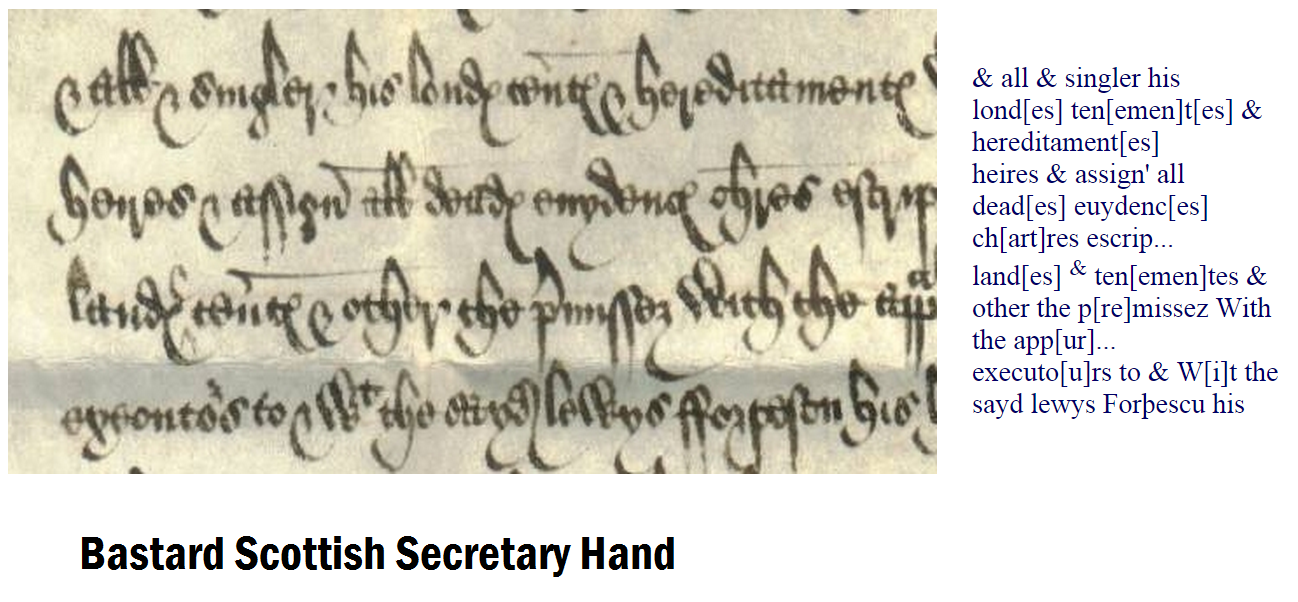
Below is a Register of Sasines for Glasgow, 1654-1656, written in Scottish secretary hand and taken from a superlative site on the subject, Scottish Handwriting.com. If you can read this without looking at the transcription, then you're on the road, at least, to reading the Voynich manuscript.
The words, of course, are Scots, not the language used in the Voynich, but if you transcribe a passage from the Voynich using letters from this alphabet, you get something strongly suggesting an arcane Fenno-Norse origin. The secretary hand was developed a century after the Voynich was written, so it would be absurd to say that the Voynich was written in Scottish secretary hand. In fact, it may be the other way around. Whatever hand this is in the Voynich may have heavily influenced the development of the Scottish secretary hand.

But how on earth, you might ask, did an arcane Fenno-Norse language end up written in a hand related to one used centuries later in Scotland?

A stigma has arisen against the Scots perhaps starting with the Romans, who became so sorely frustrated with them. By the time of the Glorious Revolution, especially the Scots in the Highlands were deemed for the most part incorrigible and illiterate. The potshots that Westminster takes to this day at the Scots (who have recently dared to clap in that non-clapping place) reflect this centuries-old stigma.

Since, like the Nordics, Scottish culture was not imbued with Judeo-Christian or Greco-Roman culture but something quite different, it was next to impossible for those south of them to admit they had any culture at all. (This is akin to researchers today clinging habitually to the canon to try to interpret the Voynich manuscript and shoehorning the imagery into explanations that they are familiar with in lieu of waking up to the presence of another, completely different culture which more than likely birthed it.)

It is good to keep in mind that Scalloway, Shetland, is a hundred miles closer to Bergen, Norway, than it is to Edinburgh. Especially in northern Scotland and most markedly across Orkney and Shetland, the Norse have had far more of an influence on Scottish culture than any people south of Hadrian's wall. The Scots language can be traced back to mainly Norse origins. For centuries the people on either side of the North Sea have traded, the Finns and the Sami being frequent visitors, along with north Germanics, and, going back all the way back to the Kvens up to the 15th century, nordic aristocrats owned tracts of land in north Scotland.
Below is a record from the county court of Chester, held on Tuesday after the feast of St Nicholas in the year 1310. It lists a fellow by the unfortunate name of Roger Fuckbythenavel preparing to be outlawed. This is so far the earliest sighting of the swear word in the English language. What is even more interesting for our purposes is the court hand in which the record was written. Note that the f appears as a double f and the l has two bizarre little top loops. In addition, the e is extremely rounded. Finally, the u and the v are identical.


Here is an example of how the smoke screen about Scottish culture has been recently lifting. A researcher at the University of Glasgow has discovered the oldest surviving non-biblical manuscript from Scotland. Although the Boethius manuscript (the 'Consolation of Philosophy') which dates to c.1130-50, was known and had previously been catalogued, scholars had believed it to be English, with Durham being the most likely place of origin. However, closer inspection has revealed that the manuscript's handwriting and illustrations do not match those of Durham, or other English books, from this period. Identifying the manuscript as a product of David I's Scottish kingdom means that Boethius was being read in Scotland 300 years earlier than previously thought. Dr Murray, who is conducting a British Academy Post-Doctoral Fellowship project on Boethius's 'Consolation of Philosophy' in Scotland, believes that this is proof that intellectual and literary cultures were flourishing in Scotland at a far earlier date than has been realised.

The Voynich derives from a medieval progenitor of Scottish Secretary Hand. The language is not Gaelic, but it is a combination of proto-Germanic and proto-Finno-Ugric, possibly a rare survivor from the Kvens. 

Perhaps you can see now, these is indeed a context for the Voynich manuscript's actual script. It's simply of course in a more obscure tongue than Latin and in a far more delicate hand than that of Robert the Bruce.


Thursday, May 7, 2015

Transcription Alphabet


The above translation within the Voynich was yielded by using
  • A transcription derived from Scottish secretary hand (see below) 
  • A search within vocabularies found only within a certain geographic area in northern Europe. One can find borrowings from Finnish, Sami, Swedish, Norse, Estonian, and Russian. 

The beauty of this theory is that the meanings of the words and the graphics consistently, mutually support each other in a common cultural context. The who, the what, the why, the where, the how, the symbolism, and the words all work as a cohesive whole. 

The Words

With the alphabet below, I have transcribed well over 80 words, which are mentioned throughout the posts. A partial list is below. For a full list, see the Voynich Word List and the running spreadsheet. Initially, I thought that many of these were names. However, now I believe that those ending in "a" tend to be singular nouns, those ending in "er" tend to be plural nouns, and those ending in "ai" or "ei" tend to be verbs in the past tense, perhaps used as adjectives, as in the English "ed". For example, "kepka" for "cap" appears throughout the Voynich in various forms, such as "ekepker" for "caps" and "kepkei" for "capped".

Sprinkled throughout the mss are simple words, for example eiere, which has several similar meanings depending on the language: if Coptic it means a conduit; if Norwegian it means owners; if Germanic it means to wobble like an egg, as eier in German means egg. Hence, the word may be used to mean source.
The original Icelandic manuscripts which are the source of our knowledge of Norse mythology did not employ a unified system of spelling. Thus the same name might be spelled several different ways even in the original manuscripts. Letters unique to the language existed, such as a modified version of the letter Wynn called Vend that was used briefly for the sounds /u/, /v/, and /w/. In particular, the length of vowels was only sporadically marked in many manuscripts and various umlauted vowels were often not distinguished from others. Another complication is that several shortcut forms for common words, syllables, and grammatical endings developed. One example is the use of the rune named maðr (man) for the word maðr. Another is the use of a special glyph for the various r-endings so common in Old Norse. These scribal abbreviations are categorized as follows:
  • Suspension, truncation, or curtailment: Certain letters of the word are omitted, with the abbreviation indicated by a superscript stroke (esp. dropping a nasal), dot(s) beside the letter, or occasionally a colon. Examples: Ꝥ for þat (etc.), ū for um, hō for hón, þan̅ for þann; .kgr. for konungr, .s. for sonr.
  • Contraction: The first and last letters are written, and the abbreviation is indicated by a dot or superscript stroke.
  • Special signs or brevigraphs: Symbols replacing words or syllables. Examples: Tironian et (⁊) for ok, ᛘ for maðr, syllabic et (Ꝫꝫ) in mꝫ (með) for /eð/.
  • Superscript letters: Regular letters contained in the word or letters specifically for abbreviation purposes. Often with syllabic content. Examples: sᵏ (sik), a zig-zag shaped symbol mainly for er and ir in u͛a (vera).  https://en.wikipedia.org/wiki/Old_Norse_orthography
A word on consonant gradation: it has been rather difficult to discern whether a single or double "l" or a single or double "k" is being used in various places in the manuscript. The letter used as an "l" seems to automatically, invariably be a double "l," but often when you drop it down to a single consonant and look it up, the meaning of the word shows up in lexicons. Consonant gradation, where consonants alternate between various "grades" like this, is typical of Uralic languages such as Finnish, Estonian, Northern Sámi, and the Samoyed language Nganasan. Of the Finnic languages, Votic is known for its extensive set of gradation patterns. So many kk's and ll's ending in a and i certainly give the Voynich manuscript a distinctly Finnish look.

Listed below are words found in the manuscript, which appear in specific languages in northern Europe:

Norwegian/Swedishsom
ikke
ei
eller
Estonian
ilusam
ikka
ei
aga
siis

Finnish
samalla
apara
taikuus
Teit - Finnish - Second-person singular past indicative form of tehdä, to do, to perform
Elä - Possibly various older forms of "elä" (Finnish) meaning "live" (be alive). "Minä elän" = I am alive, "Sinä elät" = you are alive.

Russiankepka - cap
I found these loan words because these languages are prevalent in contemporary times, so they were easy to look up. But the Voynich language itself--whether Seto, Livvi, Votyak, Southern Sami, Ume Sami, Pite Sami, Lule Sami, Northern Sami, Skolt Sami, Inari Sami, Ingrian, Ludic, Permyak, Karelian, or some other tongue spoken in north Europe--is far more difficult to find.
More gleanings from manuscript 

Alkeisa - basic


Allekksa Aleksa Alusa
Apai - aunt Apaiis aunt in Udmurt (Zyrian/Votyak).
Apara - upper body
Epais, which is French for chubby.
Eparlasai - fixative for liver of sulfur

Esaikkaisa Isogaisa = superb
Jór - horse
Kela - coil

Leiks - dock/sorrel
Para - Finnish witchcraft - being created to bring milk and butter
Pekka, Peko, Pekko

Perheit - to have a family
Samalla - in the same way or at the same time as
Sara - wounds
Sareiaia - wound treatment
Taikkusai - taikuus = magic
Tait - enchantment
Teit - Finnish - Second-person singular past indicative form of tehdä, to do, to perform
Ukko-Pekka meaning approximately "(respected) Grandpa Pekka”

The Transcription Alphabet
Below are some of the letters found in the Voynich manuscript transcribed.

"dearest sister" reverse-transcribed in English

Transcription Examples 

Below is a typical text analysis using the commonly cited transcription alphabet (not mine).
And now is a paragraph from the plants section with some early spotty translation using my transcription alphabet. Below, vowels appear to do what we would expect of them and so do consonants, and there appears to be a certain syntax at work. The meaning at least sketchily garnered appears to have to do with the pictures instead of some secretive voyage or love letter, etc.
I do believe that instead of looking for the esoteric, looking instead at natural languages would yield more accurate results. I do believe it will be located on this tree.

If this is an old dialect then even a modern person of that origin might have to spend some time on it. Here's a bit of English in an old dialect (16th c. Scots), and I can't say I breeze through it: He leuis to his barne gif his wyf hes ane man barne his haill armour … And gif it beis ane woman barne the foirsaid geir to be sauld.

So with the Voynich you've got a weird script on top of an obscure dialect on top of what is an apparently extinct language. HOWEVER, someone who knows Old Norse, proto-Finnic, and perhaps proto-Slavic should be able to translate the Voynich at last if they use the transcription alphabet furnished in this post.


Saturday, September 13, 2014

Architecture

The Swallowtail Crenellations

Much ado has been made out of the swallowtail crenellations that are depicted on the rosette map. Indeed, this depiction of a castle or fortress in the Voynich manuscript's Rosette fold-out shows a certain type of merlon quite prevalent in northern Italy during the 15th century, which indicates the Ghibelline side of two warring Italian factions. 

Here are Guelph and Ghibelline getting enough of each other in Dante's Hell.

Does this prove the manuscript originated in northern Italy?


Diane O'Donovan points out that this swallowtail style may have sprung from an indigenous and originally Achaemenid Persian style.

Here are examples of merlon styles with Vs in them from various places around the world.
Lademaher Tower, Latvia


Brandenburg Castle, Germany


Prague, Czech Republic

Orlik Castle, Czech Republic

Kos, Greece
\
Bran Castle, Romania

Kuşadası, Turkey

Kremlin, Russia
On July 19, 1425, the Italian architect Anton Fryazin (Antonio Gislardi)
laid the first stone of the Tainitskaya Tower on the south wall of the Moscow
Second Kremlin in Izmailovo, Russia

Velez Blanco, Spain

Tyumen, Russia

Sudak, Ukraine

Kremlin wall - Koromyslova Tower - Nizhny Novgorod

Reason #1 the swallowtails as a case for Italy don't hold up

Swallowtail crenellations are as much in Russia and elsewhere in Europe as they are in Italy.

Many multi-domed buildings were constructed in Russia during the 15th century. The revival of bricks in many constructions were seen in regions like Novgorod and Pskov. The first cathedral in the Moscow Kremlin complex was constructed in this period. There was also a fall in wooden constructions, as the then Tsar Ivan III ordered demolishing of all wooden structures that were surrounding the Kremlin. Glimpses of Italian influence can be seen in Russian structures of the 15th century. (From A Summary of the Truly Splendid and Opulent Russian Architecture)

Rafal T. Prinke makes this conclusion:  
All of this just confirms my earlier opinion that any resemblance of the VMS features to the "humanist hand" or Italian architecture of any type does not "prove" that it originated in Italy or even that region. Italian scholars and artists of the 15th c. were everywhere - especially in central and eastern Europe. 

Reason #2 the swallowtails as a case for Italy don't hold up

Another reason why crenellations are not as helpful as one might assume in identifying the location of a castle is that they are not the most durable part of a fortification. They get bombarded, eroded, and dispensed with in a redesign.
Hämeen linna (Häme Castle) 16th c and now

Reason #3 the swallowtails as a case for Italy don't hold up

There is yet another reason you cannot rely on the swallowtail crenellations as an indication of any sort of origin for the Voynich manuscript. These appear on a map. Maps usually are drawn by people who travel. So who can say whether the person drawing a castle with swallowtail crenellations was drawing their home or some landmark in their travels? This would seem a no-brainer, as would hundreds of blonde women sweating in a sauna pointing toward, oh I dunno, maybe...Finland...? Just a wild guess, but hey, knock yourselves out trying to find the Chai.

What about when everything else falls into place and there are swallowtail crenellations?

Several details about the Voynich manuscript point to the possibility of the swallowtail crenellations depicted being not in Italy but rather in Russia. It's a northern language heavily Finno-Ugric, the symbolism used throughout is Finno-Ugric and northern European, and the features of the women are northern European. Their ritualistic implements point toward a northern European belief system. It stands to follow, then, to look for architecture in northern Europe, not southern Europe. And indeed, given the rest of the landmarks on the map, where we should expect to see an extraordinarily long wall with swallowtail crenellations they are there in abundance.

Khanate of Kazan on the upper Volga, 1441 

The Volga, Kama and Vyatka were the main rivers of the khanate, as well as the major trade ways. Peoples subject to the khan included the Chuvash, Mari, Mordva, Tatar-Mishar, Udmurt, and Bashkir. The Permians and some of the Komi tribes were also incorporated into the Khanate.

Other Architecture

Other than the crenellations, is there any additional outstanding architectural feature in the castles that may hint to the area of origin?

Onion Cupolas

This is the sort of architecture for which Karelia and all of Russia is renowned. I don't believe this circle of onion domes is supposed to represent one building or even one city but rather the Golden Ring of Russia itself.

St. Sophia Cathedral, Novgorod

Built from 1045 - 1050 to replace the Oaken Cathedral in the middle of the 11th century, making it the oldest cathedral and oldest building that is still being used.

Balto-Slavic Red Coned Roofs 

Red coned roofs crown a plethora of castles from Lithuania to the Czech Republic.
Talinn, Estonia

Conclusion


All this goes to say that the architecture in the Voynich Manuscript spans Europe because the map itself spans several countries. It cannot be relied on solely as a locator for the distinct origin of the manuscript. It certainly nails down Europe, but any further specifics as to origin require looking elsewhere inside the manuscript.