Showing posts with label voynich manuscript. Show all posts

Tuesday, April 30, 2019

Old Permic Script and the People of the Perm Krai

Mikael Agricola, who lived in the early 1500s, is credited with creating the first comprehensive writing system in a Finnic language. He is even called "The Father of literary Finnish." However, the birch bark letter no. 292, created over 200 years before Agricola, is the oldest known document in any Finnic language.

In addition, inscriptions in Old Permic script are among the oldest relics of the Uralic languages. To set the exact date of Komi writing is impossible. But the fact that it originated long before the 10th century is evidenced by the Books of Ahmed Ibn Fadlan about his journey to the Volga in 921-922. Arab traveler and secretary of the embassy of the Baghdad Caliph wrote about the correspondence of the king of Volga Bulgaria with the ancestors of the Komi people, calling them Vysu (вису).

The Komi ancestors did not have one, but two kinds of writing. The first is the so-called practical letter of the pass, or symbol. With these signs, the zyryane (Komi) tagged their belongings and hunting grounds, and also made calendars. Similar signs existed among all Finno-Ugric and Samoyed peoples. Almost without changing, these icons endured to modern times on spinning wheels, as well as embroidered and knitted patterns.
Komi Calendar Passes

Georgy Lytkin wrote about the difference between the two types of writing in the 19th century: “Zyryan passes never had the meaning of letters, they cannot convey what the Egyptian hieroglyphs conveyed. No approach can be made between passes and stefanovsky letters.” Unlike the Komi passes collected in the 19th-20th centuries, tamga-like graffiti on archaeological finds belong to the 12th-14th centuries. They are undoubtedly the oldest of such signs. http://foto11.com/komi/docs/komipas.php


Stepan Khrap of Perm (St. Stephen) is said to have created Old Permic script for the Komi language in 1372. Actually, all he did was employ a script already well known to him. His grandfather, an educated Komi merchant Dzebas, often climbed up Vychegda and Vym in his trade affairs. It was then that he would have seen for the first time the Komi letters that Zyryan merchants used in trade.   http://www.komi.com/mc/arhiv/new001.htm
Stephan of Perm

This occurred a century before the creation of the Voynich manuscript (according to carbon dating), and roughly two centuries before Agricola and his writing system.

Not until the 17th century was Old Permic, aka Abur, superseded by the Cyrillic script from which it was loosely adapted. I say "loosely" because Old Permic is called a "highly idiosyncratic adaptation" of Cyrillic and Greek, with Komi "Tamga" signs. Interestingly, since not many persons knew it, Old Permic was also used as cryptographic writing for the Russian language.

Could the Voynich manuscript use the Komi's two writing systems, the Tamga system for f66v and f57r and for the rest of the text the more formal writing system employed by the Komi to send letters to trading partners like the Bulgar king?

Let's take a look at Old Permic script, especially Old Permic cursive, and compare it against the script in the Voynich manuscript used for what appear to be 1) a list of rune charms and 2) a calendar.

Pronounced correspondences occur on two pages, one possibly listing runic charms and the other on what appears to be a seasonal calendar. The rest of the manuscript appears to employ, however strangely,  more of a Latin script. The characters which appear similar to Old Permic are not used throughout the manuscript but rather in special, isolated places, as if they were runes or numerals. They in fact do have quite a few correspondences with Tamgas, those used in Finno-Ugric culture.

Here is a comparison between Voynichese, Hungarian Tamga-like symbols, and the Old Permic writing system.
~
~

~
~
~
~
~

~

If the Voynich manuscript has been influenced by an obsolete script from the Perm Krai, and if its folios contain words from inhabitants of the Perm Krai, then perhaps there are extant records of folk songs that would bear resemblance to the frequently repeated words in the Voynich manuscript.

So then, we have this:
One striking correspondence is that the above wedding tune from the Vatka Komi in the Krov district, uses the letters that, if my transcription is fairly accurate, are found in abundance in the Voynich manuscript: a, u, o, i, e, s, p, t, k, m, and l. In addition, it repeats small two-letter words: oi, pe, ok, and uk. 

Other correspondences exist regarding Komi mythology, folk costume, and lore.

Power over water


Mythic focus on women

Zarni Ań (Golden Woman) was the supreme goddess of the Zyrian people (Komi).

"In the mythologies of Uralic peoples, a woman is seen as the ruler of life and death and the southern and northern direction of the corresponding air directions," says Academy Professor Anna-Leena Siikala." The gods of the shamans are the gods of nature

Depictions of female suns

Päivätär ('Maiden of the Sun'), is the goddess of the Sun in Finnish mythology. Described as a great beauty, she owns the silver of the Sun, spins silver yarns, and weaves clothes out of them. In Kalevala, young maidens ask Päivätär to give them some of her silver jewelry and clothes.

Professor Anna-Leena Siikala finds it possible that Päivätär was a goddess who ruled over life and light. During Christian period, she was replaced by Virgin Mary.
Below is a contemporary depiction of Päivätär by sculptor Kaarina Kuusisto-Lukkari.
Above, Komi female sun

Symbols of spinning and weaving

Not only was Päivätär a goddess—she was the goddess of spinning, and her sister, Kuutar, goddess of the moon, was in charge of weaving.

Komi Women

Conclusion

Thus, we find shared nuances in script, mythology, and symbolism between the Voynich manuscript and Uralic culture, especially among the people of the Perm Krai. 

Wednesday, June 28, 2017

Introduction


The Voynich manuscript has been carbon dated to the 15th century (~1430). 
   Housed in Yale's Beinecke Library, it depicts largely middle-aged women dancing naked in the water of a cave, and also around star designs and zodiac signs. Other pages illustrate plants and herbal jars. 
   Statistical analysis of the manuscript's text reveals patterns similar to those of natural languages, in fact more complex than English, meaning that it is highly unlikely to be a codified language or a hoax. That much is scientifically proven. 
   Astonishingly, no one has been able to read the Voynich manuscript or figure out where it originated, who wrote it, or what its purpose was. 

   The theory in this blog establishes the following:
Script
A progenitor of Scottish Secretary Hand most closely akin to medieval Cornish manuscripts such as the Ordinalia and northern Scottish/Irish manuscripts, including the preserved letter from Robert the BruceThis blog contains a new and original transcription alphabet.
Language
A combination of old Finnish and Old Norse with some Slavic, the arcane Kven tongue OR a dialect that evolved where Austria, Hungary, and Croatia meet remain the best bet; however, a plethora of dialects in north Europe, many of them extinct, are viable candidates, perhaps especially dialects spoken around A) Torne Valley and northern Norway; B) the island of Kihnu, Estonia, whose language is a blend of Finno-Ugric and Old Swedish; C) the island of Naissaar, Estonia, when it was inhabited by the aibofolket, Estonian Swedes, in the 15th century; D) the medieval towns of Lohja, Porvoo, and Naantali, or E) the older villages of Karelia.
Authors
The many women drawn in it, called "nymphs" or elided altogether in other theories, are central instead of peripheral to it. They themselves actually wrote and drew it. They are possibly the legendary Huldra, participants in a Neolithic cult of tripartite Rhea (later [f]Reya), the original Finnic practitioners of what was then appropriated and dubbed by the Norse as Seiðr during the Late Scandinavian Iron Age. In Finland, Estonia, and Scandinavia, the Church later terminated the sacred HIIS and the underworld called Hiiela by substituting the hiis with the Church graveyard. They were healers, herbalists, midwives, brewers, bakers, cooks, spinners, weavers, embroiderers, well-water guards, water navigators, jewelry makers, tradespeople, land owners or birkarls, noblewomen, singers, dancers, and diviners. The manuscript celebrates these occupations. 
Literary Form
BaltoFinnoNorse poetry and song. Trochaic chant in the tradition of the great Finnish epics, possibly even in Kalevalan meter itself. Akin to Seto Leiko Hõpõhelme, leelo song, which is said to be able to bring down walls. Alliterative, repetitive, and playful with words. Nonlinear, with depth symmetry, like a joik. The manuscript could in fact be a guide (akin to the zibaldone)--songbook, calendar, and map--for these women to go south on a specific pilgrimage in the springtime, according to an ancient, pre-Christian folkloric belief system, the remnants of which can still be discovered in Europe today.
Origin Hotspots
LofotenNorway coming around the Gulf of Bothnia to Southern Finland (Naantali, Lohja) and the islands of Estonia, especially Kihnu, are definite candidates with almost as high a likelihood running from the Baltic region down to the Alpine mountains bordering Slovenia/Croatia, Austria, and Hungary. In these areas particularly, a patchwork of the oldest European belief system can be found in remnants, and the Voynich manuscript echoes them.
Geographic scope
Rosette map contains Fennoscandia, the Baltic, Danubian EuropeRussia's Golden Ring, the Black Sea, Mount Elbrus, and the Urals.
Topic
The women were depicting themselves performing a shamanistic water/cave ritual celebrating the sempiternal cycle of nature manifest in the seasons and in the span of human life from birth to death. The backdrop for this ritual is north European (Finno-Ugric) cosmology that reaches back into the Neolithic. Sauna/banya, still enjoyed today, echo these ancient rites, as do pilgrimages to sacred springs that have been in more recent times dedicated to saints, as well as several seasonal festivals, such as one known in English as Twelfth Night.

In the center of many of the star charts is a woman's face. These star charts may depict a celebrated Nordic ancestor (disir) and her descendants (represented by the smaller, surrounding stars) and not astronomical bodies or constellations. Indeed, these star charts resemble the large, circular brooches worn by Nordic women during the phase in their lives when they are fertile. These brooches are often said to represent the sun. The women's faces in the centers of the star charts often have rays like the sun. These symbols all hark back to an ancient female sky deity celebrated under various names throughout northern Europe.

The rosette map in the manuscript records an ancient pilgrimage from Fennoscandia to the Perm in the northern Urals marked by passage via waterways, many of which were subterranean. The blooming of plants on riverbanks beside castles helped pilgrims know when it was time to rendezvous. Stars with their varying numbers of rays may represent acolytes.

The belief system depicted in the Voynich manuscript was alluded to in sagas such as the Edda. In time it was subsumed under the spread of Christianity and re-emerged as the cult of Mary and Saint Birgitta, which was centered in Reval (Tallinn) though widespread throughout the Baltic region and into Germany. The murals of Saint Lawrence cathedral in Lohja, Finland, serve as a semiotic bridge between the pre-Christian Voynich Manuscript and the more classical, Judeo-Christian iconography of later churches around the Baltic region. 
Context
As with all shamanism water and caves were main metaphors for travel between life and death. The belief system played out on every folio is a remnant of the Neolithic fertility paradigm that once spanned Europe under names like Freya, Holda, Nerthus, Perchta, Holle, Akka, Rán [raun or raahn], and Frau Gauden. These former deities can be traced only vaguely in their later surrogates--the docile, vapid vessels of the Virgin Mary, Freya, and myriad saints who have taken over wells and springs, etc. In order to survive, the old belief system went deep underground and obviously at some point, and oftentimes with inhuman brutality, died out so thoroughly as to mystify us whenever any actual historical remnant of it gets unearthed.
The wisdom throughout the Voynich manuscript is that of the folk. It is not classical, not Judeo-Christian, not Hebrew, not Islamic, not Chinese, not South American, not Arabic, not scientific, not a cipher, not gibberish, and not a hoax. One of the duller attacks made on this theory is that nothing in it reflects any of the current research going on elsewhere about the Voynich manuscript. Indeed,  little to no real light has been shed on the Voynich since the statistical analysis and carbon dating. Most certainly this theory is a radical departure from the many blind alleys down which other scholars are still camped. Beautifully, none of the actual science done about the Voynich conflicts with the theory presented here in this blog--not the carbon dating of the vellum, not the consistency of the vellum (more like calf than the goat often used in more southerly locations), not the statistical analysis that suggests that it is a natural language. 
Remnants
Sauna and Banya, herbal knowledge, embroidery, folk songs, Twelfth Night traditions, lore (fairy tales, myth, and legend, including Tannhauser's), folk design (octogram and kolovrat), coracle design, the shell grotto of Margate, and, oh um, the Voynich manuscript. The herbal jars are treenware, household implements made from wood, often involving being turned on a lathe, further carved, and then painted. The containers in the Voynich most resemble wooden sewing nécessaires, needle cases, spice grinders and spice towers owned and used by women in their everyday work of cooking, brewing, healing, and sewing from the 11th to the 17th century. The plants in the Voynich are rendered by artists inured in the tradition of embroidery and other women's handicrafts. The flowers are often drawn and painted in a style reminiscent of needlework from the Kihnu and Muhu Islands of Estonia. 


Monday, October 17, 2016

Design & Symbol in the Voynich Manuscript

 "Images are just constructions, as any other human product." 
In visual art as in literature, what is chosen to be depicted and how it is depicted can speak volumes about the creator of a work. So it is with the Voynich. We can pick up a substantial amount of information about who created it by looking at what they drew.

Suns and Brooches

Women in many parts of Europe would have been particularly familiar with radial, circular designs. Some of them would have worn the brooches (solde, solju, sølje, risku, sakta, kösöntyű) that are found throughout this region of the globe, from Norway to Setumaa, Estonia, where only those women could wear the big brooch who were able to give birth to a child. When a girl was wearing a heaped brooch this signified the onset of menstruation and women who were not wearing brooches anymore had already passed their menopause. As you can see, these brooches were circular and big. At least for the Sami, the risku represents the sun. Now look again at the star charts with the women in the center, with light radiating from her.


Below is an excerpt from FOREST MYTHS: A BRIEF OVERVIEW OF IDEOLOGIES BEFORE ST. STEFAN by Pavel F. Limerov:
The function of a Heavenly Mother of the female deity standing on a lizard-like animal is marked by solar symbols – it may be a circle on her forehead or an additional female mask above her head, and sometimes even a mask on her chest. The Goddess Mother may have also functioned as a solar deity, and possessed an epithet Shondi Mam ‘the Solar Mother’ (cf. the Udmurt Shundy Mumy ‘Sun-Mother’) as sun is one of the symbols of heavenly and underworld fertility.

The Sun Spiral

Related to the Mesopotamian symbol for eternity, the sun spiral, known throughout Europe--in Georgia as the Borjgali (Georgian: ბორჯღალი; also Borjgala or Borjgalo) and Armenia as the Arevakhach--is usually placed above the Tree of Life and symbolizes the Sun, eternal movement, and life.  Kolovrat means spinning wheel in a number of Slavic languages and is found to be an ancient symbol of a Russian and Slavic native faith. 
Star spiral from Voynich (left) and Cross with Kolovrat, Visoki Dečani monastery, XIV century (1327-1330)
Armenian Arevakhach (Արեւախաչ, ie "Sun Cross")

Below is a sun spiral on an engraved stone found in Havor, Gotland. 
(The Art Archive/Historiska Museet Stockholm/Dagli Orti)

The stone also portrays the horses Arvakr and Alsviðr (Árvak and Alsvin), Early-Awake and Very-Swift. In Norse mythology, Sköll (Old Norse “Treachery”) is a wolf that chases the horses Árvakr and Alsviðr, that drag the chariot which contains the sun (Sól) through the sky every day, trying to eat her. Sköll has a brother, Hati, who chases Máni, the moon. At Ragnarök, both Sköll and Hati will succeed in their quests.

Below is a Voynich manuscript star chart claimed by some to be a galaxy. It is placed beside simple crochet motifs employed in Russian folk art. Russian folk art in fact goes back to the Neolithic,  predating the discovery of galaxies by several centuries. 
It would be one giant leap for mankind if he'd stop calling
the graphic at top left a galaxy.

The Animals

The animals depicted in the Voynich mss. have their precedents in European handicrafts and very commonplace nature.

The Lizard of the Underworld/Fertility

Below is a lizard with seven fish in its stomach. This graphic and passages below are from: THE PERMIAN ANIMAL STYLE, Editors Mare Kõiva & Andres Kuperjanov & Väino Poikalainen & Enn Ernits, Published by the Folk Belief and Media Group of ELM http://haldjas.folklore.ee/folklore, Estonian Folklore
"The numbers 4, 7 and 10 are significantly often also found in parts of the lizard motif and its decorations (e.g. Figures 46 and 48). I have observed a connection with fertility in the case of the lizard motif (e.g. Figures 48, 51–52). This fits to the explanation according to which lizard symbolised Earth and the under-world, the world of the dead. In Udmurtian beliefs, life was a gift from the deceased and the living received their souls from forefathers (Holmberg 1914: 51–53). When a Komi sowed a field, went hunting or fishing, he always asked the deceased for their blessing (Nalimov 1907: 10)."
...From the point of view of land, underground forces and fertility, time is the factor what makes growing possible. The numbers under discussion refer, also in connection with the lizard, to time and fertility. 
Permian bronze casts like this lizard signifying the underworld
were produced by the Komi and Udmurt people
between the 4th and the 14th centuries.
Below are Voynich animals. Note the resemblance of the animal below right to the lizards above.
Voynich animals
Garden Variety Pill Bug
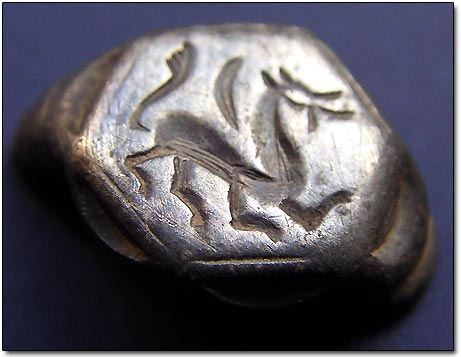
Stamp Ring found in Karelia

The Fish

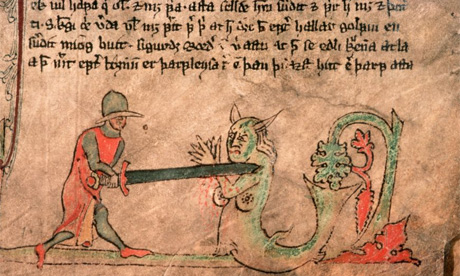
Below we have a scene from a manuscript fairly contemporary with the Voynich:


And here is a scene from the Voynich:


What's missing?
  • A blue-green monster skin
  • An ugly grimace
  • Horns or donkey ears
  • Oh yeah, and Mr. Helmet-head ready to kill her
How these women are rendered suggests that these authors/artists are antipodal to each other in philosophy, mentality, politics, and just perhaps gender.

In the Voynich scene the woman's thighs are incontestably her own, so she's not becoming the fish. If the fish were eating her, it would probably start with the head, not the feet. Rather, it appears that the woman is emerging from the fish. Her eyes are set to what's above her, and she doesn't look wholly petrified at her situation. Where is there any trace of a cultural tradition where a woman might emerge from a fish down in a cave?

Here is the Wiki on Finnish mythology:
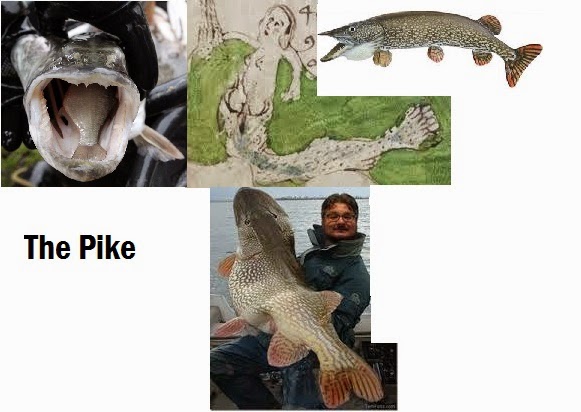
Tuonela was a dark and lifeless place, where the dead were in a state of eternal sleep. Shamans were sometimes able to reach the spirits of their dead ancestors by traveling to Tuonela in a state of trance created by rituals. He had to make his way over the Tuonela river by tricking the ferryman. While in Tuonela, the shaman had to be careful not to get caught: the living were not welcome there. Shamans who were caught could end up decaying in the stomach of a giant pikefish with no hope of returning to normal life. If the shaman died during the trance ritual, it was believed that he had been caught by the guards at Tuonela.

The pike is a very large, large-mouthed freshwater predator often speckled and with rounded lobes, as is depicted in the Voynich manuscript. This little shamaness could be emerging from Tuonela.

The Bird

The bird could be a stork, or a snow goose, or a grouse, or an ibis... I don't see any outstanding difference between it and hundreds of thousands of such birds sewn, painted, and carved in folk art. For millennia, the bird has been one of the most popular of such motifs. 
In Russian folklore The Bird carries a lot of meanings. It symbolizes the spring, The Sun itself, and different aspects of The Sun (its warmth, light, and power). Fire essence of the Bird is reflected in fairy-tales of Firebird, and in Russian euphemism for a fire ("a red rooster"). The Bird promises a good harvest and prosperity. The Bird embodies the concept of love, marriage, and motherhood. ...Images of The Swan and The Goose on women's headdresses and costumes are caused by the worship of waterfowls in Northern Russia. Scientists believe such worship was established in Neolithic Age. Northern Russia's arts and crafts are full of Swans and Geese. Birds appear not only on clothes, but also as an element of a decoration of houses, spinning-wheels, and harnesses.  More here.
And here is an excerpt from Anssi Alhonen's Notes on the Finnish Tradition:
The upper world is located in the skies and also to the south. The great birch tree (or in Finnish tradition, the giant oak) grows there. At the roots of the tree, a spring flows and marks the source of the world river. Near the tree and spring there is a warm lake, or 'sea of life', where water birds and human souls are renewed. In the Finnish folk religion this upper world became a warm and light world located in the south called Lintukoto (or 'home of the birds') and the sea of life became a body of warm water surrounding the Lintukoto. 
Finnish Mythological Cosmos

The Designs

Here are some examples of European designs in handicrafts beside those in the Voynich manuscript. What becomes clear when studying the designs in the manuscript is that the artist(s) loved putting in the following:
  • fringes
  • flowers with little circles in the middle
  • birds
  • intricate, contrasting abstract borders
  • radial designs
and other elements familiar to the tradition of folk handicrafts.

Flower of Life Rosette

Vologda Lace and  Karelian Embroidery
For more info go to 
this and this site.
Geometrical symbols, including a "flower of life" rosette,
incised on roof beams of a ceiling dating from 1681

"Passivity and obedience, moreover, are the very opposites of the qualities necessary to make a sustained effort in needlework. What's required are physical and mental skills, fine aesthetic judgement in colour, texture and composition; patient during long training: and assertive individuality of design (and consequence disobedience of aesthetic convention). Quiet strength need not be mistaken for useless vulnerability." 
― Rozsika Parker, The Subversive Stitch: Embroidery and the Making of the Feminine

Sun Symbol

Obviously, the Finns still love big, circular sun designs.

Baltic Octagram

The Embroidery and Knitting of Muhu Island, Estonia
Finnish embroidery

Embroidered Flowers

Kihnu Embroidery


"Muhu handicraft may truly be considered one of the brightest chapters in the great

treasury of Estonian folk art. At all times there have been maidens and women on this small plot of land, overgrown with junipers, who have knitted incredibly fine-textured mittens and socks they have been fond of wild color combinations, embroidered floral beauty and rather sharp-tongued humor."          
 

Karelian Embroidery 

Embroidery has a centuries-old history in traditions of Karelian and Veps people but the most ancient samples that reached our time are dated not earlier than 1200 AD (from the Henenin site). For a history of weaving and Karelian craft, go to here and here.

Csanga (old Hungarian) Embroidery

Nordic sweater collars


Alternating leaves, box fringes, and radial designs


Perm, Russia

Lace of Vologda

Vologda lace is hugely varied in its patterns, but often it begins on a lattice (left), which creates a sort of skeleton for the whole. While the Voynich map's rosettes (middle) differ from the lace sample on the right, it is structured on a grid of circles with connectors, as if on a lattice for lace-making, contrasting greatly with a typical renaissance map such as the one below.

The world tree and the quern as metaphors for the cosmos

Kalevala Mythology, Revised Edition
 By Juha Pentikäinen

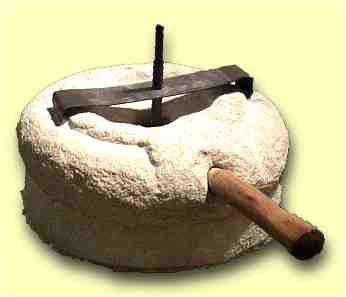
In various north European traditions, the quern is a metaphor for the world with the polar star its pivot or nail.
Eldar Heide gave a paper titled "Finno-Ugric and Scandinavian notions about the world axis and the cosmic quern" on 5 April 2013 at the third meeting of the Austmarr Network, Härnösand. 
It is well known that Finno-Ugric peoples, like people further east, had a notion that the polar star was a nail in the top of an invisible world pillar. It is also known that among the Baltic Finns, the mythic object Sampo seems to have been this world pillar, but also the firmament (revolving around the polar star) understood as a gigantic mill, as well as a magic hand mill that grinded out prosperity for its human owner in mythic times.
 Heide examines to what extent such notions were shared by the (Germanic) Scandinavian neighbours.

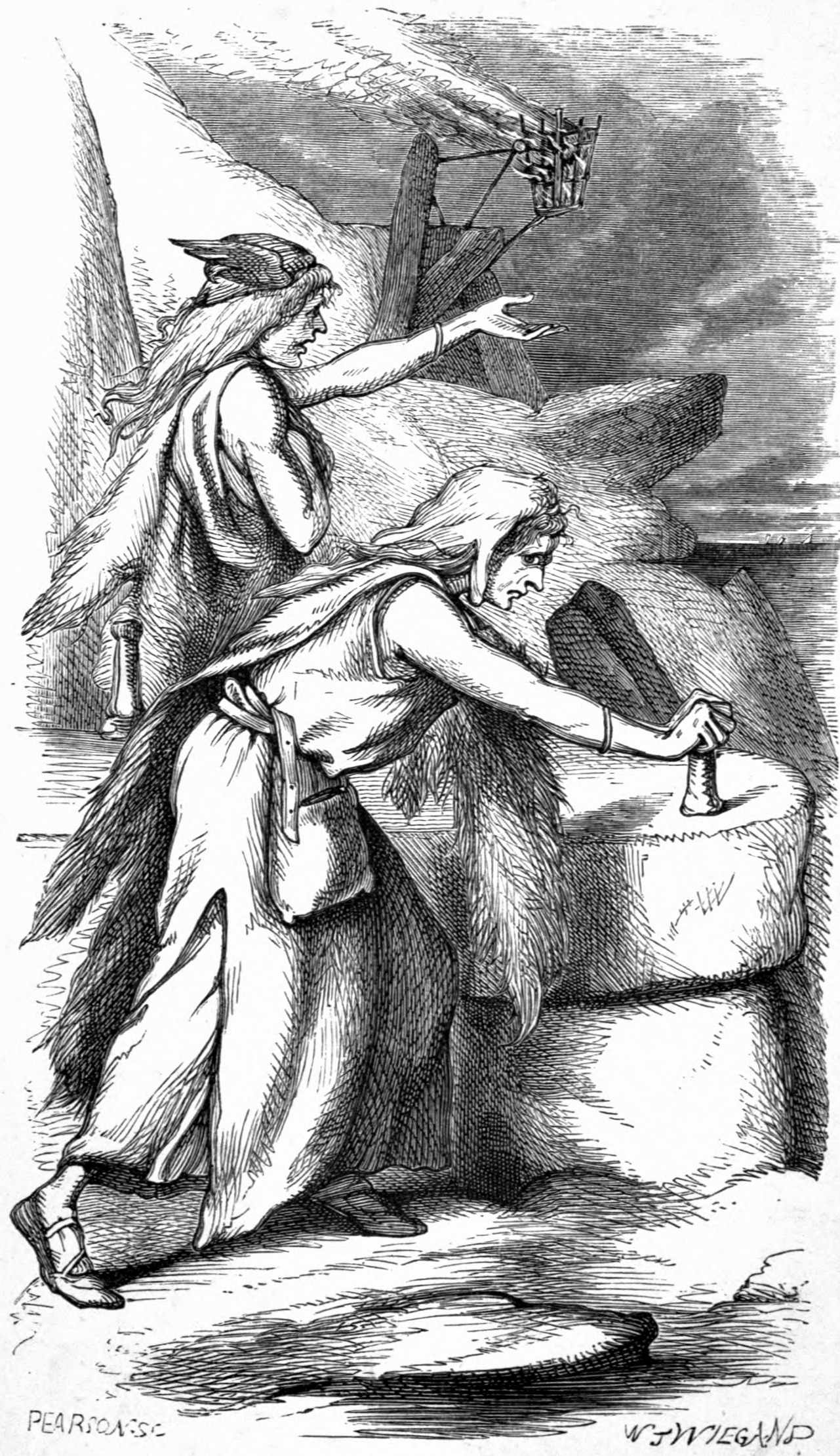
Gróttasöngr is the work song of two young slave girls bought in Sweden by the Danish King Frodi. The girls are brought to a magic grind stone to grind out wealth for the king and sing for his household. They finally grind and sing his demise.
Norse Runes and Staves


Baking

Here is a beloved shape in Karelia: the frilled oval with a soft center.

Flower
Hill
Pie!

Conclusion - Medieval/Renaissance women
as artists and writers

Especially if they were common folk, women in the 15th c. who dared to draw and write would risk trial, ostracization, and possible immolation. But let's just say for a moment that women did chance it. What they would have had to do was translate the skills they were required to have--knitting, weaving, embroidery--into skills they were not at all expected or even allowed to have: painting, cartography, botany, and writing.

Now, everything about the Voynich manuscript is odd--the penmanship, the designs, the plants, the human figures, the map, the way everything is drawn, even the containers for the herbal remedies have no precedent in the known traditions of Western Civilization, which appears to add substantial weight to the speculation that the entire thing is a hoax. It's a lark. No serious man of letters would have created this, OR rather what he really meant to record is hidden deep within what can be seen so that only those "in the know" can decipher it. 

Bollocks. 

The Voynich manuscript is WYSIWYG. The only mystery lies in how this gender bias can persist.