Showing posts with label Finnish mythology. Show all posts

Tuesday, April 30, 2019

Old Permic Script and the People of the Perm Krai

Mikael Agricola, who lived in the early 1500s, is credited with creating the first comprehensive writing system in a Finnic language. He is even called "The Father of literary Finnish." However, the birch bark letter no. 292, created over 200 years before Agricola, is the oldest known document in any Finnic language.

In addition, inscriptions in Old Permic script are among the oldest relics of the Uralic languages. To set the exact date of Komi writing is impossible. But the fact that it originated long before the 10th century is evidenced by the Books of Ahmed Ibn Fadlan about his journey to the Volga in 921-922. Arab traveler and secretary of the embassy of the Baghdad Caliph wrote about the correspondence of the king of Volga Bulgaria with the ancestors of the Komi people, calling them Vysu (вису).

The Komi ancestors did not have one, but two kinds of writing. The first is the so-called practical letter of the pass, or symbol. With these signs, the zyryane (Komi) tagged their belongings and hunting grounds, and also made calendars. Similar signs existed among all Finno-Ugric and Samoyed peoples. Almost without changing, these icons endured to modern times on spinning wheels, as well as embroidered and knitted patterns.
Komi Calendar Passes

Georgy Lytkin wrote about the difference between the two types of writing in the 19th century: “Zyryan passes never had the meaning of letters, they cannot convey what the Egyptian hieroglyphs conveyed. No approach can be made between passes and stefanovsky letters.” Unlike the Komi passes collected in the 19th-20th centuries, tamga-like graffiti on archaeological finds belong to the 12th-14th centuries. They are undoubtedly the oldest of such signs. http://foto11.com/komi/docs/komipas.php


Stepan Khrap of Perm (St. Stephen) is said to have created Old Permic script for the Komi language in 1372. Actually, all he did was employ a script already well known to him. His grandfather, an educated Komi merchant Dzebas, often climbed up Vychegda and Vym in his trade affairs. It was then that he would have seen for the first time the Komi letters that Zyryan merchants used in trade.   http://www.komi.com/mc/arhiv/new001.htm
Stephan of Perm

This occurred a century before the creation of the Voynich manuscript (according to carbon dating), and roughly two centuries before Agricola and his writing system.

Not until the 17th century was Old Permic, aka Abur, superseded by the Cyrillic script from which it was loosely adapted. I say "loosely" because Old Permic is called a "highly idiosyncratic adaptation" of Cyrillic and Greek, with Komi "Tamga" signs. Interestingly, since not many persons knew it, Old Permic was also used as cryptographic writing for the Russian language.

Could the Voynich manuscript use the Komi's two writing systems, the Tamga system for f66v and f57r and for the rest of the text the more formal writing system employed by the Komi to send letters to trading partners like the Bulgar king?

Let's take a look at Old Permic script, especially Old Permic cursive, and compare it against the script in the Voynich manuscript used for what appear to be 1) a list of rune charms and 2) a calendar.

Pronounced correspondences occur on two pages, one possibly listing runic charms and the other on what appears to be a seasonal calendar. The rest of the manuscript appears to employ, however strangely,  more of a Latin script. The characters which appear similar to Old Permic are not used throughout the manuscript but rather in special, isolated places, as if they were runes or numerals. They in fact do have quite a few correspondences with Tamgas, those used in Finno-Ugric culture.

Here is a comparison between Voynichese, Hungarian Tamga-like symbols, and the Old Permic writing system.
~
~

~
~
~
~
~

~

If the Voynich manuscript has been influenced by an obsolete script from the Perm Krai, and if its folios contain words from inhabitants of the Perm Krai, then perhaps there are extant records of folk songs that would bear resemblance to the frequently repeated words in the Voynich manuscript.

So then, we have this:
One striking correspondence is that the above wedding tune from the Vatka Komi in the Krov district, uses the letters that, if my transcription is fairly accurate, are found in abundance in the Voynich manuscript: a, u, o, i, e, s, p, t, k, m, and l. In addition, it repeats small two-letter words: oi, pe, ok, and uk. 

Other correspondences exist regarding Komi mythology, folk costume, and lore.

Power over water


Mythic focus on women

Zarni Ań (Golden Woman) was the supreme goddess of the Zyrian people (Komi).

"In the mythologies of Uralic peoples, a woman is seen as the ruler of life and death and the southern and northern direction of the corresponding air directions," says Academy Professor Anna-Leena Siikala." The gods of the shamans are the gods of nature

Depictions of female suns

Päivätär ('Maiden of the Sun'), is the goddess of the Sun in Finnish mythology. Described as a great beauty, she owns the silver of the Sun, spins silver yarns, and weaves clothes out of them. In Kalevala, young maidens ask Päivätär to give them some of her silver jewelry and clothes.

Professor Anna-Leena Siikala finds it possible that Päivätär was a goddess who ruled over life and light. During Christian period, she was replaced by Virgin Mary.
Below is a contemporary depiction of Päivätär by sculptor Kaarina Kuusisto-Lukkari.
Above, Komi female sun

Symbols of spinning and weaving

Not only was Päivätär a goddess—she was the goddess of spinning, and her sister, Kuutar, goddess of the moon, was in charge of weaving.

Komi Women

Conclusion

Thus, we find shared nuances in script, mythology, and symbolism between the Voynich manuscript and Uralic culture, especially among the people of the Perm Krai. 

Friday, November 6, 2015

The Para: An Example of Folk "Magic" and Natural Science

You may have read the post about Ukko and learned that his other name, Jumala, had started out meaning simply the heavens, and then meaning a god of heaven, and then finally God. This action of anthropomogrifying non-anthropic beings may be seen as one of the most prevalent sea changes brought about by the Church. Another example is here, with what appears to have started out as an animal deity, the Para, which then becomes demonized, and given anthropic features perhaps to make it look funny, absurd, evil, freakish, and unpleasant.

What does the Para have to do with the Voynich manuscript? A charm song for the Para is listed among others, as follows:
Not only is he mentioned, but the little guy might even make an appearance in the manuscript. Hint: he doesn't look much like the Paran painted on the walls of St. Lawrence Church in Lohja, Finland, and he doesn't help actually milk the cows. The nature of his aid could be a bit more subtle.

Here is a rough translation of the Finnish Wiki on the Para

Para (Sw. Bara or bjära) is Finnish and the Swedish folklore known as a farm or a house holder of a kind elf, and also the owner apuolento. However, Para, unlike modern-day stories graciously elves often described as a fearsome look and mightily being. Paraa is typically described as a round ball of yarn or birch bark roll look, but in addition to para could also be a feline form of a bird or frog. The spherical shape was more common in the Swedish tradition and an animal figure in Finnish. Paran task was to help the house and the owner, and the increase of wealth. Parat often went to steal other people's property or families or milk from their cows, and brought it to her mistress or master. Para and its owner were in contact with each other so that if Paraa damaged, it will also be posted injured.

Paran properties 

Lohja church armory vault painted a picture in which a witch milked, assisted by improved cow. Adjacent to another woman churning butter beside him to have been stolen from improved milk.

Paran could own especially the witch. The witch persecutions of people have been accused of owning improvement. The walls of churches in Northern Europe and Finland sometimes described as a witch by churning improvement or other similar apuolennon stolen from milk, apuolento side. Such a scene is also Lohja church wall, Parat which are described in unicorns, isokorvaisia ​​devil-like creatures.

Para arrive when called to assist the people of the house, or wife, but also requires the services of, respect, and food. Paran was able to call help if, for example, knew the right spell. In a story of this kind of spell was:
Synny para, synny para!Ei ole silmää näkemässä,Eikä korvaa kuulemassa!
No para, para created!
It is not seeing eye,
And to pay to hear!
Another version:
Synny para, synny para,saat puolen ruumiistani,Saat puolen sielustani!
No para, para arise,
you get half of my body,
For half of my soul!
St. John's night was the granary keyhole to listen to would fall within your grain counting. If you would, then there would be para to calculate the mass of grain, and the case should be a good harvest. However, if the coffers kilisisi to himself, then para to the money counting, and livelihood would be secured.

Seskar and Lavan Island para known as butter, milk and kananmunavarkaana which was browner than a squirrel.

Paranvoiksi named a slime suspected of being in folklore from the fact that the para disturbed vomit out of the kähveltämästään butter. Therefore, paranvoita is also called paranpaskaksi or -oksennukseksi.

Paraa could not damage the bullets, but if it was able to kill, it was also followed by the death of its owner. The remaining best was only three burnt stick.

Paran origin 

The shamanic cultures all over the world are familiar with Paraa-like holders and apuolentoja, and apparently this kind is well known in Finland long ago. Paran was considered to be emerged vicious soul, and to be the soul of the animal. The Witch, therefore, self-improvement walked likeness. It was a witch then the conscious self, do not let the writings of clarity.

In Sweden, told the witches receiving paransa Satan while visiting Blåkullassa. In Finland, it was considered that the para prepared, for example, by placing a ball of yarn or in some way the spindle's heart wafers. Ready for moving in Para took the character of the animal.

The Possible Science behind the Myth

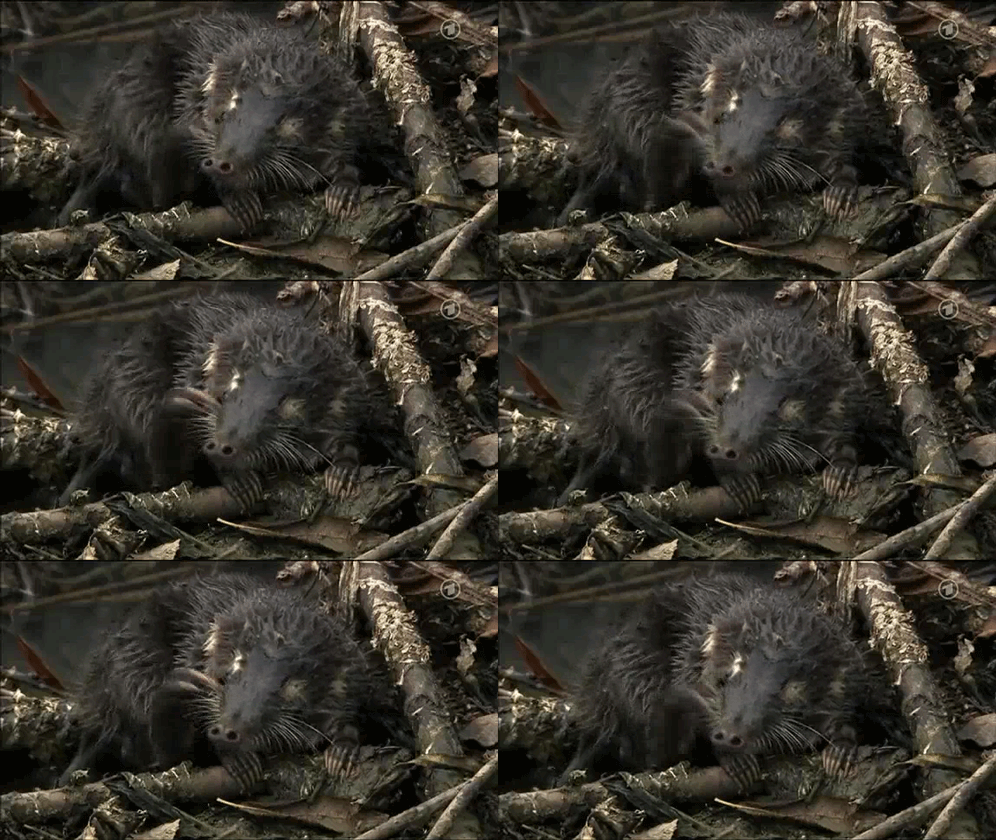
I'm not sure where that origin piece was going, BUT at this point it is almost impossible to tell how much of the Para myth is post and pre-Christian, but a devilish spin does seem to have been put on the character of the Para. That said, let's go back to why such a being might in any way be seen as beneficial, even lucky. First of all, let's say this drawing that has been called an armadillo and a pangolin is in fact a wet little water vole and the dripping from his pillow isn't some weird alchemical elixir of life: it's just water.

Here's more from JPR Environmental on the European water vole:
Once a common feature on most watercourses in the UK, water voles (Arvicola terrestris) have suffered a dramatic decline over the last 100 years but particularly during the last 30 years. Water voles favour slow-flowing, narrow water courses about 1 m in depth that do not fluctuate in water level through the year. Mud or clay banks and with plenty of bank side emergent vegetation is needed for burrowing, feeding and cover.

Happy Water Voles to You

A thriving population of these little beasties spells a great place to graze your cattle, so it stands that they were medieval good luck omens. Sometimes, magic is just reading the nature in front of you and deciding your actions based on empirical observation. It certainly wouldn't do anyone any good to steal somebody else's water voles, BUT if you killed them, you certainly weren't helping yourself out.

Another candidate

The creature on the pillow could be another aquatic rodent whose habitat is throughout Europe, Castor fiber, the European Beaver, and its value may be seen not only changing the environment to create ideal watering holes for cattle but also in a substance that was extracted from its glands even as far back as the early middle ages.

Castoreum was still in the materia medica in the 18th century as a treatment for many ailments—including headache, fever, and hysteria. The Romans believed the fumes produced by burning castoreum could induce an abortion. Paracelsus thought it could be used in the treatment of epilepsy. Castoreum was also used as an analgesic, anti-inflammatory, and antipyretic. Castoreum was described in the 1911 British Pharmaceutical Codex for use in dysmenorrhea and hysterical conditions (i.e., pertaining to the womb), for raising blood pressure and increasing cardiac output. The activity of castoreum has been credited to the accumulation of salicin from willow trees in the beaver's diet, which is transformed to salicylic acid and has an action very similar to aspirin. (Wiki)

 The majority of medicinal herbs used in the Swedish collection have a strong smell (for example, myrrh, myrtle, juniper, mustard), which is employed in practically all the treatments for mental ailments. The only recipe ingredi-ent made from an animal, castoreum, from the beaver's castoreunt pods, has a very powerful smell and was utilized for insomnia. The Occitan collection also includes plenty of aromatic herbs and flowers (basil, thyme, oregano, sage. rosemary, dog rose, to name a few), but the range of ingredients used is much larger, which makes comparison difficult.
From Mental (Dis)Order in Later Medieval Europe

And yet another candidate


A Russian Desman (Desmana moschata) is a small semiaquatic mammal that inhabits the Volga, Don and Ural River basins. Decidedly rich and thick in nature, desman fur used to be highly sought after by the fur trade.
Desmans belong to the same family as moles but are adapted for a more aquatic lifestyle. They posses a similar long, cylindrical body, but the tail is longer and flatter than that of a mole and is broadened by a fringe of stiff hairs (3). The legs are also covered in stiff hairs and the thick, waterproof coat is brownish-red in colour, fading to ashy-grey on the underside (2) (3). The snout is long and flexible and the back feet are completely webbed in order to provide propulsion in water.

Conclusion

The pillow holding the little creature in the Voynich manuscript is dripping, signifying that whatever rests on it is most likely wet. Therefore, the pattern on the back of the creature does not have to be scales and probably is not. It's the clumped, wet fur of a rodent, perhaps the water vole or the European beaver, both serving a beneficial role during the Middle Ages either as the maker and indicator of ideal grazing grounds or as the holder of a prized healing ingredient. Lauded in north European folklore, the para later became demonized by the Church into an anthropomorphic monster meddling in the milk production industry with witchcraft.

Wednesday, August 26, 2015

The Men in the Voynich Manuscript

For months I have been hesitant to point this out because at least a few researchers may very well excitedly declare that the portrait of the manuscript's author has been found. This would be based solely on the fact that this figure is male.

I don't think he's the author at all or even the artist but rather a fellow celebrant who has been welcomed into these rites precisely because he does not identify with his sex but rather with the surrounding women.

If you look at the way he is drawn, you might notice the hand doing the drawing isn't half as sure of itself with proportion and anatomical placement as it is with the females. A comparison of the arms with his neighbor will clue you in to the fact that the artist was not at all comfortable drawing the male figure. His privates are a bit of a hurried scribble even to the point where they look detached, and the testicles appear to be missing altogether. Plus, his nipples are placed just under his clavicle. But the artist duly gives him the heavier jaw and more structured cheeks of a male, a slash of a mouth, and a line along the nose perhaps to make the visage look more angular. In addition, certainly he lacks female breasts so conspicuous on all his companions, and the female rounded shape. He's quite boxy, but notice no muscles and no facial hair. Facial hair is absent throughout the entire manuscript: not one beard or mustache except that the crossbow holder has some chin whiskers.* Muscles, also, are absent. This artist and the culture within which the artist resides appears to place little to no value on symbols of masculinity.
You could say the crossbow shows some indication of masculinity, but even it looks more a cute toy than a weapon used to introduce death in warfare.

*I have been informed by an artist that this crossbow holder could possibly be a female, as it seems to have a bust and fine facial features, such as the pointed chin and reduced jaw. The neck also has a slender profile. So even this, arguably the most obvious depiction of masculinity, could indeed be a female figure dressed as a male.

Just when you think you've nailed something down about the Voynich it will turn the tables on you. I found another man, bearded, among the women dancing in the cylinders.
To his left is the Slavic word Утки or Utka, meaning duck.


Thursday, September 4, 2014

The Beauties of Bad Press

Slings, Arrows, and Glories 

In the post called Baba Yaga and Dappled Others, I talked about the lore throughout northern Europe of these frightful, knowledgeable hags notorious for using trickery and scare tactics. Russian damsels encounter them holed up in strange abodes deep in the forest and have to get over their fear of these women and accept help from them in order to proceed on their quest for love and happiness. Finland's national hero Väinämöinen reckons with such a force when he wants to marry a daughter of one of them. Check them out. Wouldn't you like to bide a wee and have a cuppa, dearie?

Louhi
Baba Yaga


Riding the Smear Campaign

In the Kalevala, Pohjola is the dark and mysterious northland that is ruled by an "evil" witch. Adam von Bremen says that “In the ocean there are also many other islands, all full of cruel savages, and, therefore, the seafarer avoid them. Likewise, told amazons in the Baltic sea at these beaches, which is why they call it the land of women.” 
In standard history's eyes, a forbidding and forever cold land run by women, where men can get fooled and poisoned, would be seen more as a tragic wasteland to shun than anything to illuminate, laud, or spend much time writing about. It is anti-history. What we can learn of it we must glean from remnant warnings and anathema. The rest could have quite literally gone up in smoke.

Let's return for a moment to Kvenland as it might have been during the centuries leading up to the time of the Voynich manuscript--the 15th century. The map below shows migrations of tribes through Karelia. The Finnish–Novgorodian wars were a series of conflicts between Finnic tribes in eastern Fennoscandia and the Republic of Novgorod from the 11th or 12th century to early 13th century. The wars' effect on the Finns' society contributed to the eventual Swedish conquest of Finland in 1249.

And just to the south, in the Baltic states, similar dynamics were playing out.

Let's say you are a woman of advanced age leading your people. Given how other tribes will see you, you can be either dismissed or feared. Let's say the stakes are these: if you are dismissed then people will invade your land, take your resources, attack your sons, and carry off your daughters. Welcome to history.

A recent study completed at the University of Eastern Finland suggests that persons captured during raids into areas which today constitute parts of Finland, the Russian Karelia and the Baltic Countries ended up being sold on these remote trade routes. There was a particular demand for blonde girls and boys who were seen as exotic luxury items, and it was financially beneficial to transport them to the far-away markets. The study by Professor Jukka Korpela was published as a General Article in Russian History (1/2014), which is a leading journal addressing the history of Russia.
Looked at another way, the LEAST mysterious manuscript in the world.
In this land awash with various tribes at war with one another and ever under the threat of conquest, people learned to live by their wits, as so many legends both Sami and otherwise exemplify. Trickery was part of survival, whether it was to lead the enemy off a cliff, which is a common device in Sami lore, or whether it was to poison the water, as the women in Kvenland were reported to have done.
Albert Edelfelt's painting of Finnish girls in their boat
Below is a particularly manly Louhi speaking with a pair of not-so-happy-with-her Finnish heroes.

During the time when people actually had to figure out what to do about such women, or the women who practiced venerating and emulating such iconic feminine forces, here is Reginald Scot in 1584 detailing some of their purported supernatural powers:
“[Witches] can raise and suppresse lightning and thunder, raine and haile, clouds and winds, tempests and earthquakes. Others doo write, that they can pull downe the moone and the starres. Some write that with wishing they can send needles into the livers of their enimies. Some that they can transferre corne in the blade from one place to another. Some, that they can cure diseases supernaturallie, flie in the aire, and danse with divels. Some write, that they can plaie the part of Succubus, and contract themselves to Incubus; and so yoong prophets are upon them begotten, &c. Some say they can transubstantiate themselves and others, and take the forms and shapes of asses, woolves, ferrets, cowes, apes, horsses, dogs, &c. Some say they can keepe divels and spirits in the likenesse of todes and cats.”  The Discoverie of Witchcraft  
It's funny stuff to us, now, but back then, people did actually believe all this sorcery was real. They put old shoes in the attic to ward off evil. They said their prayers as if the Devil were camping on their doorstep. To this day, the images born of this dark age live on in our imaginations.


Whatever damage the Enlightenment of the late 17th and 18th centuries gave to Western thought, yet it did demand a rational mind that questioned reactions born of ignorance and fear. By the early 1800s, at least in Europe, executions for witchcraft had come to an end, but this was only after the deaths of tens of thousands of people.

That said, look what this Swedish king did as early as the 14th century (Translation by Pauli Kruhse):

The Letter of Protection by King Birger Magnusson for womankind in Karelia on Oct. 1, 1316.

The original parchment letter was until the end of 19th century kept in the Viipuri (Viborg) city archives. Now it has been moved to the National Archives in Helsinki. The backside of the document contains a writing: Privilege to womankind, wives widows maidens, in Viborg and the whole of Karelia given by King Birger Anno 1316 and similarly confirmed by King Albrecht Anno 1360.

All who will see this letter, we Birger, by the grace of God King of the Swedes and the goths, Salute wishing eternal Salvation in Lord. Through this note we will for both those to come as well for those living now, following the advice and consent of the Noble men Gentlemen Canute Jonsson, the judge (lagman) of the ostrogoths, Thor Kætilsson, and Johannes Brunckow, our high chancellor (drots) and other members of our council, firmly pass a statute, to be obeyed as a law, that all wives and women who live subjected to our castle of Vyborg or in the land of Karelia be they married, widows, nuns or virgins, shall enjoy peace and security like in our realm Sweden herself for both in property and person, so that our royal punishment will most severely meet the transgressors. Therefore all and everyone are strictly prohibited from burdening the foregoing wives and women with any kind of injustice or molesting, or inflicting on them any kind of corporal violence, if he wants in our kingdom to avoid the punishment, which is what is in our Swedish realm told in the due law. Date Yninge Anno Domini 1316, on the first of October.
(Seal)
At least by the year 1316, Karelia became quite officially a land of women.

Now let's return to a scene from the Voynich manuscript.
Aside from the fact that they're female, they don't at all look like Baba Yaga or Louhi, capable of working all this nasty preternatural mischief. Many scholars indeed ignore the Voynich women's obvious middle and advanced ages and pronounce them all that idyllic, vapid, cavorting, innocuous, sexually provocative creature, the nymph. Yet look how the older two appear to be brilliantly living up to the saying, "Nothing gets in the way of a postmenopausal woman." What if these are then, in fact, our Baba Yaga and Louhi? This could be how they saw themselves, not at all vicious hags but powerful women coming together and doing something cool with nature. Under attack from invading tribes, these women may not have had much choice in using trickery and making themselves out to be fiercely destructive forces. They could have been defending their land, their people, their freedom, their way of life, and their sons and daughters. Bad press would seem then a mixed blessing. On the one hand, people would hesitate to mess with you or your loved ones. After all, Adam von Bremen warns: AVOID THESE ISLES. On the other hand, eventually those same people could get organized enough to burn you. 

The profound dark cast on the significance of the Voynich manuscript and by extension the society which engendered it does not need a conspiracy in order to have transpired. It needed merely an all too common blind spot regarding women. Put that into the equation and all interpretation can become amazingly skewed, the obvious obscured and the obscure subsumed under more familiar endeavor.  
The rise and fall of great men, as of nations, are often involved in an obscurity, which the unaided powers of the brightest intellect cannot remove. As a dense, black cloud, covering the sun, shrouds all nature in gloom, till a gleam, darting from behind, not only gilds the edge, but illuminates and cheers the whole scene; so Revelation throws a clear light on the dark page of man’s story, by which the Divine Hand is seen reducing confusion to order, and introducing men and measures to promote ‘peace on earth, and goodwill toward men.’ 
This quote is taken from a preface written in 1858 by the Reverend Joseph Bosworth of Christ Church, Oxford. The passage introduces King Alfred's Anglo-Saxon Version of the Compendium History of the World by Orosius. Every word screams teleology, hubris, and agenda. It is the same skewed perspective that made Pythagoras declare:
There is a good principle which created order, light, and man, and an evil principle which created chaos, darkness, and woman.
Here is a 19th c. depiction of the Norse sea goddess, Ran, surrounded by her water nymphs or wave girls.
The crone looks to be performing a similar ritual as those in the Voynich, and the girls are doing the same thing--watching and learning. Distilled into supernatural beings, these figures reside only in mythology. As figments of pure fancy far removed from the days when such women entered, here and there, the annals of history, they are romanticized. Distance allows them to be thus circumscribed back into certain discourses--as icons in art and literature. Thus emptied of their own meaning, they become merely vehicles for carrying others' meaning.
This phenomenon, called cultural cannibalism, leaves little left to piece together. Because of cultural cannibalism, the pieces that do survive rarely make sense within the context of history as we know it, which is Bosworth's and von Bremen's history. When a find is unearthed, it can cause an upset in how we think of our story, challenging our presumptions to an uncomfortable degree. Controversy inevitably follows on the heels of that cognitive dissonance.

Such is the world of the Voynich manuscript, a mystery with a thousand conflicting theories. It is one of the greatest anomalies the world has ever stumbled upon.