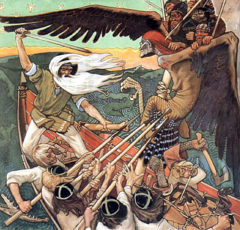
You may have read the post about Ukko and learned that his other name, Jumala, had started out meaning simply the heavens, and then meaning a god of heaven, and then finally God. This action of anthropomogrifying non-anthropic beings may be seen as one of the most prevalent sea changes brought about by the Church. Another example is here, with what appears to have started out as an animal deity, the Para, which then becomes demonized, and given anthropic features perhaps to make it look funny, absurd, evil, freakish, and unpleasant.
What does the Para have to do with the Voynich manuscript? A charm song for the Para is listed among others, as follows:
Not only is he mentioned, but the little guy might even make an appearance in the manuscript. Hint: he doesn't look much like the Paran painted on the walls of St. Lawrence Church in Lohja, Finland, and he doesn't help actually milk the cows. The nature of his aid could be a bit more subtle.
Here is a rough translation of the Finnish Wiki on the Para
Para (Sw. Bara or bjära) is Finnish and the Swedish folklore known as a farm or a house holder of a kind elf, and also the owner apuolento. However, Para, unlike modern-day stories graciously elves often described as a fearsome look and mightily being. Paraa is typically described as a round ball of yarn or birch bark roll look, but in addition to para could also be a feline form of a bird or frog. The spherical shape was more common in the Swedish tradition and an animal figure in Finnish. Paran task was to help the house and the owner, and the increase of wealth. Parat often went to steal other people's property or families or milk from their cows, and brought it to her mistress or master. Para and its owner were in contact with each other so that if Paraa damaged, it will also be posted injured.
Paran properties
Lohja church armory vault painted a picture in which a witch milked, assisted by improved cow. Adjacent to another woman churning butter beside him to have been stolen from improved milk.
Paran could own especially the witch. The witch persecutions of people have been accused of owning improvement. The walls of churches in Northern Europe and Finland sometimes described as a witch by churning improvement or other similar apuolennon stolen from milk, apuolento side. Such a scene is also Lohja church wall, Parat which are described in unicorns, isokorvaisia devil-like creatures.
Para arrive when called to assist the people of the house, or wife, but also requires the services of, respect, and food. Paran was able to call help if, for example, knew the right spell. In a story of this kind of spell was:
Synny para, synny para!Ei ole silmää näkemässä,Eikä korvaa kuulemassa!
No para, para created!
It is not seeing eye,
And to pay to hear!
Another version:
Synny para, synny para,saat puolen ruumiistani,Saat puolen sielustani!
No para, para arise,
you get half of my body,
For half of my soul!
St. John's night was the granary keyhole to listen to would fall within your grain counting. If you would, then there would be para to calculate the mass of grain, and the case should be a good harvest. However, if the coffers kilisisi to himself, then para to the money counting, and livelihood would be secured.
Seskar and Lavan Island para known as butter, milk and kananmunavarkaana which was browner than a squirrel.
Paranvoiksi named a slime suspected of being in folklore from the fact that the para disturbed vomit out of the kähveltämästään butter. Therefore, paranvoita is also called paranpaskaksi or -oksennukseksi.
Paraa could not damage the bullets, but if it was able to kill, it was also followed by the death of its owner. The remaining best was only three burnt stick.
Paran origin
The shamanic cultures all over the world are familiar with Paraa-like holders and apuolentoja, and apparently this kind is well known in Finland long ago. Paran was considered to be emerged vicious soul, and to be the soul of the animal. The Witch, therefore, self-improvement walked likeness. It was a witch then the conscious self, do not let the writings of clarity.
In Sweden, told the witches receiving paransa Satan while visiting Blåkullassa. In Finland, it was considered that the para prepared, for example, by placing a ball of yarn or in some way the spindle's heart wafers. Ready for moving in Para took the character of the animal.
The Possible Science behind the Myth
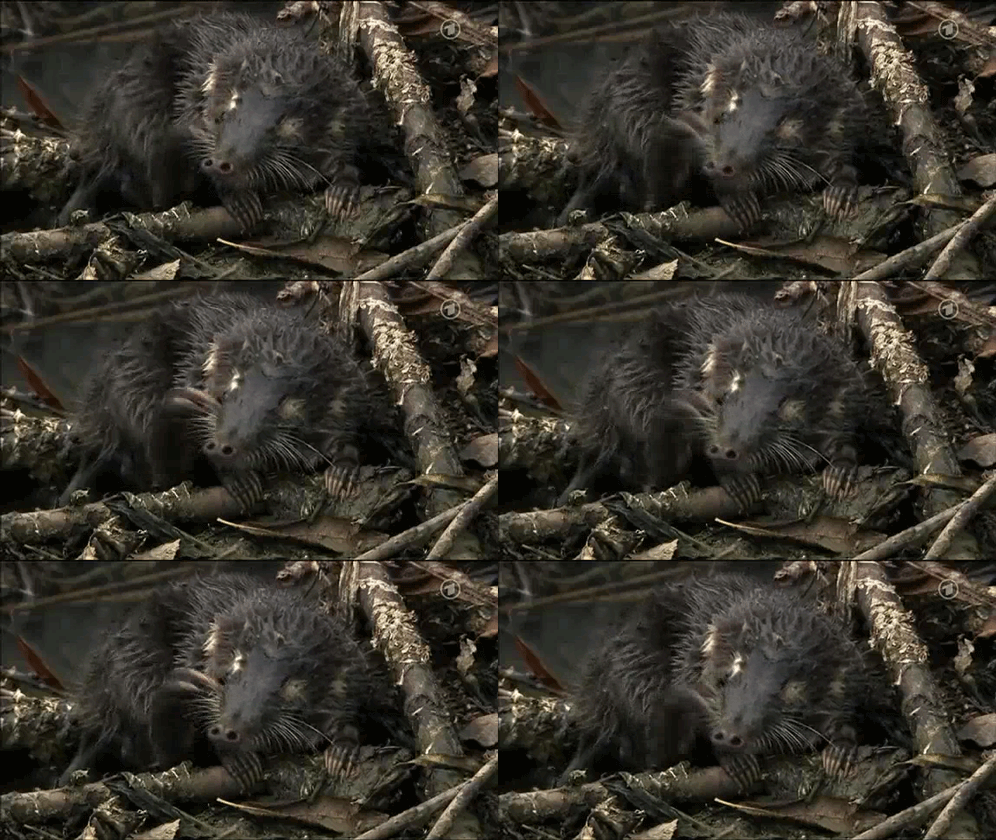
I'm not sure where that origin piece was going, BUT at this point it is almost impossible to tell how much of the Para myth is post and pre-Christian, but a devilish spin does seem to have been put on the character of the Para. That said, let's go back to why such a being might in any way be seen as beneficial, even lucky. First of all, let's say this drawing that has been called an armadillo and a pangolin is in fact a wet little water vole and the dripping from his pillow isn't some weird alchemical elixir of life: it's just water.
Once a common feature on most watercourses in the UK, water voles (Arvicola terrestris) have suffered a dramatic decline over the last 100 years but particularly during the last 30 years. Water voles favour slow-flowing, narrow water courses about 1 m in depth that do not fluctuate in water level through the year. Mud or clay banks and with plenty of bank side emergent vegetation is needed for burrowing, feeding and cover.
Happy Water Voles to You
A thriving population of these little beasties spells a great place to graze your cattle, so it stands that they were medieval good luck omens. Sometimes, magic is just reading the nature in front of you and deciding your actions based on empirical observation. It certainly wouldn't do anyone any good to steal somebody else's water voles, BUT if you killed them, you certainly weren't helping yourself out.
Another candidate
The creature on the pillow could be another aquatic rodent whose habitat is throughout Europe, Castor fiber, the European Beaver, and its value may be seen not only changing the environment to create ideal watering holes for cattle but also in a substance that was extracted from its glands even as far back as the early middle ages.
Castoreum was still in the materia medica in the 18th century as a treatment for many ailments—including headache, fever, and hysteria. The Romans believed the fumes produced by burning castoreum could induce an abortion. Paracelsus thought it could be used in the treatment of epilepsy. Castoreum was also used as an analgesic, anti-inflammatory, and antipyretic. Castoreum was described in the 1911 British Pharmaceutical Codex for use in dysmenorrhea and hysterical conditions (i.e., pertaining to the womb), for raising blood pressure and increasing cardiac output. The activity of castoreum has been credited to the accumulation of salicin from willow trees in the beaver's diet, which is transformed to salicylic acid and has an action very similar to aspirin. (Wiki)
The majority of medicinal herbs used in the Swedish collection have a strong smell (for example, myrrh, myrtle, juniper, mustard), which is employed in practically all the treatments for mental ailments. The only recipe ingredi-ent made from an animal, castoreum, from the beaver's castoreunt pods, has a very powerful smell and was utilized for insomnia. The Occitan collection also includes plenty of aromatic herbs and flowers (basil, thyme, oregano, sage. rosemary, dog rose, to name a few), but the range of ingredients used is much larger, which makes comparison difficult.
From Mental (Dis)Order in Later Medieval Europe
And yet another candidate
A Russian Desman (Desmana moschata) is a small semiaquatic mammal that inhabits the Volga, Don and Ural River basins. Decidedly rich and thick in nature, desman fur used to be highly sought after by the fur trade.
Desmans belong to the same family as moles but are adapted for a more aquatic lifestyle. They posses a similar long, cylindrical body, but the tail is longer and flatter than that of a mole and is broadened by a fringe of stiff hairs (3). The legs are also covered in stiff hairs and the thick, waterproof coat is brownish-red in colour, fading to ashy-grey on the underside (2) (3). The snout is long and flexible and the back feet are completely webbed in order to provide propulsion in water.
Conclusion
The pillow holding the little creature in the Voynich manuscript is dripping, signifying that whatever rests on it is most likely wet. Therefore, the pattern on the back of the creature does not have to be scales and probably is not. It's the clumped, wet fur of a rodent, perhaps the water vole or the European beaver, both serving a beneficial role during the Middle Ages either as the maker and indicator of ideal grazing grounds or as the holder of a prized healing ingredient. Lauded in north European folklore, the para later became demonized by the Church into an anthropomorphic monster meddling in the milk production industry with witchcraft.
The Voynich manuscript contains several drawings of containers that were apparently used to store and carry medicinal powders from the roots depicted beside the containers.
The photographs above are of a carved wooden needlecase, possibly once painted. The finder believed it to be from Victorian Bavaria.
Treen, literally "of a tree" is a generic name for small handmade functional household objects made of wood. Treen is distinct from furniture, such as chairs, and cabinetry, as well as clocks and cupboards.
Salt cellar, The National Museum of Finland The salt container is a horn, cover and base made of wood. The cover has a leather strap which is threaded metal and bony ring. The bottle is decorated with a ribbed surface with Diagonal in width, depth and distance relative to each other varies
Salt container; birch bark container
The National Museum of Finland
Tuohinen salt jar. Side is on top of a number of knurled birchbark strips. The base is wooden.
Before the late 17th-century, when silver, pewter, and ceramics were introduced for tableware, most small household items, boxes and tableware were carved from wood. The herbal jars in the Voynich appear to be turned, carved, and painted wood. Below are some of the Voynich manuscript jars beside treenware (spice urns, necessaires, and needle cases) created in various European countries.
Quite a few of the Voynich herbal jars have feet such as these three steins below, which were made in Norway. However, the Voynich side patterns appear to be similar to the round box in the lower left, which was made in Poland.
Below is a typical Italian renaissance apothecary jar. They very often have portraits and lettering, and the shape tends to be either cylindrical or stout. Here, angels, dragons, saints, and portraits are used to embellish, whereas the decoration on the Voynich jars, like the Polish wooden box above, stays cleanly non-figurative.
Some have also suggested that the Voynich jars are Egyptian perfume bottles like the one below.
Certainly we are getting closer to the curvier shapes of the Voynich containers. However, glass would have been outrageously costly. In addition, the neck of a glass perfume bottle would make it difficult to insert or extract the roots depicted beside the container, even were they to be ground to a fine dust. Finally, nothing else in the manuscript points to any connection with Egypt.
Where the Voynich manuscript was written, wood was far more plentiful and less costly than glass or the fine clay needed for ceramics, and the countries in the Baltic region and Scandinavia have been fine craftsmen in wood for centuries before the Voynich was written.
Altarpiece of carved wood, Naantali Monastery, Finland
The objects appear to have been turned on a lathe and subsequently carved and painted.
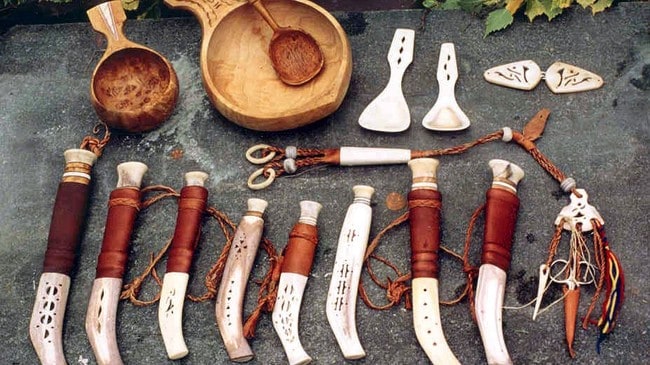
Made from various materials, sewing kits with needle cases like the 10th c. bronze one above were popular up to the late 19th century. The women of the Voynich may have gutted and then used their sewing necessaires to store roots and then used the needle cases to carry the medicinal powders. A precedent for carrying a belt with such implements as powder containers, needle cases, spoons, etc. may be found among the Sami, who have for millennia crafted such beautiful item they call duodji. These often hang from a belt.
It is past time to re-examine Norse, Balto-Finnic, and Germanic culture especially with an eye to the potential extent to which the Sami have influenced them. I do believe many innovations and traditions attributed to the Norse made their way into that culture via the ancient Kvens' adoption but also appropriation and exploitation of Sami culture. The Kvens themselves were subsumed beneath later migrations from the South so that this link became forgotten, but the echoes remain. Here I discuss further Sami influences found in the Voynich manuscript.
The containers have terms related to what the concoction would be used for. For example, it may be a base used in blending active agents, or its purpose could be to boost fertility or help in healing a wound or a remedy for a certain ailing organ. The plants, on the other hand, appear to be labeled with their common (folk/local) names, perhaps at times just a characteristic of the plant, and nothing else. Again, this is 15th century folk medicine. To read it requires forgetting Linnaeus, botany, modern medicine, and, though not all, most of Latin.
\
Despite the harsh Nordic climatic conditions, a great number of medicinal and culinary herbs have been used since early in Finland's history. The first-used plants originated from the Finnish flora, but later the plant spectrum was enlarged by non-domestic species. The introduction of new herb species was influenced by several historical factors, such as medieval monastery culture or the Swedish governmental policy favouring the domestic cultivation of herbs during the 18th century (Peldan 1967). In military fortresses, herb gardens supplied the necessary healing plant materials for the surgeons, and in towns a herb garden of about 100 m2 was the precondition for the permission for a new pharmacy. The available historical sources report different number of species used as medicinal and spice plants in Finland. In the earliest plant list, from the Naantali Monastery near Turku (South West Finland), medicinal use of 21 plant species was reported in 1440 (Peldan 1967). Elias Tillandz in 1673 listed about 60 species used and cultivated around Turku for medicinal and flavouring purposes (Ruoff 2001). In the first Finnish language herb book, Pietari Gadd described the cultivation of 17 spice and medicinal plants (Gadd 1768). A literature survey by Saarnijoki (1976) listed the medicinal plants which were cultivated in the vegetable and herb gardens in Finland during the 17th to 19th centuries. The number of the most popular herb species was 24. Kalliomaki (1999) mentioned 50 herb species from the wild and from garden cultivation which were used for medicinal purposes in Finland.
From Report of a Working Group on Medicinal and Aromatic Plants, edited by E. Lipman
"...The old tradition of monasteries as healing centres continued throughout the late Middle Ages. In particular, the ancient learning of herbal tradition was preserved and transmitted in monastic manuscripts," as is exemplified in the chapter of Niiranen, in which the herbal recipes of the monastery of Naantali is analysed. Such learning was not a monopoly of monks and nuns and herbal guide books were used in lay settings as well. During the last centuries of the Middle Ages lay settings became increasingly important in the field of healing, as monasteries lost a lot of their former importance after the birth of universities. From the fourteenth century on, new types of sources such as health books and personal health guides, texts produced mainly for the upper middle class, increased in number. Guide books were composed also by the elite, as McClecry's analysis of the Portuguese king Duarte's (1433-1438) texts, Loyal Counsellor and Book of Advice, reveals. Not only living well but also dying well was in the interest of medieval people; these moral issues were also emphasised in artistic representations, as Sophie Oosterwijk argues in her chapter 'This Worlde is but a Pilgrimage': Mental Attitudes in/to the Medieval Dante Macabre.'
The structural similarity with herbals is in accordance with the assumptions made about the influence of medieval Danish herbals. Similarly to the Occitan collection, recipes concerning mental disorders are dispersed among other recipes for common ailments such as fevers, stomach and skin diseases, frost-bite, bleeding nose, dysentery, toothache, broken bones, dog bites, assorted wounds, baldness and hair loss. There are no veterinary recipes (in comparison to one in the Occitan collection) and only one how-to-do recipe (in contrast to several household chores among Occitan recipes). How to make ink with wormwood in order to prevent mice from eating hooks is the only advice on daily life offered for the Swedish audience." This tip undoubtedly refers to the world of universities or monasteries where books were frequently used. However, magic is not present in any form and no prayers or fragments of liturgical texts are cited in the Swedish collection. The Swedish text is shorter than its Occitan counterpart. There are only nine paragraphs, each concerning one main ingredient and different mixtures made from it, in seven folios, whereas the Occitan collection consists of larger volume of folios with more than 300 individual recipes. The identification of all the recipes that concern mental disorders is not easy."
From Mental (Dis)Order in Later Medieval Europeedited by Sari Katajala-Peltomaa and Susanna Niiranen, page 164
Sweet Chestnuts
The leaves, picked in June and July when they are in best condition and dried. They have also been used in the fresh state. Chestnut leaves have no odour, but an astringent taste.
Medicinal Action and Uses
In some places Chestnut leaves are used as a popular remedy in fever and ague, for their tonic and astringent properties.
Their reputation rests, however, upon their efficacy in paroxysmal and convulsive coughs, such as whooping-cough, and in other irritable and excitable conditions of the respiratory organs.
Culpepper says:
'if you dry the chestnut, both the barks being taken away, beat them into powder and make the powder up into an electuary with honey, it is a first-rate remedy for cough and spitting of blood.
"Do you arrive from a doughty deed or do you strive for a doughty deed?"
This is the question a strange and formidable old woman asks in an old Russian fairy tale. "Doughty" means intrepid, dauntless--that is, brave and persistent. The question is so phrased as to leave no room for the person being asked to be doing anything but performing heroic acts. And who is this hero that is being asked? Hercules? Achilles? Siegfried? Kullervo?
Nah, not at all. It's a girl who has struck out into the forest to find her beloved after her sisters played a trick that wounded him and made him flee--well, fly, actually, since he's sometimes a falcon. This is the story called "The Feather of Finist" or "Bright-hawk's Feather," and the old woman figures prominently again and again in traditional Russian and Slavic lore.
She goes by the name of Baba Yaga, and like Morgan le Fay, she's imbued with strange, numinous powers. She's cryptic, tricky, sometimes working for the good of the hero, sometimes not, and always somehow "in the know." After reading a few of these tales, you get the sense that you'd be an idiot not to do exactly what she tells you to do, regardless of whether you understand it. She's obviously not Russian because she objects to how Russians smell, and she complains about how the Russians are encroaching on what she calls "the free world." Time and again, Baba Yaga is found on a trek into dense, dark forest before the trees thin out and we come to a deep blue ocean.
There are many theories using Russian and Slavic terminology to explain the quixotic name of Baba Yaga. But what if the actual person who inspired such a character originally named herself, and when she did she wasn't using Russian or Slavic but rather her own tongue?
Female Sami deities
These three have to do with pregnancy and childbirth:
Uksahkka ("Door Wife"): midwife helper of newborns and protector of menstruating women and of children from illnesses and other dangers. In homes she stood near the door. Sarahkka: a well-respected goddess who molds an unborn baby's body around a soul. She also helps the mother give birth and sat near the hearth. Drinks were offered to her by women, who also ate a special gruel in her honor. Similar to Artemis/Diana. Juksahkka ("Bow Woman"): goddess who can make an unborn child male; also an instructor of boys. She lived near the entrance of the home. In some ways reminiscent of Athena/Minerva.
Then there is Yambe-Akka or Jabme-akka the Sami Goddess of the Underworld. Her name means 'The Old Woman of the Dead'.
Finally, there are Beaivi, the sun, and her daughter, both of whom are discussed in the decorative arts post.
You may have noticed that the top four of these end in the same word: Ahkka or Akka, meaning wife, woman, female deity/spirit. Together, they were worshipped as the Akka--the combined feminine force in nature as it is interpreted by the Sami. These female spirits appear in both Sami shamanism and Finnish mythology. Worship of the akka was common and took the form of sacrifices, pleas for help and various rituals. Some Sámi believed the akka lived under their tents.
"Minister" in Sami language is baahpa. Click the word to hear it pronounced. It's very, very close to Baba.
When the original Baba Yaga was explaining what she was, could she have used Samigiella: Baahpa-Akka to designate herself as a minister of the Akka, that is, a female Sami shaman (Northern Sami: noaidi, Lule Sami: noajdde, Southern Sami: nåejttie, Skolt Sami: nōjjd, Ter Sami: niojte, Kildin Sami: noojd/nuojd)? Or might that be how other Sami described her to foreigners: the sage woman?
Bába means "midwife" in modern Hungarian, and originally they were wise old women, later equated with witches as Christianity became widespread.)
Heeeeeeeeeere's Baba!
Party animal, frightful hag, capital Bad-a**, and man's best foe--this is Baba Yaga taking a chest-high left peeler with the insane bottom turn and a righteous tube before kick-out. Let's get to know this woman better.
Over the river and through the dark, dismal forest, to Baba's House we go...
Left below is a rendering of Baba Yaga's dwelling, the infamous revolving hen's leg house. Below right is a Sami storehouse, the comparison of which is variously made elsewhere, so no sense in rehashing. More here.
Baba's Decor
Below is another intrepid hero, this one named Vasilisa, coming to grips with Baba's choice of lighting.
Below is a depiction of a Sami dwelling in the film The Cuckoo. The yellow circle highlights three reindeer skulls. The red circle highlights the hen-legged storehouse. The blue circle indicates the little door slanting back into which a person on entering descends. All of these are characteristics of Baba Yaga's legendary abode. How easily these dwellings might suggest the fabulous and terrible to a visitor unfamiliar with Sami ways.
Here is the skull of a reindeer without the antlers. Beside it, another Sami dwelling.
The skulls on the poles in the story of Finist's feather are said to be human. Skulls did historically (still do) adorn many a nordic forest dwelling, whether of Sami or other people. Typically, they are from reindeer and/or bear. If you read this article about the ritual surrounding the Sami bear hunt, you will get a sense of how elaborate and exceedingly careful and reverent is the Sami's relation to the bear. Though I'll link this video, I don't actually recommend it (Brownbear hunting and the Sami traditions and mythology) except as a quick, albeit clumsy, overview of that relationship. In the video the bear skull beside the woman (above left) does a weird, unnatural floating movement when the camera moves. I suspect it was not originally there but rather got doctored into the film at a later date. Superimposing the bear skull may have been the only way to get this woman to sit and joik beside a thing so powerful in her belief system. The scene is obviously terribly contrived. True to their reverence for the bear, the Sami appear to adhere to the tradition of burying its entire skeleton in a lifelike position. Whether that is true for all Sami tribes, I don't know.
The Finns on the other hand apparently hung the skulls on pine posts. Below is an explanation of Finnish belief and tradition regarding the bear skull:
Kallohonka (Finnish) is pine, which bears skulls placed the feast after. Bear's bones are buried under the oak tree. The skulls are usually placed in the middle of the tree to look to the east. Together, the tree may have several bear skulls. The kallohoka may have stood for the world's wood (Maailmanpuu) symbol--that is, the tree of life--and raising the skull onto the tree is thought to return the bear to the sky, from which it was born.
The belief that spiritual power is received from the dead is very apparent in the Finnish tradition. A Tietäjä, for example, might drink from a human skull in order to gain excellent memory, or use other rituals related to the dead to gain the increased mental powers which would help him in his work. Most importantly, the tietäjä always drew his power from the underworld before doing healing.
All of this skull imagery to be found in the landscape of Fennoscandia may have melded inside the imagination with another item that certainly would have held the fire that Vasilisa is after in the fairy tale. These to an already-spooked mind might appear a charnel aglow.
Sauna rocks
I still greatly doubt it, but having put forth these speculations, I'll admit a real Baba or two may have gone for the gold on this one. After all, nothing says "Go away" like a human skull used as a lamp. In a future post called The Beauties of Bad Press, I'll explain the reason it might have been to Baba's advantage to cultivate terror and distaste.
Go, Baba, go!--Baba's wheels
Here we have Baba Yaga again depicted flying in her mortar, this time with a broom instead of a pestle.
Beside her is a Voynich woman sitting in a similar bucket-like contraption. Beside them is a woman paddling a coracle, which is a small one-person boat shaped like a mortar with a paddle for its pestle. Coracles are very well known throughout the British Isles.
Albert Edelfelt's painting of Finnish girls in their boat
The question is, did the Sami or other nordic peoples have coracles or anything like them? The Kvens were said to have small, fast boats. Kvenland, Pohjala, Karelia--these are lands with great stretches of forests heavily brocaded with lakes and waterways. It would make sense for boats to be the main form of transport, but how big they were and whether they resembled the coracle waits for more research.
The Flying Dutchman effect is when a ship at sea appears to fly. When such a mirage changes shape to where it is not even recognizable, it is called a Fata Morgana. A Fata Morgana is most commonly seen in polar regions, especially over large sheets of ice which have a uniform low temperature. It can however be observed in almost any area. In polar regions the Fata Morgana phenomenon is observed on relatively cold days, however in deserts, over oceans, and over lakes, a Fata Morgana can be observed on hot days. Here is an example:
Fata Morgana is an Italian phrase derived from the vulgar Latin for "fairy" and the Arthurian sorceress Morgan le Fay, from a belief that these mirages, often seen in the Strait of Messina, were fairy castles in the air or false land created by her witchcraft to lure sailors to their death.
So here we have a natural phenomenon named after a legendary witch who knew and took advantage of it to trick her enemies. She may not have been the only witch to do so. Baba Yaga manages to speed off in her little container looking as if she were flying.
Just before Baba Yaga arrives at her dwelling, goes the story, the trees rustle. Perhaps it's not Baba Yaga's arrival upsetting the trees but rather some headwind or evening breeze she's taking advantage of to ride home on.
Baba's Way
A large part of this sort of magic, it would seem, is about propitiousness. It's about knowing intimately one's environment and taking such brilliant advantage of its rhythms and secrets that one appears to command nature when in fact one simply knows the whens, wheres, and hows. In this way, concentrating on exactly what is, these early practitioners of native wisdom could be viewed as having more in common with the rudiments of science than with religion. I'll discuss the reason for all the smoke and mirrors in the future Beauties of Bad Press post.
Baba's Not Alone
This (the red-head to the right) is a famous rendering of Louhi, the Witch of the North, mistress of Pohjola, who features prominently in Finland's national epic, The Kalevala. It is a story about a culture's pride but also, like the Russian fairy tales, about the meeting and merger of various cultures in northern Europe. Like Baba Yaga, Louhi is old, ugly, exacting, and expert at flying. Neither Finnish nor Russian, she rules Pohjola, a dark and misty north land of forest and lake. She has three beautiful daughters and one son, and the old man Väinämöinen, is a Finn (deity) trying to marry one of her daughters. She's not making it easy for him.
The central task she gives him is to make the Sampo, a magical contraption that can grind out abundance. Brushing aside for the moment the myth's fantastic overtones, Louhi's demand makes perfect sense. The crux of the question any mother would want answered is this: Do you have the technology, old man, to keep my daughter alive during the winter? Väinämöinen's stance is antagonistic, then, because his future mother-in-law is challenging his know-how. During particularly harsh times, the Sami make what they call bark bread or starvation bread. Harvested from the inner bark of Scots pine, this flour prevented tapeworms and afforded vitamin C to ward scurvy. This was a landscape that demanded heartiness for survival. Health freed people up to make more of their surroundings than merely putting their minds to day-to-day subsistence.
Thus, health itself created its own magical abundance, Women may have done the bark gathering, but men were probably in charge of fashioning a mill that could grind the inner bark of Scots pine. Throughout the Kalevala, the type of heroic deeds most highly praised is far less brute strength or divine breeding than wits and use of technology. In this way the Kalevala differs markedly from its Greek, Roman, or Norse literary cousins.
Sami duodji (handicrafts)are ornamental and highly functional
Let's look at some other women-in-the-know in this area. A vǫlva or völva (Old Norse and Icelandic respectively (the same word, except that the second letter evolved from ǫ to ö); plural vǫlvur (O.N.), völvur (Icel.), sometimes anglicized vala; also spákona or spækona) is a shamanic seeress in Norse paganism, and a recurring motif in Norse mythology. Here's a scary priestess from the History Channel's Vikings series speaking the all-important words, "Put the body on the bench." More here.
Episode 6 of Season 1
Here's a modern interpretation of a viking volva spelling a guy's future with runes.
And here is a video on the whispering witches of Poland.
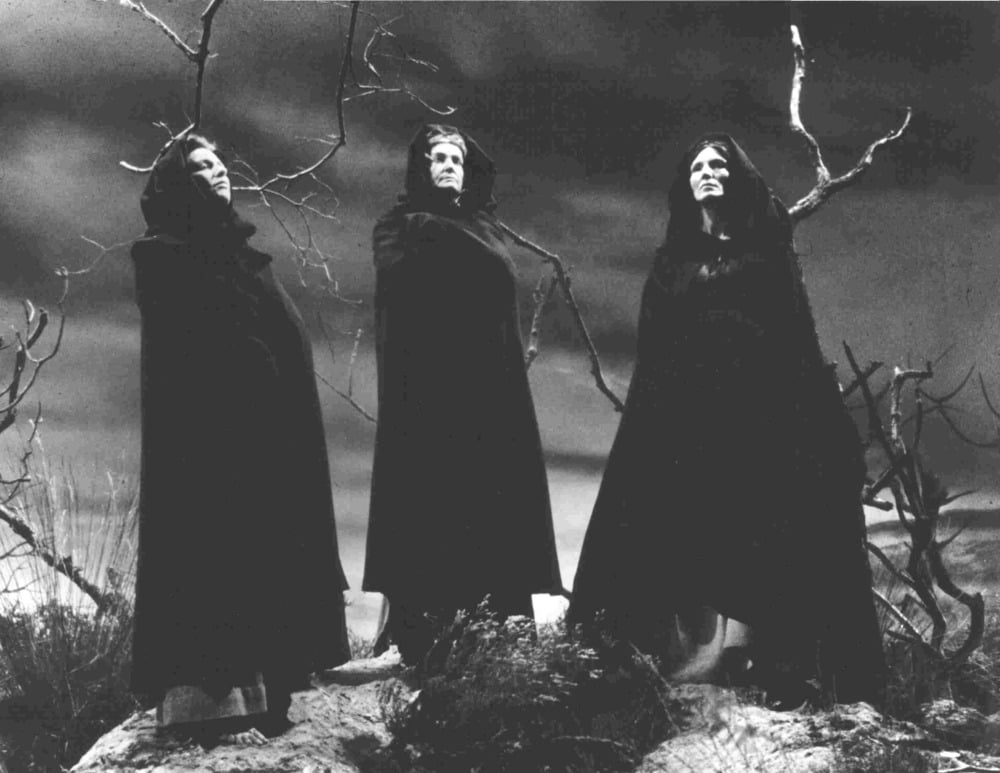
Finally, here is a site on north Scotland's Orkney Islands, known as the Witches' Haven, and below three spaewives, the "Weird Sisters" from Shakespeare's MacBeth.
The AS wyrd is represented in English and Scots by “weird,” e.g., “he maun dree his weird” (suffer his destiny). Some link with Teutonic Fate-goddesses is therefore to be found in the “three weird sisters” of our earlier literature. Holinshed relates that three women “in straunge and ferly apparell, resembling creatures of an elder world,” met Macbeth and Banquo and foretold their destinies. “These women were either the weird sisters, that is the goddesses of destinie, or else some nimphs or feiries, endued with knowledge or prophecie by their Nicromanticall science.” They are Shakespeare’s witches or weird sisters, the Fatae or Parcae of Boece’s History. A story of “The weird Sisters” is mentioned in The Complaynt of Scotland, but it is now unknown, and the additions to Warner’s Albion’s England (106 A.D.) speak of “the weird elves,” as Spenser has “three fatal Impes” in his Ruines of Time, and Chaucer “the fatal sustrin” (sisters), akin to “the weird lady of the woods” in Percy’s ballad, who prophesied from a cave about Lord Albert’s child, then stole him away and nurtured him.
Whatever the ultimate origin of the Norns and similar dispensers of destiny may have been, they had human counterparts in actual prophetesses or magic-wielders, like the old Scots “spae-wife,” who foretold an infant’s future, or the Norse Spakona or Volva. In some references to these it is not easy to say where the human aspect ends and the supernatural begins. As Grimm says: “prophesying, inspiring and boon-bestowing women were always supposed to pass through the country, knocking at the houses of those whom they would bless,” and “tales of travelling gifting sorceresses were much in vogue all through the Middle Ages.” In the story of Nornagest the Norns are called Volor and Spakonur, and are said to travel through the land. In Viga-Glums-saga a Volva or spae-wife called Oddibjorg goes about the land, prophesying and telling stories, her prophecies depending on the kind of entertainment which she receives. Quite possibly the supernatural Norns were a reflection of such actual women who claimed and were believed to possess powers of prophecy and even of influence on human destiny. Excerpted from EDDIC MYTHOLOGY by John Arnott MacCulloch
Conclusion
Legend tells us over and over that at one point, Europe was brimming with women trying to read, interpret, and share knowledge of the world around them. I am not saying that all the women depicted in the Voynich manuscript were Sami. Maybe not a single one was. But look at how close part of Sapmi is to a region called Pohjanmaa (Swedish: Österbotten, English: Ostrobothnia), which some have connected to Pohjola, this fabled northern land of lakes, forest, and women.
Lappi (Sapmi) showing Pohjanmaa just to the south
I'd go so far as to say the ancient wisdom of sauna, the use of herbs during childbirth, and the chanting during the gathering of plants and the labor and delivery, all of which can be found in the Voynich may well have origins either in the Sami or a sister culture not so far from them that has since vanished from history, leaving only whispers.




.jpg)