Showing posts with label codex. Show all posts

Friday, November 6, 2015

The Para: An Example of Folk "Magic" and Natural Science

You may have read the post about Ukko and learned that his other name, Jumala, had started out meaning simply the heavens, and then meaning a god of heaven, and then finally God. This action of anthropomogrifying non-anthropic beings may be seen as one of the most prevalent sea changes brought about by the Church. Another example is here, with what appears to have started out as an animal deity, the Para, which then becomes demonized, and given anthropic features perhaps to make it look funny, absurd, evil, freakish, and unpleasant.

What does the Para have to do with the Voynich manuscript? A charm song for the Para is listed among others, as follows:
Not only is he mentioned, but the little guy might even make an appearance in the manuscript. Hint: he doesn't look much like the Paran painted on the walls of St. Lawrence Church in Lohja, Finland, and he doesn't help actually milk the cows. The nature of his aid could be a bit more subtle.

Here is a rough translation of the Finnish Wiki on the Para

Para (Sw. Bara or bjära) is Finnish and the Swedish folklore known as a farm or a house holder of a kind elf, and also the owner apuolento. However, Para, unlike modern-day stories graciously elves often described as a fearsome look and mightily being. Paraa is typically described as a round ball of yarn or birch bark roll look, but in addition to para could also be a feline form of a bird or frog. The spherical shape was more common in the Swedish tradition and an animal figure in Finnish. Paran task was to help the house and the owner, and the increase of wealth. Parat often went to steal other people's property or families or milk from their cows, and brought it to her mistress or master. Para and its owner were in contact with each other so that if Paraa damaged, it will also be posted injured.

Paran properties 

Lohja church armory vault painted a picture in which a witch milked, assisted by improved cow. Adjacent to another woman churning butter beside him to have been stolen from improved milk.

Paran could own especially the witch. The witch persecutions of people have been accused of owning improvement. The walls of churches in Northern Europe and Finland sometimes described as a witch by churning improvement or other similar apuolennon stolen from milk, apuolento side. Such a scene is also Lohja church wall, Parat which are described in unicorns, isokorvaisia ​​devil-like creatures.

Para arrive when called to assist the people of the house, or wife, but also requires the services of, respect, and food. Paran was able to call help if, for example, knew the right spell. In a story of this kind of spell was:
Synny para, synny para!Ei ole silmää näkemässä,Eikä korvaa kuulemassa!
No para, para created!
It is not seeing eye,
And to pay to hear!
Another version:
Synny para, synny para,saat puolen ruumiistani,Saat puolen sielustani!
No para, para arise,
you get half of my body,
For half of my soul!
St. John's night was the granary keyhole to listen to would fall within your grain counting. If you would, then there would be para to calculate the mass of grain, and the case should be a good harvest. However, if the coffers kilisisi to himself, then para to the money counting, and livelihood would be secured.

Seskar and Lavan Island para known as butter, milk and kananmunavarkaana which was browner than a squirrel.

Paranvoiksi named a slime suspected of being in folklore from the fact that the para disturbed vomit out of the kähveltämästään butter. Therefore, paranvoita is also called paranpaskaksi or -oksennukseksi.

Paraa could not damage the bullets, but if it was able to kill, it was also followed by the death of its owner. The remaining best was only three burnt stick.

Paran origin 

The shamanic cultures all over the world are familiar with Paraa-like holders and apuolentoja, and apparently this kind is well known in Finland long ago. Paran was considered to be emerged vicious soul, and to be the soul of the animal. The Witch, therefore, self-improvement walked likeness. It was a witch then the conscious self, do not let the writings of clarity.

In Sweden, told the witches receiving paransa Satan while visiting Blåkullassa. In Finland, it was considered that the para prepared, for example, by placing a ball of yarn or in some way the spindle's heart wafers. Ready for moving in Para took the character of the animal.

The Possible Science behind the Myth

I'm not sure where that origin piece was going, BUT at this point it is almost impossible to tell how much of the Para myth is post and pre-Christian, but a devilish spin does seem to have been put on the character of the Para. That said, let's go back to why such a being might in any way be seen as beneficial, even lucky. First of all, let's say this drawing that has been called an armadillo and a pangolin is in fact a wet little water vole and the dripping from his pillow isn't some weird alchemical elixir of life: it's just water.

Here's more from JPR Environmental on the European water vole:
Once a common feature on most watercourses in the UK, water voles (Arvicola terrestris) have suffered a dramatic decline over the last 100 years but particularly during the last 30 years. Water voles favour slow-flowing, narrow water courses about 1 m in depth that do not fluctuate in water level through the year. Mud or clay banks and with plenty of bank side emergent vegetation is needed for burrowing, feeding and cover.

Happy Water Voles to You

A thriving population of these little beasties spells a great place to graze your cattle, so it stands that they were medieval good luck omens. Sometimes, magic is just reading the nature in front of you and deciding your actions based on empirical observation. It certainly wouldn't do anyone any good to steal somebody else's water voles, BUT if you killed them, you certainly weren't helping yourself out.

Another candidate

The creature on the pillow could be another aquatic rodent whose habitat is throughout Europe, Castor fiber, the European Beaver, and its value may be seen not only changing the environment to create ideal watering holes for cattle but also in a substance that was extracted from its glands even as far back as the early middle ages.

Castoreum was still in the materia medica in the 18th century as a treatment for many ailments—including headache, fever, and hysteria. The Romans believed the fumes produced by burning castoreum could induce an abortion. Paracelsus thought it could be used in the treatment of epilepsy. Castoreum was also used as an analgesic, anti-inflammatory, and antipyretic. Castoreum was described in the 1911 British Pharmaceutical Codex for use in dysmenorrhea and hysterical conditions (i.e., pertaining to the womb), for raising blood pressure and increasing cardiac output. The activity of castoreum has been credited to the accumulation of salicin from willow trees in the beaver's diet, which is transformed to salicylic acid and has an action very similar to aspirin. (Wiki)

 The majority of medicinal herbs used in the Swedish collection have a strong smell (for example, myrrh, myrtle, juniper, mustard), which is employed in practically all the treatments for mental ailments. The only recipe ingredi-ent made from an animal, castoreum, from the beaver's castoreunt pods, has a very powerful smell and was utilized for insomnia. The Occitan collection also includes plenty of aromatic herbs and flowers (basil, thyme, oregano, sage. rosemary, dog rose, to name a few), but the range of ingredients used is much larger, which makes comparison difficult.
From Mental (Dis)Order in Later Medieval Europe

And yet another candidate
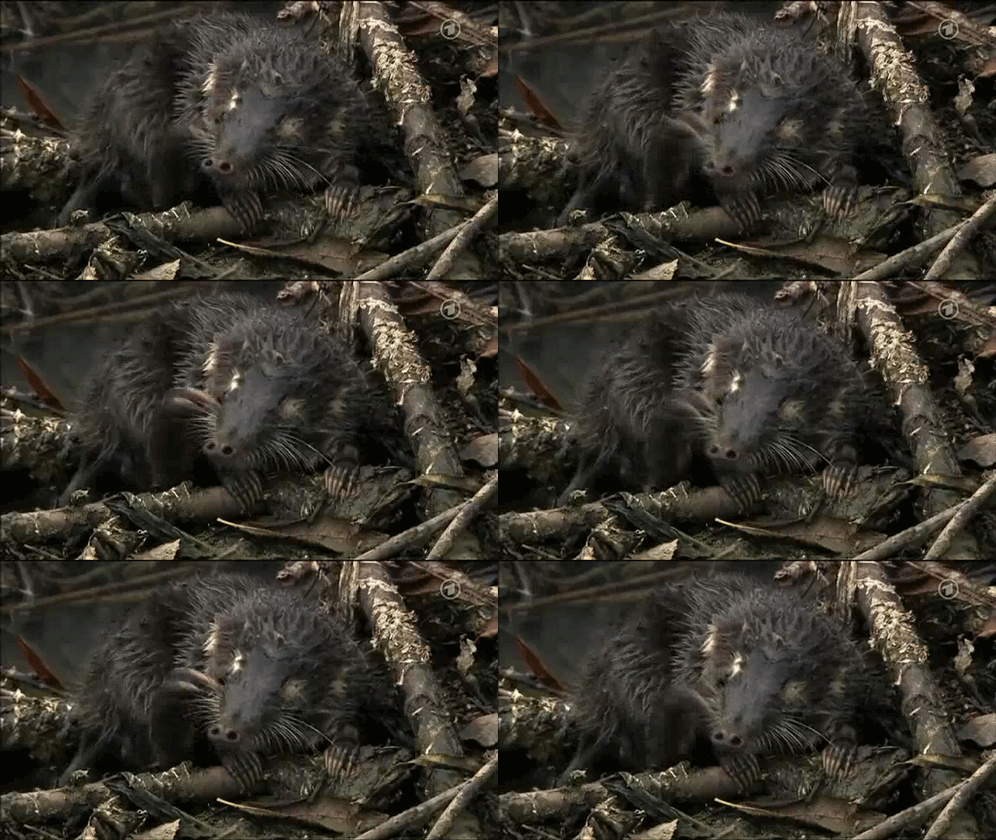

A Russian Desman (Desmana moschata) is a small semiaquatic mammal that inhabits the Volga, Don and Ural River basins. Decidedly rich and thick in nature, desman fur used to be highly sought after by the fur trade.
Desmans belong to the same family as moles but are adapted for a more aquatic lifestyle. They posses a similar long, cylindrical body, but the tail is longer and flatter than that of a mole and is broadened by a fringe of stiff hairs (3). The legs are also covered in stiff hairs and the thick, waterproof coat is brownish-red in colour, fading to ashy-grey on the underside (2) (3). The snout is long and flexible and the back feet are completely webbed in order to provide propulsion in water.

Conclusion

The pillow holding the little creature in the Voynich manuscript is dripping, signifying that whatever rests on it is most likely wet. Therefore, the pattern on the back of the creature does not have to be scales and probably is not. It's the clumped, wet fur of a rodent, perhaps the water vole or the European beaver, both serving a beneficial role during the Middle Ages either as the maker and indicator of ideal grazing grounds or as the holder of a prized healing ingredient. Lauded in north European folklore, the para later became demonized by the Church into an anthropomorphic monster meddling in the milk production industry with witchcraft.

Sunday, June 28, 2015

The Handwriting

The Old Permic or Abur alphabet was created in the 14th century by the Russian missionary Stepan Khrap (1373- 1395), who become St Stephen of Perm. It was modeled on the Greek and Cyrillic alphabets, but many of the letters resemble the Komi religious "Tamga signs". (...) Komi (Коми), which is also known as Zyrian, or Komi-Zyrian, is spoken by about 350,000 people mainly in the Komi Republic (Коми Республика) in the northeast of European Russia.
Hauksbók ('Book of Haukr'), Reykjavík, Stofnun Árna Magnússonar
Above is an example of myriad Medieval manuscripts to be found within the golden hoard of Norse literary tradition. This Icelandic manuscript dates from the 14th century and was created by the Icelander Haukr Erlendsson. It recounts Eiríks saga rauða or the Saga of Erik the Red.

Medieval Norse history is inextricably woven into the history of the northern British isles because quite early on as well as Scandinavia the Norse settled there in substantial numbers. The culture of Orkney, for example, may be said to be far more Norse than that of Britain south of Hadrian's Wall. This is good to keep in mind when studying the Voynich manuscript because the script closest to it hails from Scotland.

Take a look at the following word from a different manuscript and see if you can read it.
Perhaps you came up with saPro.

Or outio.
Or oaPro.You're getting along about as far as most scholars who are studying the Voynich.

This word in fact does not come from the Voynich at all but rather from a letter that gained some renown in June of 2013 for its re-identification as being written by Robert the Bruce to Edward II. It was originally attributed to Robert's son.

Here it is in full.

The word above is, in fact, Latin.


Had it been written in a far more obscure tongue, scholars might still be stumbling about with its transcription and translation, but since it is Latin, the translation came rather easily, especially compared to the Voynich.

Take a look at some other words in this letter from Robert the Bruce, written roughly a hundred years before the Voynich.
Here's just a snippet from the Voynich.
Since it's in Latin, the letter "k" is at best scarce in Robert the Bruce's letter and may be completely absent, just as it appears to be in the Voynich. Rather, the "k" sound, if it appears, is presented as double c's as in ecclesie. Here's some Wiki on it.
In the earliest Latin inscriptions, the letters C, K and Q were all used to represent the sounds /k/ and /g/ (which were not differentiated in writing). Of these, Q was used to represent /k/ or /g/ before a rounded vowel, K before /a/, and C elsewhere. Later, the use of C and its variant G replaced most usages of K and Q. K survived only in a few fossilized forms such as Kalendae, "the calends".
When Greek words were taken into Latin, the Kappa was transliterated as a C. Loanwords from other alphabets with the sound /k/ were also transliterated with C. Hence, the Romance languages generally use C and have K only in later loanwords from other language groups. The Celtic languages also chose C over K, and this influence carried over into Old English. Today, English is the only Germanic language to productively use hard C in addition to K (although Dutch uses it in learned words of Latin origin and follows the same hard/soft distinction in pronouncing such words as English).
But let's say that in the Voynich, the language used is very fond of k's yet the writers are more familiar with (or have only an example of) Latin script. What they may do is for every k they wish to write pen a pair of c's.

The Handwriting

A manuscript written in Sweden at about the time the Voynich manuscript was written.
Detail from 'The Mirror of the Life of Christ', an illuminated 15th-century Scottish manuscript.

Below is a Register of Sasines for Glasgow, 1654-1656, written in Scottish secretary hand and taken from a superlative site on the subject, Scottish Handwriting.com. If you can read this without looking at the transcription, then you're on the road, at least, to reading the Voynich manuscript.
The words, of course, are Scots, not the language used in the Voynich, but if you transcribe a passage from the Voynich using letters from this alphabet, you get something strongly suggesting an arcane Fenno-Norse origin. The secretary hand was developed a century after the Voynich was written, so it would be absurd to say that the Voynich was written in Scottish secretary hand. In fact, it may be the other way around. Whatever hand this is in the Voynich may have heavily influenced the development of the Scottish secretary hand.

But how on earth, you might ask, did an arcane Fenno-Norse language end up written in a hand related to one used centuries later in Scotland?

A stigma has arisen against the Scots perhaps starting with the Romans, who became so sorely frustrated with them. By the time of the Glorious Revolution, especially the Scots in the Highlands were deemed for the most part incorrigible and illiterate. The potshots that Westminster takes to this day at the Scots (who have recently dared to clap in that non-clapping place) reflect this centuries-old stigma.

Since, like the Nordics, Scottish culture was not imbued with Judeo-Christian or Greco-Roman culture but something quite different, it was next to impossible for those south of them to admit they had any culture at all. (This is akin to researchers today clinging habitually to the canon to try to interpret the Voynich manuscript and shoehorning the imagery into explanations that they are familiar with in lieu of waking up to the presence of another, completely different culture which more than likely birthed it.)

It is good to keep in mind that Scalloway, Shetland, is a hundred miles closer to Bergen, Norway, than it is to Edinburgh. Especially in northern Scotland and most markedly across Orkney and Shetland, the Norse have had far more of an influence on Scottish culture than any people south of Hadrian's wall. The Scots language can be traced back to mainly Norse origins. For centuries the people on either side of the North Sea have traded, the Finns and the Sami being frequent visitors, along with north Germanics, and, going back all the way back to the Kvens up to the 15th century, nordic aristocrats owned tracts of land in north Scotland.
Below is a record from the county court of Chester, held on Tuesday after the feast of St Nicholas in the year 1310. It lists a fellow by the unfortunate name of Roger Fuckbythenavel preparing to be outlawed. This is so far the earliest sighting of the swear word in the English language. What is even more interesting for our purposes is the court hand in which the record was written. Note that the f appears as a double f and the l has two bizarre little top loops. In addition, the e is extremely rounded. Finally, the u and the v are identical.


Here is an example of how the smoke screen about Scottish culture has been recently lifting. A researcher at the University of Glasgow has discovered the oldest surviving non-biblical manuscript from Scotland. Although the Boethius manuscript (the 'Consolation of Philosophy') which dates to c.1130-50, was known and had previously been catalogued, scholars had believed it to be English, with Durham being the most likely place of origin. However, closer inspection has revealed that the manuscript's handwriting and illustrations do not match those of Durham, or other English books, from this period. Identifying the manuscript as a product of David I's Scottish kingdom means that Boethius was being read in Scotland 300 years earlier than previously thought. Dr Murray, who is conducting a British Academy Post-Doctoral Fellowship project on Boethius's 'Consolation of Philosophy' in Scotland, believes that this is proof that intellectual and literary cultures were flourishing in Scotland at a far earlier date than has been realised.

The Voynich derives from a medieval progenitor of Scottish Secretary Hand. The language is not Gaelic, but it is a combination of proto-Germanic and proto-Finno-Ugric, possibly a rare survivor from the Kvens. 

Perhaps you can see now, these is indeed a context for the Voynich manuscript's actual script. It's simply of course in a more obscure tongue than Latin and in a far more delicate hand than that of Robert the Bruce.


Tuesday, March 3, 2015

Voynich on the Halfshell


Well over 70 words (I've lost count) gleaned using a new transcription alphabet indicate constructions of an old Finno-Ugric origin with a substantial amount of Old Norse. In addition, there is a distinct Slavic influence.


The pages depict female heliocentric star charts resembling Nordic brooches. They also depict kolovrats, octagrams, sauna/banya, torcs, a seidr staff, the sun cross symbol, intercalary year, red conical roofs, onion domes, plants from the northern hemisphere, a landscape resembling the Ruskeala marble caves, zaftig fair blond women, a Permic-like lizard of the underworld, the pike of Tuonela, and runic glyphs (comparable to those found in Icelandic magic books).

All of this points to core elements of north European culture that can be found in Scandinavian, Finno-Ugric, north Germanic, and to some extent Celtic traditions. These belief systems go back thousands of years.

Some visual designs are reminiscent of a Sami shamanic drum, Karelian embroidery, and Vologda lace. The herbal powder receptacles are modified sewing necessaires in the tradition of north European treenware.

In addition, some of the pages contain text suggestive of Karelian runic charm songs or Sami joiks in that they are highly alliterative and trochaic. Major language candidates include Elfdalian, Meänkieli, and Orkney Norn. The script is an earlier relative of Scottish Secretary Hand.

While the manuscript remains an extraordinary piece of work, it is not from outer space or the Divine, including those Renaissance men who were perceived as such. Rather it was created by a bunch of largely blond, mostly middle-aged northern European women most likely on pilgrimage to perform some water/fertility ritual akin to the legend of Venusbergs, the cult of Perchta, or ancient Finnish tradition.


This blog delves further into all of these areas.

Just an aside: All anyone would get from licking the glass of the manuscript's case, thinking it has any numinous powers (apparently people are doing this), would be essence of Windex.