Showing posts with label Old Norse. Show all posts

Thursday, December 31, 2015

The Kvens and the Voynich Manuscript

A brief history of the Kvens

Over a thousand years ago, the word Kvens (quain, qwaen, quen, cwen, fin, finn) meant to most western people the Finno-Ugric family of peoples who lived in the British Isles, Denmark and northern Germany until they merged with invading Celts and Goths from the east. The Kvens of Western and Central Europe are the people who disappeared from the map, but their name still lives in various forms between Scotland and Kainuu, Finland.

According to Scandinavian legend, in ancient times, the Finnish tribe called the Quen lived in the whole of Finland south of Sapmi. Kvens committed predatory raids on Sami territory and as a result on the Saami areas Kven villages formed up to the northern outskirts of the Gulf of Bothnia. The Gulf of Bothnia's coast was named Kainuu from these Kven villages. At first meant Kainuu meant the coast on both the Swedish and Finnish sides of the bay.
Comprehensive Historical Timeline

The Roman historian Tacitus (ca. 55-117) writes in his Germanica of the enigmatic Sithoni. Tacitus and Adam of Bremen (1070s) describe a country ruled by women: Terra Feminarum. Modern research identifies these as the Kvener. English King Alfred and his Norwegian columnist Ohthere (Ottar, about 890) gives a good description of their kingdom and its history. The value of Icelandic sagas as source material has varied, but their geographical value still holds even in terms of the country's historical location. Snorri Sturluson gave a different interpretation of Norway's founding in the saga Fundinn Noregr. He replaced the Odin myth royal fairy tale with the story about the fabulous kings of Kvenland, which in fact were the giants mentioned in Icelandic mythology. References in Finnish folk poetry to Pohja or Pohjola also mean Kainuu/Kvenland. (This is the land of Louhi, the Witch of the North, mistress of Pohjola, who features prominently in Finland's national epic, The Kalevala and is discussed in a blog post titled The Baba Yaga and dappled others.)
The former Kvenland was thus a unit in the early Baltic history and lay around the Bothnia bay. Kvenland belonged neither to Sweden or Finland, for back then there was no Sweden or Finland. The first threat to its existence came from Karelians and Novgorod from about the year 1100, and it seems that most of the former Kvenland came under Karelian supremacy during that time. There are several sources that account for Kvener cooperating with the Northmen against the Karelians, and others tell of Kvener in cooperation with the Karelians against the Northmen. Birger Jarl's genocide in Tavastland in the middle of the 13th century, known as the second crusade, was directed at the pavilions, which have been said to have been war against Karelians / Russians and sometimes allied themselves to the Swedish invasion, which was basically aimed at Novgorod. Birger Jarl's ravages of Häme was the preparation of the so-called Third Crusade against the already Christian Karelians, who enjoyed patronage in Novgorod. (The above introduction to the Kvens was excerpted from United by Water.)

~~~

Who knows? Doggerland may turn out to have been an important ancient seat of Kvenland, and maybe that's why the people themselves seem to have vanished. I would not be surprised if most of the Danish bog mummies were Kven pilgrims on the way to Lejre from Norway. I believe, also, the Kvens' instrument, the jouhikko, gave the Welsh their crwth and the Scots their gue, and the Kven skin boats gave the Celts their curachs and coracles. That is, I think the Kvens voyaged west and brought innovation with them.

~~~

Danish/Norwegian tax records from the 16th century already list some Kvens living in North Norway. Also, the famous map of Scandinavia by Olaus Magnus from 1539 shows a possible Kven settlement roughly in between today's Tromsø and Lofoten named "Berkara Qvenar". Kvens of this time are often connected to the birkarl organization in northern Sweden. In some early documents Kvens are also grouped together with the Sami people, who are the indigenous people of Central and Northern Norway. Wiki

Once the later migrations transpire, discerning early from late Kvens becomes impossible. Nevertheless, there is this report of Kven that may be from the Berkara Qvenar. Olaus Magnus knows sequences and thus they are in his Carta Marina (1539). Bureus mention in their atlases (1611, 1626) Cajania province, which coincides with the Finnish Ostrobothnia. Central European cartographic tradition (Tschudi, Herbenstein, about 1550) felt that Kayenskaja Zemlya, and Cayeni (kajaanit, kvener, kainuulaiset) has been under Russian rule, but conquered by Swedish kings. Cayeni lived according to him, both in northern Sweden and Ostrobothnia, ie Finnish Ostrobothnia. Tschudi also identifies Norrbotten Ostrobothnias north of the border and went under the peace treaty in Nöteborg (1323) just south of Pyhäjoki (in Petäoja). Several later European cartographers confuse fields and their positions here in the periphery of Europe, and Mercator (late 1500s) and others place Kayenskaja Zemlya in the Arctic Ocean. United by Water
Olaus Magnus - http://www.npm.ac.uk/rsdas/projects/carta_marina/ "Carta Marina satellite images"
Carta marina, a wallmap of w:Scandinavia, by Olaus Magnus. The caption reads : Marine map and Description of the Northern Lands and of their Marvels, most carefully drawn up at Venice in the year 1539 through the generous assistance of the Most Honourable Lord Hieronymo Quirino.
A - Tromso
B - Maelstrom
C - Lofoten
D - Possible Kven settlement - Berkara Qvenar
E - Some devilish little dude sweeping the floor. What does he stand for?
F - An island with mound houses similar to those found in Greenland and nowhere else on this map. Why are they also here?
G - A couple on skis practicing archery. This is a remarkably egalitarian depiction of a woman in the 16th century.

By contrast, Francesco Primaticcio painted this in roughly the same year. It's Helen again, getting raped.

While speaking along the lines of gender specifically, Kvens appear to have been by necessity extraordinarily egalitarian as opposed to their southern counterparts, giving rise to tales of northern amazon tribes, yet along ethnographic lines they appear not to have been egalitarian at all, for as noted elsewhere, they enslaved and taxed the Sami people as egregiously as did any later Norseman. Gunnloth from Snorri's account, who guarded the mead of the Scalds (poetry), may originally have been a Kven from Kven myth, and her uncle, Baugi, a birkarl owning nine Sami, the slaves who killed each other for the whetstone. In the tale, Odin himself Bolverk. Compare this to words such as Boiorix ("king of the Boii", one of the chieftains of the Cimbri) and Boiodurum ("gate/fort of the Boii", modern Passau) in Germany and the modern regional names of Bohemia (Boiohaemum), a mixed-language form from boio- and Proto-Germanic *haimaz, "home": "home of the Boii," and 'Bayern', Bavaria, which is derived from the Germanic Baiovarii tribe (Germ. *baio-warioz: the first component is most plausibly explained as a Germanic version of Boii; the second part is a common formational morpheme of Germanic tribal names, meaning 'dwellers', as in Anglo-Saxon -ware); this combination "Boii-dwellers" may have meant "those who dwell where the Boii formerly dwelt". 

According to Strabo, writing two centuries after the Gallic invasion of north Italy in around 350 BC, rather than being destroyed by the Romans like their Celtic neighbours,
"the Boii were merely driven out of the regions they occupied; and after migrating to the regions round about the Ister, lived with the Taurisci, and carried on war against the Daci until they perished, tribe and all — and thus they left their country, which was a part of Illyria, to their neighbours as a pasture-ground for sheep."
Thus we may have in this myth an ancient tale of cultural appropriation not first by a conqueror but by a wanderer of a lost tribe, himself abducted by the Kvens and set to labor among the Sami, who either escapes later or is released and eventually makes himself the hero of a tale about how he acquired (stole) from the Kvens the art of poetry. Many tales within Norse and Finnish mythology bear marks of an earlier origin and different telling, a thing that scholars of these texts have been repeatedly faced with and forced to explain, one egregious example being the lifting of the sea deity Nerthus from a north German tribe and making her Njorth.

The Birkarls

Birkarls (birkarlar in Swedish, unhistorical pirkkamiehet or pirkkalaiset in Finnish; bircharlaboa, bergcharl etc. in historical sources) were a small, unofficially organized Finnish group that controlled taxing and commerce in central Lappmarken in Sweden during the 13th to 17th centuries.
The most probable assumption is that Birkarls were originally Finnish traders mainly from historical Tavastia. King Magnus III Birgersson is traditionally claimed to have granted their privileges to control the trade and taxes in the north in the later half of the 13th century, possibly just legalizing an already existing situation. Birkarls (bircharlaboa) are first mentioned in 1328, when they are listed as one of the settler groups in northern Hälsingland that covered the western coast of Gulf of Bothnia all the way up and around the gulf to Oulu River.
The main purpose of the birkarl organization was to control the trade with Sami people and tax them. Sami people were traditionally taxed by Norwegians already in the Viking Age or even earlier. Later Russians started to tax them as well. After having southern Finland under control around 1250, Sweden became interested in the situation in the north. Eventually, some Sami people paid taxes to all three states. Birkarls were just one element in the colonial system taking benefit of the Sami area.
It seems that birkarls' privileges were more de facto, than de jure. No document has survived granting them official right to the tax and trade monopoly in the north, even though the state first supported and later tolerated the situation for centuries.
In practise, a birkarl owned the Sami people on his area, and they were treated as if they were property. Privileges to own Sami people usually went in the family. Later, birkarl privileges became merchandise as well.
Birkarls were active on Tornio, Luleå and Piteå River valleys, Tornio being their main area. Each of the valleys formed a separate "lappmark" with its own birkarls. 
It is often speculated in Finland that ancient Kvens which are mentioned in some Norwegian and Icelandic sources in the early Middle Ages, were an organization similar to birkarls. According to this theory, "Kvenland" would have then been the same area where birkarls later operated. The very small number of birkarls makes this connection unlikely. Swedish sources also mention birkarls to be settlers in their area of operation still in the early 14th century whereas Kvenland is mentioned to be a land comparable to Sweden and Norway already in the Viking Age.
It is however likely, that northern Norwegians generally called birkarl traders as "Kvens" in the Middle Ages and later. Olaus Magnus mentions both of the terms in his publication Historia de Gentibus Septentrionalibus ("A Description of the Northern Peoples") from 1555 CE. Those Finnish traders that went from Tornio to Norway, are told to have been called "Kvens".
Whatever the case, most of the Kven minority in present-day northern Norway has immigrated from the same area on which birkarls were active. Wiki
The author of the wiki article does not take into account that Kven society was made up of two widely disparate occupations: the far-ranging traders who by and large were men and the women who by and large were the rulers and administrators of the land (Kvens as seafaring traders first and foremost and women as rulers on land come from insights shared with me by researcher Andres Paabo, who has conducted a mountain of work on prehistoric seafaring traders all over the world. I recommend his website: Uirala http://www.paabo.ca/uirala/uiralamenu.html).

This helps to explain some things:
  1. How Kvens could be so influential as to rule isles in Scotland and yet later appear to have so few land holdings in Scandinavia
  2. How Kvens appeared to vanish suddenly, with no evidence of calamity. We read in the legends of very powerful wily queens or their beautiful daughters being wooed. We hear nothing of what happened to their men. Plague? Storms? War? Conversion? Famine? Slavery? Or simply the lure of other lands? Perhaps all of these to some extent.
  3. How an entire people may be given a title according to an outsider's perspective and reality be more complex than first glance. 
At any rate, the tax collection and other administrative duties of the birkarls most likely often fell on the shoulders of the women as well. A later post in this blog will shed light on a host of Nordic women of mixed ancestry who owned and managed sometimes vast tracts of land during the 15th century, proving that to some extent the Kven birkarls in fact did not die out at all but rather when it came into vogue to cancel out, wholesale, any significance women may hold--past, present, or future in the annals of history, be it medical, legal, political, or religious, any remnant trace of the Kvens fell into oblivion with their story. Hence, her story of where she came from mattered far less than his of how she was won.

The word "Kven" and its etymological connection to the female sex

cwen  - a noun for woman
Old English From Proto-Germanic *kwēniz ‎(“woman, wife”), from Proto-Indo-European *gʷn. Cognate with Old Saxon quān, Old Norse kvæn, Gothic qens. The Indo-European root is also the source of Ancient Greek γυνή ‎(gun), (Greek γυναίκα ‎(gynaíka)), Proto-Slavic *žena (Old Church Slavonic жена ‎(žena), Russian жена ‎(žena)), Old Irish ben (Welsh benyw), and Albanian zonjë.

Seo clæneste cwen ofer eorþan: the purest woman on earth.
wife
queen
Aðelwulf cyng Carles dohtor hæfde to cwene: King Athelwulf took Charles's daughter as his queen.
nominative      cwēn    cwēne, cwēna
accusative        cwēn, cwēne   cwēne, cwēna
genitive           cwēne  cwēna
dative  cwēne  cwēnum
cwene (woman, wife, prostitute)
Middle English quene
Modern English queen
English: quean
Danish: kvinde
Norwegian: kvinne
Swedish: kvinna

The Kven Language (Kainun Kieli)

The Kven language is a Finnic language spoken in northern Norway by the Kven people. For political and historical reasons, it received the status of a minority language in 2005 within the framework of the European Charter for Regional or Minority Languages. Linguistically, however, it is seen as a mutually intelligible dialect of the Finnish language, and grouped together with the Peräpohjola dialects such as Meänkieli, spoken in Torne Valley in Sweden.

Kven dialects include: Lyngen, Nordreisa, Kvænangen, Alta, Porsanger, Tana, Nord-Varanger, Sør-Varanger.
Contrary to popular belief, the dialects spoken by the Kvens and Kainuu peoples are not closely related. The Kainuu dialect is one of the Savonian dialects that was formed from the 16th century onwards, when immigrants from Savonia started to settle in the northern wastelands.

The Kven language has come to incorporate many Norwegian loanwords, such as tyskäläinen (from the Norwegian word tysk, meaning German) instead of standard Finnish saksalainen. The Kven language also uses some old Finnish words that are no longer used in Finland.

Like the old Kven tongue, Voynichese is FENNO-NORSE.

The Voynich manuscript may in fact be written in the old Kven tongue. It is looking very, very likely. Interestingly, numerous early Germanic words have survived largely unchanged as borrowings in Finnic languages. Some of these may be of Proto-Germanic origin or older still, while others reflect developments specific to Norse. Some examples (with the reconstructed Proto-Norse form):
  • Estonian/Finnish kuningas < *kuningaz "king" (Old Norse kunungr, konungr)
  • Finnish ruhtinas "prince" < *druhtinaz "lord" (Old Norse dróttinn)
  • Finnish sairas "sick" < *sairaz "sore" (Old Norse sárr)
  • Estonian juust, Finnish juusto "cheese" < *justaz (Old Norse ostr)
  • Estonian/Finnish lammas "sheep" < *lambaz "lamb" (Old Norse lamb)
  • Finnish hurskas "pious" < *hurskaz "prudent, wise, quick-minded" (Old Norse horskr)
  • Finnish runo "poem, rune" < *rūno "secret, mystery, rune" (Old Norse rún)
  • Finnish vaate "garment" < *wādiz (Old Norse váð)
  • Finnish viisas "wise" < *wīsaz (Old Norse víss)
The old Kven language in its original form has in part vanished and in part it has greatly contributed to and has assimilated with other Fennoscandian languages.

And what happened to Old Norse?

Around 1350 the Black Death ravaged Norway which weakened the country and the population was greatly reduced. The upper class were those who were literate in the country. They became extinct, as did much of the art of writing forvant and resources of cultural life were gone. Swedish, Danish and northern German nobles intermarried into the remains of the Norwegian share which made ​​it foreigners who took over much of the power in Norway. Original literature regarding the Norwegians was no longer written, only literature regarding administration and trade. When Norway came under Danish rule, the language disappeared altogether.

Well...yes and no. Its roots survive everywhere in Norwegian and other Nordic languages.


Monday, September 7, 2015

The Voynich and Childbirth


The Dangers of Childbirth
As recently as 1800, life expectancy for newborns was very low around the world. In addition, just a hundred years ago a woman was more than 70-times more likely to die while giving birth. Childbirth was thus a treacherous experience which must have been made all the more treacherous by well-meaning women like those described below and a terrible prankster who can throw his voice.
[Brother Peder told us that] in his homeland, Denmark, it is the custom that when women are lying-in the neighbouring wives come and help them to keep cheerful with dancing and uninhibited songs. So it happened that one time when a group of women had assembled for a lying-in and were intent on making a row in accordance with the country's evil custom, they
assembled a bundle of straw and formed it into the likeness of a man, with arms of straw, put a belt and hat on him, and called him “Bovi”.
Then they performed their ring-dance, and two women jumped up and sang with him between them, and between the verses, as the custom is, they turned to him with unseemly gestures and said to him: “Sing with us, Bovi, sing with us; why are you silent?”
And at once the devil, who had these wretched women in his power, replied: “Oh yes, I shall sing!” and he (not the bundle itself of course, but the devil sitting in it) screamed out and gave such a powerful yell that some of them fell down dead, while others were struck with such horror and fear that they were ill for a long time afterwards and barely escaped with their lives.
Jorgen & Axel Olrik, “Kvindegilde i Middelalderen”, Danske Studier. (1907), 175-76, at p. 175. Trans. Tom Pettitt & Leif Søndergaard. The Medieval European Stage, 500 - 1550. Ed. William Tydeman. Cambridge: Cambridge University Press, 2001, pp. 615-665, No.J68, at p. 659. 
Until the advent of 21st-century obstetrics, women were more or less left to their own devices regarding how to survive giving birth, or their in-laws. Nevertheless, it stands to follow that those who were generally thought to know how to bring about successful births tended to be highly valued within their communities.

According to a history of obstetrics, "prior to the 18th century, caring for pregnant women in Europe was confined exclusively to women, and rigorously excluded men. The expectant mother would invite close female friends and family members to her home to keep her company. Skilled midwives managed all aspects of the labour and delivery. The presence of physicians and surgeons was very rare and only occurred once a serious complication had taken place and the midwife had exhausted all measures to manage the complication. Calling a surgeon was very much a last resort and having men deliver women in this era whatsoever was seen as offending female modesty." An informative paper on this can be found in Volume 5 of Health Science Journal: Midwives in early modern Europe (1400-1800) by Maria Kontoyannis and Christos Katsetos.

Seahorse

Male Reproductive System

This little guy, one of the few males depicted in the manuscript, is holding just one thing...or not.

This may be a tactful illustration explaining to girls their impregnation.

Sponges and Feminine Hygiene

I found this from a Facebook posting:
Voynich Manuscript f66r Scottish Sponge Gum Laminaria
25 May 2012 at 13:03
"On f66r is drawn a lady in labor shown with two sponges and a pot of gum solution. She is certainly not dead but appears to be having a foot first or breech delivery as indicated by the shape of her abdomen. The tools for the procedure of cervical dilation she is undergoing are the two sponges and the pot of gum solution." More here.
According to the poster, the only other place in the world that this method was traditionally used besides Scotland was in Denmark. That's all well and good. However, the sponges above look more like typical sponges, not Laminaria, which looks more like a seaweed.

Laminaria digitalis

The sponges depicted in the manuscript may be more closely related to the Halichondria panicea or Breadcrumb sponge, an abundant sponge of coastal areas of the North Atlantic and the Mediterranean Sea. During low tide, you can find this remarkable sponge on jetties and under stones.

It usually looks like a thick bready crust with 'volcano' chimneys. Those are the excreting pores. The breadcrumb sponge has a strange smell, similar to exploded gunpowder. Halichondria panicea occurs on kelp stipes where it may dominate in tidal rapids and on other algae such as Halidrys siliquosa (sea oak). In low or variable salinity (for instance, in the western Baltic), it may be found encrusting predominantly on red algae such as Phyllophora sp. and Phycodrys sp. 


Or these may be some other sponge. The fact is that for centuries sponges have been used in feminine hygiene and for contraception.

Caliper or Another Scoop?

This looks like either a caliper to measure the baby's head or, dare I say it, a crude forceps to grasp the head and pull the baby out. That, in fact, might have been the original forceps--a caliper grabbed out of desperation. I do not doubt that Chamberlen's making his little hundred-year-old "secret" proprietary was the part that was his idea. It could also be the head-on view of another scoop or spoon.


A case made for prenatal ritual

Below are depictions of typical medieval and Roman births with the squatting stool, someone behind for support, and someone in front with a bucket of water.
Or you might, like me, be forced to give birth lying flat on your back. This is a painful, uncomfortable position that works against gravity instead of with it. Note the massive washtub with, one might guess, the proverbial hot water.

Below is an illustration from the Voynich mss. showing gravid women relaxing in the water.

Compare this to some modern water-birthing/prenatal course scenes below.
Now add to this various instruments held by the women which suggest midwifery, such as the sponge, the caliper, the vulva-like contraption, and what may be respectively symbols of the male and female reproductive systems, and it becomes clear that much of the manuscript involves birth and fertility/fecundity--making the crops grow, the rain fall, and the kids come out ok.
Indeed, the Voynich manuscript has kids.

Spinning, Hulda, and the Voynich

The Voynich Manuscript depicts the stages of spinning from distaff to finished spindle.
The women in the Voynich manuscript are depicted carrying implements that would not appear to belong in a watery cave. Two are from spinning: a drop spindle and a distaff. However, within the context of a ritual revolving around a deity associated with these arts, it makes perfect sense.

Drop Spindle


There are many old beliefs assigning powerful significance to the drop spindle. Svetlana Zhulnickova relates the following ritual:
There is also a custom in Karelia when a baby reaches the age of 6 months the mother makes a special ritual "banya" (sauna) for him. When people prepare the sauna for the baby they put a spindle into the stove together with firewood, that is because 6 month is the age when baby usually gets the first tooth, and that means [her/his] own soul. "Superstitions about the Spindle in Russian Karelia"

Distaff

The word distæf in Old English meant literally "flax staff," from dis- "a bunch of flax" and stæf "staff." Because women usually did the spinning, the distaff came to be a symbol for women's work. The word distaff in time took on the meaning "women's work" and later "woman." The noun distaff is rarely used in this way today, but the female members of a family are still referred to as the distaff side. 
Berchta or Perchta, 19th c. engraving by Karl Jauslin 
Which deities were matrons of the art of spinning, weaving, and sewing?

Päivätär ('Maiden of the Sun'), is the goddess of the Sun in Finnish mythology. Described as a great beauty, she owns the silver of the Sun, spins silver yarns, and weaves clothes out of them. In Kalevala, young maidens ask Päivätär to give them some of her silver jewelry and clothes. Not only was Päivätär a goddess—she was the goddess of spinning, and her sister, Kuutar, goddess of the moon, was in charge of weaving.

Frau Bercht, Frau Percht, Striga Holda, Perchta, Frau Holda, and Frau Holle, among others, are names for an ancient deity once worshiped throughout Europe. She was the protectress of agriculture and women's handicrafts. Her name and the names Huld and Hulda may be cognate with that of the Scandinavian being known as the huldra or Huldra. The most steadfast connections are with Frau Holle and Hulda on one hand, and the Old Norse Hlóðyn, a byname for the Earth, Thor’s mother, on the other. This deity is also frequently equated with Nerthus, who also rides in a wagon, and Odin's wife, Frigg, from her alternate names Frau Guaden [Wodan], Frau Goden, and Frau Frekke as well as her position as mistress of the Wild Hunt. 
She was often depicted holding a distaff and/or drop spindle or sitting at a spinning wheel. 
The distaff frequently symbolized women's power, as in the medieval illustrations below.
  • German engraving (1450-1467) of a tournament between man and woman; to the left, a naked man rides a unicorn, holding a rack as his armour; his opponent is a woman on a horse to the right, equipped with distaff; the entire background is covered by ornamental foliage, on which three birds are placed.


  • Image from a French Arthurian romance, 1201-1300, Bibliothèque nationale de France,
    Département des manuscrits, Français 95, 226r. 


  • Above is a photo of Norse seidr staffs collected by Max Dashu. She says:
  • Seiðstaffs of the völur (Old Norse seeresses) are based on the design of distaffs. This symbolism ties in the shamanic staffs with the Spinning of the Norns, with fate-weirding actions, and it also helps to explain the intense female gendering of seiðr, the entranced ceremonies referred to in the Edda and sagas.,,  
Ynglingasaga says that Freyja "was a blótgyðja [sacrificial priestess]; she was the first to teach seiðr to the Æsir, as it was practiced among the Vanir.” [Ynglingasaga 4] In the same poem, Snorri claims this "greatest power" for Odinn; “But this sorcery [fjolkyngi], as is known, brings with it so much ergi that manly men thought it a shame to perform, and so this skill was taught to the priestesses.” [Ynglingasaga 7]  --Max Dashu, Witches and Pagans, forthcoming
  • Voynich woman holding staff and descending into cave
  • Spin-offs from distaffs and seidr staffs include a staff with snakes winding about it. Eileithyia, a Minoan goddess of childbirth and labour, is probably one of the earliest deities shown handling snakes. It is conjectured that this goddess (Alauta) was adopted from an early Indo-European culture.
Engraving from Le immagini de i dei antichi (Images of the Ancient Gods) by Vincenzo Cartari, 16th c.
Perchta
In German legends, 'frau Holda' was the protectress of women's crafts, but none so much as spinning, traditionally a woman's task strong in magical connotations and links to the other world. Holda first taught the craft of making linen from flax. The legend of Frau Holle is found as far as the Voigtland, past the Rhön mountains in northern Franconia, in the Wetterau up to the Westerwald and from Thuringia to the frontier of Lower Saxony. The fairy tale of Mother Holle as recorded from local German folk by the Grimm Brothers contains the following elements: spinning, a well, Frau Holle's feather bed, the belief that shaking it makes it snow on earth, harvesting, and a subterranean realm where Frau Holle, (as folk must have witnessed in bits of green remaining beneath bark, soil, and snow) dwells. Running throughout the tale is this underlying theme of seasonality--sunny blooming meadow-> apple harvest->feather winter->Persephone-like emergence of the "golden girl."
People prayed to Frau Holle for protection, abundance, and healing.

To blow = to heal

The woman inside the sun below right looks like she is blowing out air. To the left of her is a scene from the movie "The Cuckoo." In it, the Sami widow Anni blows on near-death Finnish Soldier Veiko to turn him back to the land of the living.
Below is Veiko's soul being beckoned toward the land of the dead.

Here is a scene from the movie Khadak, in which a Mongolian shaman takes a rather eye-opening approach to a similar situation.


Below is an excerpt from Vladimir Napolskikh's "Seven Votyak Charms" from Estonian Folklore.
The common Votyak word for the healer (or witch-doctor) is emjas'kis' "healer" - a participle (= nomen agentis) from emjany; "to heal" - or pel'l'as'kis' "blower" - a participle from pel'l'as'kyny "to blow"; the last word describes one of the main ways of magic treatment, well-known throughover all the Europe, when the healer blows upon the water with charming and gives it to the patient to drink. 

Women "in the know" were also known as the vǫlur, tietäjä, seiðkonur, vísendakona, vǫlva, seiðkona, seiðr, noita, cailleach,  emjas'kis' or noaidi.


Water, Women, and Ritual

Fundamentally, the Voynich manuscript portrays the relationship between specific elements at work within a very particular belief system. Timing in the graphic below would include what season it is (where the sun is in relation to the earth and how the plants and animals are responding) and how far along a woman is in her pregnancy. These made up the heartbeat of a world that was far less metaphysical than it was ultraphysical. So, no, you won't find alchemy or classical ontology here. It is the world of the folk.
This post explores European myths and legends that associate water with women, fertility and the netherworld.
Many pools, wells or fountains are associated with the water-holda (roughly translated) throughout Germany. She haunts lakes and fountains and is seen as a fair White Lady bathing in the water and disappearing, a trait in which she resembles Nerthus. Like Nerthus, she too drives about in a wagon, sometimes requiring the help of a peasant to repair it. When he carves a new linchpin for her, she pays him with the cast-off wood chips which turn into gold if he is wise enough to take them. Young women would sometimes bathe in the icy Alpine pools in the hopes of becoming healthy fertile mothers. Germanic Mythology

Saturday: pool day

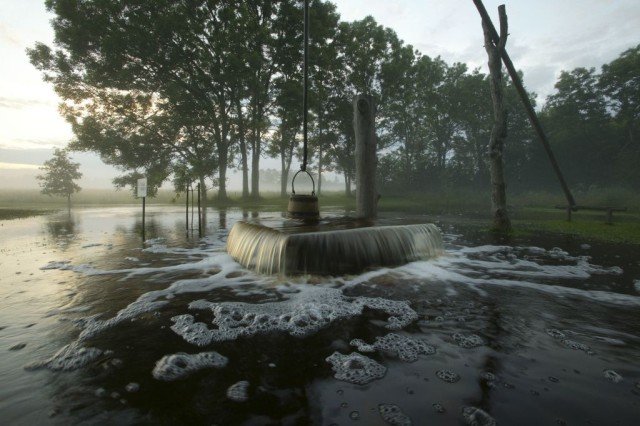
Tuhala Witches’ Well

Tuhala settlement is believed to be 3,000 years old and sits on Estonia’s largest field of porous karst, where 15 underground rivers flow through a maze of caverns, audible but unseen by human inhabitants. One result is sinkholes large enough to swallow horses — the Horse’s Hole, as it is known, appeared in 1978 — and there’s also the “Mother-in-Law’s Hole”. 

In the case of Tuhala Witch’s Well, water starts to spout up from the well and flood the area when excess water from the Mahtra swamp fills up the underground river and the overflowing river water seeks an escape through the well. The quantity of water flowing through the Tuhala River must be at least 5000 liters per second in order for the river to overflow. Water erupts for only a short period of time and not every year. It usually happens in late March or early April.

According to local legend, the well boils over when the “witches of Tuhala” make a sauna below the ground and beat each other with birch branches, causing a commotion on the surface. This year  “the witches” got into action on 18th April…  Tuhala Witch’s Well and ancient Estonian mythology

Water, waterbirds, and Finnish Mythological World View

Here is an excerpt from Anssi Alhonen's Notes on the Finnish Tradition:
The upper world is located in the skies and also to the south. The great birch tree (or in Finnish tradition, the giant oak) grows there. At the roots of the tree, a spring flows and marks the source of the world river. Near the tree and spring there is a warm lake, or 'sea of life', where water birds and human souls are renewed. In the Finnish folk religion this upper world became a warm and light world located in the south called Lintukoto (or 'home of the birds') and the sea of life became a body of warm water surrounding the Lintukoto.
In folk belief, waterbirds were harbingers between upper and lower realms 
Finnish Mythological Cosmos showing Anniki's Well

Women, Water, and Ritual
covered in James Frazer's
 The Golden Bough

Bathing is practiced as a rain-charm in some parts of Southern and Western Russia. ...It is recorded in official documents that during a drought in 1790 the peasants of Scheroutz and Werboutz collected all the women and compelled them to bathe, in order that rain might fall.

To put an end to drought and bring down rain [in Dorpat, Russia], women and girls of the village of Ploska are wont to go naked by night to the boundaries of the village and there pour water on the ground.

In a district of Transylvania when the ground is parched with drought, some girls strip themselves naked, and, led by an older woman, who is also naked, they steal a harrow and carry it across the fields to a brook, where they set it afloat. Next they sit on the harrow and keep a tiny flame burning on each corner of it for an hour. Then they leave the harrow in the water and go home.

Śmigus dyngus in Wilamowicach


Wilamowice [vilamɔˈvit͡sɛ] is a village in Gmina Skoczów, Cieszyn County, Silesian Voivodeship, southern Poland. It has a population of about 460. It lies on south-western slopes of Górka Wilamowicka in Silesian Foothills, in the historical region of Cieszyn Silesia. The inhabitants of this area speak their own language, Vilamovian, which is somewhat similar to German. The people here still practice an ancient celebration called Śmigus-Dyngus (also known as lany poniedziałek, meaning "Wet Monday", Ukrainian: Поливаний понеділок). Held on Easter Monday in Poland and Ukraine, it is also observed by Polish diaspora communities, particularly among Polish Americans, who call it Dyngus Day. Similar celebrations are held in the Czech Republic and Slovakia (Oblévačka in Czech, Oblievačka in Slovak, both meaning "Watering") and in Hungary, where it is known as Vízbevető or Water Plunge Monday. Traditionally, boys throw water over girls and spank them with pussy willow branches on Easter Monday, and girls do the same to boys on Easter Tuesday. This is accompanied by a number of other rituals, such as making verse declarations and holding door-to-door processions, in some regions involving boys dressed as bears. The origins of the celebration are uncertain, but it may date to pagan times (before 1000 AD); it is described in writing as early as the 15th century and continues to be observed in Central Europe. The New Cambridge Medieval History suggests that it originated far to the west of Poland and was adopted under German influence.

A Dyngus procession would also be held, either on Easter Monday or Tuesday. A parade of boys would take part in a march known as chodzenie po dyngusie – "going on the Dyngus" – or z kogutkiem – "with the cockerel", a reference to the use of a live bird, usually taken without permission and stuffed with grain soaked in vodka to make him crow loudly. (A decorated and carved wooden rooster was sometimes used as an alternative.) The rooster was a symbol of fertility, carried on a small two-wheeled wagon which had been painted red and decorated with ribbons and flowers, to which was often also added small puppets representing a wedding party. This would be pushed from door to door by the boys, who would crow like roosters and sing Dyngus songs conveying good wishes and requests for gifts and food. In some regional variants of po dyngusie, the boys would march through the village with one of their number dressed as a bear with a bell on his head – either wearing a real bearskin or a stand-in made of pea vines. The group would go from door to door collecting "gifts for the bear" before "drowning" the bear in a nearby stream or pond. The "bears" were often invited in as they were believed to ensure that there would be a good harvest, reflecting a very ancient belief in the power of the bear to prevent evil, encourage crop growth and cure diseases. In Mazowsze and Małopolska, boys wearing bearskins would also chase girls. (Compare with Scotland's Hogmanay).

Water and the Nether World

Aado Lintrop's On the Udmurt Water Spirit and the Formation of the Concept of 'Holy' among Permian Peoples in Estonian Folklore discusses the commonly held belief in this region that the realm of the dead is situated on the other side of water.

In Estonian mythology, Hiiela is the land and dwelling place of the dead; it is located directly beneath sacred oak groves where the dead are buried. Hiis was the Estonian popular wildlife sanctuary, which applied by means of rituals and sacrifices to higher forces' (spirits, deities, ancestors) favor. Nowadays, mainly defined by the sacred sacred grove.

Synonyms: manala, allilm, hauatagune maailm (riik), teispoolsus, surnute riik, õndsate riik, sealilm, teine maailm, surmariik, surmavald surmavalla väravad, varjuriik, varjude riik (vald, maa), toonela, hiiela, allmaailm, altmaailm van, mana, teine ilm, pimeduseriik, surmaorg, teispoolne maailm, [igavene] rahumaa, [igavene] rahuriik, igavesed jahimaad

And in German legend, Holda held her court within the Hörselberg, and from this mountain would
issue the Wild Hunt, with her at its head. The faithful Eckhart was said to sit at the base of the mountain warning travellers to return whence they came; he also rode ahead of the Wild Hunt warning people to seek shelter from the coming storm.

While Holda in northern Germany is described as leading a procession of the dead, her close counterpart in southern Germany, Perchta, is described as being surrounded by the souls of unborn children, or children who died before they were baptised. This points to Holda's dual role as protectress of souls both entering and leaving this world.


19th c. depiction of the Norse sea goddess, Ran,
 surrounded by her water nymphs or wave girls

Rauni, the Rowan, and the Rainbow

The following is excerpted from Virve Sirapik's Rainbow, Colours, and Science Mythology in Estonian Folklore
Interesting connections are coming out likewise with the riddle Üle ilma pihelgas ('The rowan-tree over the world'), the typical Finnish version from it being Pitkä vitsa pihlajainen yli meren ulottuu. Finnish folklorist Uno Harva has referred to an Estonian Swedish variant (the Estonian Swedes lived in the western part and on several islands of Estonia from 13th century to 1944, their selfname was aibofolket): Iwe wärde raunträ in connection with the Finnish deity Rauni. According to Agricola Rauni was the wife of the thundergod Ukko, known also by Swedish Lapps under the name of Ravdna and the rowan-tree (raudna in Swedish Lappish) was dedicated to her. Harva supposed, that the rowan-tree could be a code-name, euphemism for the rainbow and rauni meant originally both rowan and rainbow. Later from it there developed the personification of the rainbow as the wife of the thunder god (Harva 1948). Without considering the essential role the rowan-tree has had in folk-beliefs one may refer to its protective properties against the thunder (e.g. Hwb. d. Abergl. sub rot). Analogical properties were attributed to other things with red details. So, one can suppose the holiness of the rowan-tree was to some extent derived from its red berries. One can also refer to the Old Norse word rauda 'red' (Islandic raudr, Lithuanian raûdas, Sanskrit rudhir). The Estonian word raud 'iron' is derived from it, as rust is also red. Likewise, the name of the deity Rauni could be derived from the Old Norse rauda. One can again recall the connection of red and rainbow in the Balto-Finnic folk songs and suppose, that the rainbow and rowan-tree were linked by the red colour.
Probably the most frequent phrase in the Voynich manuscript is jelksa jellom, which means something like hallelujah or glory be or sing praises. On the above page, a few other words recur that don't necessarily appear on other pages. Rei or roi (in red) is nearly universal for king. Uka or Ukka (in blue) may refer to the Finnic thunder deity, Ukka. Ron, Raun, Roun, Rom may refer to his wife, Raun, who was associated with the rowan tree and the rainbow, which ancient folklore often depicted as a bridge between the worlds of the living and the dead.

The Poses

Finally, the poses of the women suggest typical folk dance moves that have been made during various at rituals and festivals for centuries.

Conclusion

The manuscript appears to be a calendar map to use for a pilgrimage from Naissar Island, Estonia, south to a place near Prague. As such, it is a sort of communal scripture to be passed down to future generations to help define a people and secure their wholeness and prosperity. 

You might think that while such ceremonies centering around water and presided over by priestesses may have once existed, nothing exists today. 

Actually, a traditional ceremony in Japan has been recently revived, and indeed the myriad cultures that had made up the former Soviet Union look to the way Japan is preserving its cultural heritage as a role model for reviving their own. I'd link the video, but they took it off.

Here is more information about this ritual, called the Momosoomonomairi:
The Shuri Tonokura Community Association held a Nubi dedicatory ceremony at Shuri Castle on December 22. In this ceremony, people traditionally took water from the Heduukka River in Kunigami and the Takushi Hija River in Urasoe and presented it to the Ryukyu Kingdom’s authorities in Shuri.
On this occasion, about 40 people, including local residents in officials’ costumes, noro or female oracles and female officials, paraded from the Shuri Community Center to the castle. There, the “officials” presented the water to the Aumushirare or high-ranking female oracle and prayed for a bountiful harvest.
Seventy-five-year-old Setsuko Funakoshi, who served as the Aumushirare, said, “I prayed for next year to bring health and prosperity to the Okinawan people.”