Showing posts with label archaeology. Show all posts

Tuesday, April 30, 2019

Old Permic Script and the People of the Perm Krai

Mikael Agricola, who lived in the early 1500s, is credited with creating the first comprehensive writing system in a Finnic language. He is even called "The Father of literary Finnish." However, the birch bark letter no. 292, created over 200 years before Agricola, is the oldest known document in any Finnic language.

In addition, inscriptions in Old Permic script are among the oldest relics of the Uralic languages. To set the exact date of Komi writing is impossible. But the fact that it originated long before the 10th century is evidenced by the Books of Ahmed Ibn Fadlan about his journey to the Volga in 921-922. Arab traveler and secretary of the embassy of the Baghdad Caliph wrote about the correspondence of the king of Volga Bulgaria with the ancestors of the Komi people, calling them Vysu (вису).

The Komi ancestors did not have one, but two kinds of writing. The first is the so-called practical letter of the pass, or symbol. With these signs, the zyryane (Komi) tagged their belongings and hunting grounds, and also made calendars. Similar signs existed among all Finno-Ugric and Samoyed peoples. Almost without changing, these icons endured to modern times on spinning wheels, as well as embroidered and knitted patterns.
Komi Calendar Passes

Georgy Lytkin wrote about the difference between the two types of writing in the 19th century: “Zyryan passes never had the meaning of letters, they cannot convey what the Egyptian hieroglyphs conveyed. No approach can be made between passes and stefanovsky letters.” Unlike the Komi passes collected in the 19th-20th centuries, tamga-like graffiti on archaeological finds belong to the 12th-14th centuries. They are undoubtedly the oldest of such signs. http://foto11.com/komi/docs/komipas.php


Stepan Khrap of Perm (St. Stephen) is said to have created Old Permic script for the Komi language in 1372. Actually, all he did was employ a script already well known to him. His grandfather, an educated Komi merchant Dzebas, often climbed up Vychegda and Vym in his trade affairs. It was then that he would have seen for the first time the Komi letters that Zyryan merchants used in trade.   http://www.komi.com/mc/arhiv/new001.htm
Stephan of Perm

This occurred a century before the creation of the Voynich manuscript (according to carbon dating), and roughly two centuries before Agricola and his writing system.

Not until the 17th century was Old Permic, aka Abur, superseded by the Cyrillic script from which it was loosely adapted. I say "loosely" because Old Permic is called a "highly idiosyncratic adaptation" of Cyrillic and Greek, with Komi "Tamga" signs. Interestingly, since not many persons knew it, Old Permic was also used as cryptographic writing for the Russian language.

Could the Voynich manuscript use the Komi's two writing systems, the Tamga system for f66v and f57r and for the rest of the text the more formal writing system employed by the Komi to send letters to trading partners like the Bulgar king?

Let's take a look at Old Permic script, especially Old Permic cursive, and compare it against the script in the Voynich manuscript used for what appear to be 1) a list of rune charms and 2) a calendar.

Pronounced correspondences occur on two pages, one possibly listing runic charms and the other on what appears to be a seasonal calendar. The rest of the manuscript appears to employ, however strangely,  more of a Latin script. The characters which appear similar to Old Permic are not used throughout the manuscript but rather in special, isolated places, as if they were runes or numerals. They in fact do have quite a few correspondences with Tamgas, those used in Finno-Ugric culture.

Here is a comparison between Voynichese, Hungarian Tamga-like symbols, and the Old Permic writing system.
~
~

~
~
~
~
~

~

If the Voynich manuscript has been influenced by an obsolete script from the Perm Krai, and if its folios contain words from inhabitants of the Perm Krai, then perhaps there are extant records of folk songs that would bear resemblance to the frequently repeated words in the Voynich manuscript.

So then, we have this:
One striking correspondence is that the above wedding tune from the Vatka Komi in the Krov district, uses the letters that, if my transcription is fairly accurate, are found in abundance in the Voynich manuscript: a, u, o, i, e, s, p, t, k, m, and l. In addition, it repeats small two-letter words: oi, pe, ok, and uk. 

Other correspondences exist regarding Komi mythology, folk costume, and lore.

Power over water


Mythic focus on women

Zarni Ań (Golden Woman) was the supreme goddess of the Zyrian people (Komi).

"In the mythologies of Uralic peoples, a woman is seen as the ruler of life and death and the southern and northern direction of the corresponding air directions," says Academy Professor Anna-Leena Siikala." The gods of the shamans are the gods of nature

Depictions of female suns

Päivätär ('Maiden of the Sun'), is the goddess of the Sun in Finnish mythology. Described as a great beauty, she owns the silver of the Sun, spins silver yarns, and weaves clothes out of them. In Kalevala, young maidens ask Päivätär to give them some of her silver jewelry and clothes.

Professor Anna-Leena Siikala finds it possible that Päivätär was a goddess who ruled over life and light. During Christian period, she was replaced by Virgin Mary.
Below is a contemporary depiction of Päivätär by sculptor Kaarina Kuusisto-Lukkari.
Above, Komi female sun

Symbols of spinning and weaving

Not only was Päivätär a goddess—she was the goddess of spinning, and her sister, Kuutar, goddess of the moon, was in charge of weaving.

Komi Women

Conclusion

Thus, we find shared nuances in script, mythology, and symbolism between the Voynich manuscript and Uralic culture, especially among the people of the Perm Krai. 

Thursday, December 31, 2015

The Kvens and the Voynich Manuscript

A brief history of the Kvens

Over a thousand years ago, the word Kvens (quain, qwaen, quen, cwen, fin, finn) meant to most western people the Finno-Ugric family of peoples who lived in the British Isles, Denmark and northern Germany until they merged with invading Celts and Goths from the east. The Kvens of Western and Central Europe are the people who disappeared from the map, but their name still lives in various forms between Scotland and Kainuu, Finland.

According to Scandinavian legend, in ancient times, the Finnish tribe called the Quen lived in the whole of Finland south of Sapmi. Kvens committed predatory raids on Sami territory and as a result on the Saami areas Kven villages formed up to the northern outskirts of the Gulf of Bothnia. The Gulf of Bothnia's coast was named Kainuu from these Kven villages. At first meant Kainuu meant the coast on both the Swedish and Finnish sides of the bay.
Comprehensive Historical Timeline

The Roman historian Tacitus (ca. 55-117) writes in his Germanica of the enigmatic Sithoni. Tacitus and Adam of Bremen (1070s) describe a country ruled by women: Terra Feminarum. Modern research identifies these as the Kvener. English King Alfred and his Norwegian columnist Ohthere (Ottar, about 890) gives a good description of their kingdom and its history. The value of Icelandic sagas as source material has varied, but their geographical value still holds even in terms of the country's historical location. Snorri Sturluson gave a different interpretation of Norway's founding in the saga Fundinn Noregr. He replaced the Odin myth royal fairy tale with the story about the fabulous kings of Kvenland, which in fact were the giants mentioned in Icelandic mythology. References in Finnish folk poetry to Pohja or Pohjola also mean Kainuu/Kvenland. (This is the land of Louhi, the Witch of the North, mistress of Pohjola, who features prominently in Finland's national epic, The Kalevala and is discussed in a blog post titled The Baba Yaga and dappled others.)
The former Kvenland was thus a unit in the early Baltic history and lay around the Bothnia bay. Kvenland belonged neither to Sweden or Finland, for back then there was no Sweden or Finland. The first threat to its existence came from Karelians and Novgorod from about the year 1100, and it seems that most of the former Kvenland came under Karelian supremacy during that time. There are several sources that account for Kvener cooperating with the Northmen against the Karelians, and others tell of Kvener in cooperation with the Karelians against the Northmen. Birger Jarl's genocide in Tavastland in the middle of the 13th century, known as the second crusade, was directed at the pavilions, which have been said to have been war against Karelians / Russians and sometimes allied themselves to the Swedish invasion, which was basically aimed at Novgorod. Birger Jarl's ravages of Häme was the preparation of the so-called Third Crusade against the already Christian Karelians, who enjoyed patronage in Novgorod. (The above introduction to the Kvens was excerpted from United by Water.)

~~~

Who knows? Doggerland may turn out to have been an important ancient seat of Kvenland, and maybe that's why the people themselves seem to have vanished. I would not be surprised if most of the Danish bog mummies were Kven pilgrims on the way to Lejre from Norway. I believe, also, the Kvens' instrument, the jouhikko, gave the Welsh their crwth and the Scots their gue, and the Kven skin boats gave the Celts their curachs and coracles. That is, I think the Kvens voyaged west and brought innovation with them.

~~~

Danish/Norwegian tax records from the 16th century already list some Kvens living in North Norway. Also, the famous map of Scandinavia by Olaus Magnus from 1539 shows a possible Kven settlement roughly in between today's Tromsø and Lofoten named "Berkara Qvenar". Kvens of this time are often connected to the birkarl organization in northern Sweden. In some early documents Kvens are also grouped together with the Sami people, who are the indigenous people of Central and Northern Norway. Wiki

Once the later migrations transpire, discerning early from late Kvens becomes impossible. Nevertheless, there is this report of Kven that may be from the Berkara Qvenar. Olaus Magnus knows sequences and thus they are in his Carta Marina (1539). Bureus mention in their atlases (1611, 1626) Cajania province, which coincides with the Finnish Ostrobothnia. Central European cartographic tradition (Tschudi, Herbenstein, about 1550) felt that Kayenskaja Zemlya, and Cayeni (kajaanit, kvener, kainuulaiset) has been under Russian rule, but conquered by Swedish kings. Cayeni lived according to him, both in northern Sweden and Ostrobothnia, ie Finnish Ostrobothnia. Tschudi also identifies Norrbotten Ostrobothnias north of the border and went under the peace treaty in Nöteborg (1323) just south of Pyhäjoki (in Petäoja). Several later European cartographers confuse fields and their positions here in the periphery of Europe, and Mercator (late 1500s) and others place Kayenskaja Zemlya in the Arctic Ocean. United by Water
Olaus Magnus - http://www.npm.ac.uk/rsdas/projects/carta_marina/ "Carta Marina satellite images"
Carta marina, a wallmap of w:Scandinavia, by Olaus Magnus. The caption reads : Marine map and Description of the Northern Lands and of their Marvels, most carefully drawn up at Venice in the year 1539 through the generous assistance of the Most Honourable Lord Hieronymo Quirino.
A - Tromso
B - Maelstrom
C - Lofoten
D - Possible Kven settlement - Berkara Qvenar
E - Some devilish little dude sweeping the floor. What does he stand for?
F - An island with mound houses similar to those found in Greenland and nowhere else on this map. Why are they also here?
G - A couple on skis practicing archery. This is a remarkably egalitarian depiction of a woman in the 16th century.

By contrast, Francesco Primaticcio painted this in roughly the same year. It's Helen again, getting raped.

While speaking along the lines of gender specifically, Kvens appear to have been by necessity extraordinarily egalitarian as opposed to their southern counterparts, giving rise to tales of northern amazon tribes, yet along ethnographic lines they appear not to have been egalitarian at all, for as noted elsewhere, they enslaved and taxed the Sami people as egregiously as did any later Norseman. Gunnloth from Snorri's account, who guarded the mead of the Scalds (poetry), may originally have been a Kven from Kven myth, and her uncle, Baugi, a birkarl owning nine Sami, the slaves who killed each other for the whetstone. In the tale, Odin himself Bolverk. Compare this to words such as Boiorix ("king of the Boii", one of the chieftains of the Cimbri) and Boiodurum ("gate/fort of the Boii", modern Passau) in Germany and the modern regional names of Bohemia (Boiohaemum), a mixed-language form from boio- and Proto-Germanic *haimaz, "home": "home of the Boii," and 'Bayern', Bavaria, which is derived from the Germanic Baiovarii tribe (Germ. *baio-warioz: the first component is most plausibly explained as a Germanic version of Boii; the second part is a common formational morpheme of Germanic tribal names, meaning 'dwellers', as in Anglo-Saxon -ware); this combination "Boii-dwellers" may have meant "those who dwell where the Boii formerly dwelt". 

According to Strabo, writing two centuries after the Gallic invasion of north Italy in around 350 BC, rather than being destroyed by the Romans like their Celtic neighbours,
"the Boii were merely driven out of the regions they occupied; and after migrating to the regions round about the Ister, lived with the Taurisci, and carried on war against the Daci until they perished, tribe and all — and thus they left their country, which was a part of Illyria, to their neighbours as a pasture-ground for sheep."
Thus we may have in this myth an ancient tale of cultural appropriation not first by a conqueror but by a wanderer of a lost tribe, himself abducted by the Kvens and set to labor among the Sami, who either escapes later or is released and eventually makes himself the hero of a tale about how he acquired (stole) from the Kvens the art of poetry. Many tales within Norse and Finnish mythology bear marks of an earlier origin and different telling, a thing that scholars of these texts have been repeatedly faced with and forced to explain, one egregious example being the lifting of the sea deity Nerthus from a north German tribe and making her Njorth.

The Birkarls

Birkarls (birkarlar in Swedish, unhistorical pirkkamiehet or pirkkalaiset in Finnish; bircharlaboa, bergcharl etc. in historical sources) were a small, unofficially organized Finnish group that controlled taxing and commerce in central Lappmarken in Sweden during the 13th to 17th centuries.
The most probable assumption is that Birkarls were originally Finnish traders mainly from historical Tavastia. King Magnus III Birgersson is traditionally claimed to have granted their privileges to control the trade and taxes in the north in the later half of the 13th century, possibly just legalizing an already existing situation. Birkarls (bircharlaboa) are first mentioned in 1328, when they are listed as one of the settler groups in northern Hälsingland that covered the western coast of Gulf of Bothnia all the way up and around the gulf to Oulu River.
The main purpose of the birkarl organization was to control the trade with Sami people and tax them. Sami people were traditionally taxed by Norwegians already in the Viking Age or even earlier. Later Russians started to tax them as well. After having southern Finland under control around 1250, Sweden became interested in the situation in the north. Eventually, some Sami people paid taxes to all three states. Birkarls were just one element in the colonial system taking benefit of the Sami area.
It seems that birkarls' privileges were more de facto, than de jure. No document has survived granting them official right to the tax and trade monopoly in the north, even though the state first supported and later tolerated the situation for centuries.
In practise, a birkarl owned the Sami people on his area, and they were treated as if they were property. Privileges to own Sami people usually went in the family. Later, birkarl privileges became merchandise as well.
Birkarls were active on Tornio, Luleå and Piteå River valleys, Tornio being their main area. Each of the valleys formed a separate "lappmark" with its own birkarls. 
It is often speculated in Finland that ancient Kvens which are mentioned in some Norwegian and Icelandic sources in the early Middle Ages, were an organization similar to birkarls. According to this theory, "Kvenland" would have then been the same area where birkarls later operated. The very small number of birkarls makes this connection unlikely. Swedish sources also mention birkarls to be settlers in their area of operation still in the early 14th century whereas Kvenland is mentioned to be a land comparable to Sweden and Norway already in the Viking Age.
It is however likely, that northern Norwegians generally called birkarl traders as "Kvens" in the Middle Ages and later. Olaus Magnus mentions both of the terms in his publication Historia de Gentibus Septentrionalibus ("A Description of the Northern Peoples") from 1555 CE. Those Finnish traders that went from Tornio to Norway, are told to have been called "Kvens".
Whatever the case, most of the Kven minority in present-day northern Norway has immigrated from the same area on which birkarls were active. Wiki
The author of the wiki article does not take into account that Kven society was made up of two widely disparate occupations: the far-ranging traders who by and large were men and the women who by and large were the rulers and administrators of the land (Kvens as seafaring traders first and foremost and women as rulers on land come from insights shared with me by researcher Andres Paabo, who has conducted a mountain of work on prehistoric seafaring traders all over the world. I recommend his website: Uirala http://www.paabo.ca/uirala/uiralamenu.html).

This helps to explain some things:
  1. How Kvens could be so influential as to rule isles in Scotland and yet later appear to have so few land holdings in Scandinavia
  2. How Kvens appeared to vanish suddenly, with no evidence of calamity. We read in the legends of very powerful wily queens or their beautiful daughters being wooed. We hear nothing of what happened to their men. Plague? Storms? War? Conversion? Famine? Slavery? Or simply the lure of other lands? Perhaps all of these to some extent.
  3. How an entire people may be given a title according to an outsider's perspective and reality be more complex than first glance. 
At any rate, the tax collection and other administrative duties of the birkarls most likely often fell on the shoulders of the women as well. A later post in this blog will shed light on a host of Nordic women of mixed ancestry who owned and managed sometimes vast tracts of land during the 15th century, proving that to some extent the Kven birkarls in fact did not die out at all but rather when it came into vogue to cancel out, wholesale, any significance women may hold--past, present, or future in the annals of history, be it medical, legal, political, or religious, any remnant trace of the Kvens fell into oblivion with their story. Hence, her story of where she came from mattered far less than his of how she was won.

The word "Kven" and its etymological connection to the female sex

cwen  - a noun for woman
Old English From Proto-Germanic *kwēniz ‎(“woman, wife”), from Proto-Indo-European *gʷn. Cognate with Old Saxon quān, Old Norse kvæn, Gothic qens. The Indo-European root is also the source of Ancient Greek γυνή ‎(gun), (Greek γυναίκα ‎(gynaíka)), Proto-Slavic *žena (Old Church Slavonic жена ‎(žena), Russian жена ‎(žena)), Old Irish ben (Welsh benyw), and Albanian zonjë.

Seo clæneste cwen ofer eorþan: the purest woman on earth.
wife
queen
Aðelwulf cyng Carles dohtor hæfde to cwene: King Athelwulf took Charles's daughter as his queen.
nominative      cwēn    cwēne, cwēna
accusative        cwēn, cwēne   cwēne, cwēna
genitive           cwēne  cwēna
dative  cwēne  cwēnum
cwene (woman, wife, prostitute)
Middle English quene
Modern English queen
English: quean
Danish: kvinde
Norwegian: kvinne
Swedish: kvinna

The Kven Language (Kainun Kieli)

The Kven language is a Finnic language spoken in northern Norway by the Kven people. For political and historical reasons, it received the status of a minority language in 2005 within the framework of the European Charter for Regional or Minority Languages. Linguistically, however, it is seen as a mutually intelligible dialect of the Finnish language, and grouped together with the Peräpohjola dialects such as Meänkieli, spoken in Torne Valley in Sweden.

Kven dialects include: Lyngen, Nordreisa, Kvænangen, Alta, Porsanger, Tana, Nord-Varanger, Sør-Varanger.
Contrary to popular belief, the dialects spoken by the Kvens and Kainuu peoples are not closely related. The Kainuu dialect is one of the Savonian dialects that was formed from the 16th century onwards, when immigrants from Savonia started to settle in the northern wastelands.

The Kven language has come to incorporate many Norwegian loanwords, such as tyskäläinen (from the Norwegian word tysk, meaning German) instead of standard Finnish saksalainen. The Kven language also uses some old Finnish words that are no longer used in Finland.

Like the old Kven tongue, Voynichese is FENNO-NORSE.

The Voynich manuscript may in fact be written in the old Kven tongue. It is looking very, very likely. Interestingly, numerous early Germanic words have survived largely unchanged as borrowings in Finnic languages. Some of these may be of Proto-Germanic origin or older still, while others reflect developments specific to Norse. Some examples (with the reconstructed Proto-Norse form):
  • Estonian/Finnish kuningas < *kuningaz "king" (Old Norse kunungr, konungr)
  • Finnish ruhtinas "prince" < *druhtinaz "lord" (Old Norse dróttinn)
  • Finnish sairas "sick" < *sairaz "sore" (Old Norse sárr)
  • Estonian juust, Finnish juusto "cheese" < *justaz (Old Norse ostr)
  • Estonian/Finnish lammas "sheep" < *lambaz "lamb" (Old Norse lamb)
  • Finnish hurskas "pious" < *hurskaz "prudent, wise, quick-minded" (Old Norse horskr)
  • Finnish runo "poem, rune" < *rūno "secret, mystery, rune" (Old Norse rún)
  • Finnish vaate "garment" < *wādiz (Old Norse váð)
  • Finnish viisas "wise" < *wīsaz (Old Norse víss)
The old Kven language in its original form has in part vanished and in part it has greatly contributed to and has assimilated with other Fennoscandian languages.

And what happened to Old Norse?

Around 1350 the Black Death ravaged Norway which weakened the country and the population was greatly reduced. The upper class were those who were literate in the country. They became extinct, as did much of the art of writing forvant and resources of cultural life were gone. Swedish, Danish and northern German nobles intermarried into the remains of the Norwegian share which made ​​it foreigners who took over much of the power in Norway. Original literature regarding the Norwegians was no longer written, only literature regarding administration and trade. When Norway came under Danish rule, the language disappeared altogether.

Well...yes and no. Its roots survive everywhere in Norwegian and other Nordic languages.


Friday, November 6, 2015

The Para: An Example of Folk "Magic" and Natural Science

You may have read the post about Ukko and learned that his other name, Jumala, had started out meaning simply the heavens, and then meaning a god of heaven, and then finally God. This action of anthropomogrifying non-anthropic beings may be seen as one of the most prevalent sea changes brought about by the Church. Another example is here, with what appears to have started out as an animal deity, the Para, which then becomes demonized, and given anthropic features perhaps to make it look funny, absurd, evil, freakish, and unpleasant.

What does the Para have to do with the Voynich manuscript? A charm song for the Para is listed among others, as follows:
Not only is he mentioned, but the little guy might even make an appearance in the manuscript. Hint: he doesn't look much like the Paran painted on the walls of St. Lawrence Church in Lohja, Finland, and he doesn't help actually milk the cows. The nature of his aid could be a bit more subtle.

Here is a rough translation of the Finnish Wiki on the Para

Para (Sw. Bara or bjära) is Finnish and the Swedish folklore known as a farm or a house holder of a kind elf, and also the owner apuolento. However, Para, unlike modern-day stories graciously elves often described as a fearsome look and mightily being. Paraa is typically described as a round ball of yarn or birch bark roll look, but in addition to para could also be a feline form of a bird or frog. The spherical shape was more common in the Swedish tradition and an animal figure in Finnish. Paran task was to help the house and the owner, and the increase of wealth. Parat often went to steal other people's property or families or milk from their cows, and brought it to her mistress or master. Para and its owner were in contact with each other so that if Paraa damaged, it will also be posted injured.

Paran properties 

Lohja church armory vault painted a picture in which a witch milked, assisted by improved cow. Adjacent to another woman churning butter beside him to have been stolen from improved milk.

Paran could own especially the witch. The witch persecutions of people have been accused of owning improvement. The walls of churches in Northern Europe and Finland sometimes described as a witch by churning improvement or other similar apuolennon stolen from milk, apuolento side. Such a scene is also Lohja church wall, Parat which are described in unicorns, isokorvaisia ​​devil-like creatures.

Para arrive when called to assist the people of the house, or wife, but also requires the services of, respect, and food. Paran was able to call help if, for example, knew the right spell. In a story of this kind of spell was:
Synny para, synny para!Ei ole silmää näkemässä,Eikä korvaa kuulemassa!
No para, para created!
It is not seeing eye,
And to pay to hear!
Another version:
Synny para, synny para,saat puolen ruumiistani,Saat puolen sielustani!
No para, para arise,
you get half of my body,
For half of my soul!
St. John's night was the granary keyhole to listen to would fall within your grain counting. If you would, then there would be para to calculate the mass of grain, and the case should be a good harvest. However, if the coffers kilisisi to himself, then para to the money counting, and livelihood would be secured.

Seskar and Lavan Island para known as butter, milk and kananmunavarkaana which was browner than a squirrel.

Paranvoiksi named a slime suspected of being in folklore from the fact that the para disturbed vomit out of the kähveltämästään butter. Therefore, paranvoita is also called paranpaskaksi or -oksennukseksi.

Paraa could not damage the bullets, but if it was able to kill, it was also followed by the death of its owner. The remaining best was only three burnt stick.

Paran origin 

The shamanic cultures all over the world are familiar with Paraa-like holders and apuolentoja, and apparently this kind is well known in Finland long ago. Paran was considered to be emerged vicious soul, and to be the soul of the animal. The Witch, therefore, self-improvement walked likeness. It was a witch then the conscious self, do not let the writings of clarity.

In Sweden, told the witches receiving paransa Satan while visiting Blåkullassa. In Finland, it was considered that the para prepared, for example, by placing a ball of yarn or in some way the spindle's heart wafers. Ready for moving in Para took the character of the animal.

The Possible Science behind the Myth

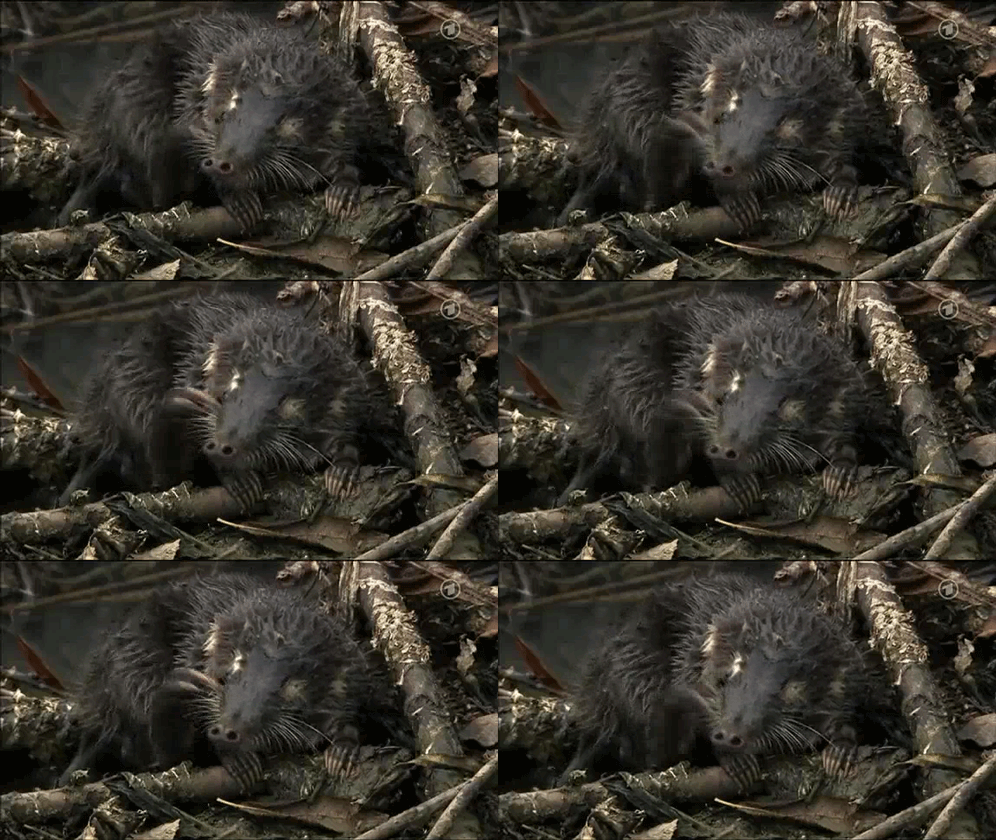
I'm not sure where that origin piece was going, BUT at this point it is almost impossible to tell how much of the Para myth is post and pre-Christian, but a devilish spin does seem to have been put on the character of the Para. That said, let's go back to why such a being might in any way be seen as beneficial, even lucky. First of all, let's say this drawing that has been called an armadillo and a pangolin is in fact a wet little water vole and the dripping from his pillow isn't some weird alchemical elixir of life: it's just water.

Here's more from JPR Environmental on the European water vole:
Once a common feature on most watercourses in the UK, water voles (Arvicola terrestris) have suffered a dramatic decline over the last 100 years but particularly during the last 30 years. Water voles favour slow-flowing, narrow water courses about 1 m in depth that do not fluctuate in water level through the year. Mud or clay banks and with plenty of bank side emergent vegetation is needed for burrowing, feeding and cover.

Happy Water Voles to You

A thriving population of these little beasties spells a great place to graze your cattle, so it stands that they were medieval good luck omens. Sometimes, magic is just reading the nature in front of you and deciding your actions based on empirical observation. It certainly wouldn't do anyone any good to steal somebody else's water voles, BUT if you killed them, you certainly weren't helping yourself out.

Another candidate

The creature on the pillow could be another aquatic rodent whose habitat is throughout Europe, Castor fiber, the European Beaver, and its value may be seen not only changing the environment to create ideal watering holes for cattle but also in a substance that was extracted from its glands even as far back as the early middle ages.

Castoreum was still in the materia medica in the 18th century as a treatment for many ailments—including headache, fever, and hysteria. The Romans believed the fumes produced by burning castoreum could induce an abortion. Paracelsus thought it could be used in the treatment of epilepsy. Castoreum was also used as an analgesic, anti-inflammatory, and antipyretic. Castoreum was described in the 1911 British Pharmaceutical Codex for use in dysmenorrhea and hysterical conditions (i.e., pertaining to the womb), for raising blood pressure and increasing cardiac output. The activity of castoreum has been credited to the accumulation of salicin from willow trees in the beaver's diet, which is transformed to salicylic acid and has an action very similar to aspirin. (Wiki)

 The majority of medicinal herbs used in the Swedish collection have a strong smell (for example, myrrh, myrtle, juniper, mustard), which is employed in practically all the treatments for mental ailments. The only recipe ingredi-ent made from an animal, castoreum, from the beaver's castoreunt pods, has a very powerful smell and was utilized for insomnia. The Occitan collection also includes plenty of aromatic herbs and flowers (basil, thyme, oregano, sage. rosemary, dog rose, to name a few), but the range of ingredients used is much larger, which makes comparison difficult.
From Mental (Dis)Order in Later Medieval Europe

And yet another candidate


A Russian Desman (Desmana moschata) is a small semiaquatic mammal that inhabits the Volga, Don and Ural River basins. Decidedly rich and thick in nature, desman fur used to be highly sought after by the fur trade.
Desmans belong to the same family as moles but are adapted for a more aquatic lifestyle. They posses a similar long, cylindrical body, but the tail is longer and flatter than that of a mole and is broadened by a fringe of stiff hairs (3). The legs are also covered in stiff hairs and the thick, waterproof coat is brownish-red in colour, fading to ashy-grey on the underside (2) (3). The snout is long and flexible and the back feet are completely webbed in order to provide propulsion in water.

Conclusion

The pillow holding the little creature in the Voynich manuscript is dripping, signifying that whatever rests on it is most likely wet. Therefore, the pattern on the back of the creature does not have to be scales and probably is not. It's the clumped, wet fur of a rodent, perhaps the water vole or the European beaver, both serving a beneficial role during the Middle Ages either as the maker and indicator of ideal grazing grounds or as the holder of a prized healing ingredient. Lauded in north European folklore, the para later became demonized by the Church into an anthropomorphic monster meddling in the milk production industry with witchcraft.

Sunday, October 11, 2015

A Page of the Voynich Translated: #f5v

During spring when sunlight (Phes/Hulda's bright phase) heats the fallow ground at the time when life wakes to migrate, the hoofed animals moving from the south, the moon low or new, then walk south by the singing Ukelei river--make a joyful sound and walk southward.
The above is a translation of the page shown below. It would be interesting to discover whether a certain Rumex does bloom along the river Ukleja during the spring months or whether the waters of the river are known to make a sound either from ice break-up or snow melting off the mountains and swelling the river, causing rapids.

These lines bring to mind what nearly every middle-schooler learns by heart: Chaucer's Prologue to the Canterbury Tales, which may have been a literary convention of the day, that is, to say picturesquely that when spring arrives it's time to move south on a pilgrimage.(1)

Several aspects about the Voynich made arriving at this transcription and translation a challenge.
  1. Different letters look alike. It is especially easy to mistake the k with the u.
  2. Double letters are not necessarily double but rather single. This is often so with the l, the k, and the f.
  3. The phrases have not an English syntax but a Finnic syntax so that word order matters less than declension, and the declension does not necessarily follow Finnish to the letter so that only the root or lemma can be surmised. What might be helpful pronouns are thus subsumed under suffixes that are not always obvious. Example:
  4. It is often difficult to tell where a new word begins. For example, is the first word or two Lekker, Le eker, Leukker, Leeker, La eker, Laeker…? One of many inaccurate presumptions about the Voynich is that it was written with absolutely no mistakes. This is asserted by people who can't begin to read the thing. Actually, sketchy letters, foibled letters, tired handwriting, and creative spelling (as was the rule during this time in history) abound, making it even more of a challenge to transcribe.
  5. It's not in Finnish and may not even be in Livonian. Rather, it could be the ancient Kven tongue, some mixture of old Slovene, Hungarian, and old Norse, or perhaps a dialect used by the Estonian Swedes or aibofolket in the 15th century. When I began this translation, I thought for certain that it would be about the plant itself, but as you can see, the words don't really point directly to sorrel except in a contextual sense. A sorrel where I live shows up in early spring along with toadflax, indeed in fallow fields. I don't know whether this is the case with this Rumex. 
Interestingly, three geographical sites mentioned in this blog as being included in the Voynich manuscript form an almost straight vertical line from Torups in Sweden through Ukleja (mentioned here) down to Prague with surrounding castles that resemble those in the Voynich. This all ties into the discussion in the Language Candidates post about the likelihood of the Voynich being about a pre-Christian pilgrimage.

Below is a table showing a breakdown of how I arrived at this translation. You can find a more comprehensive list of words translated from the Voynich manuscript here: Voynich Lexicon.
Voynich word
Possible Meaning
Lekker
play (I'm at last taking basic Norwegian and this word is now an absolute no-brainer)
ker
oak/cows/during
alkua
A start, beginning, inception, incipience. (Finnish) Partitive singular form of alku.  From the verb alkaa (“to begin”) + -u.
From Proto-Finnic *alkadak, from Proto-Uralic *alka- (“beginning”). Cognates include Mansi овл (ōwl, “head”).
Phes
Name of a nature deity akin to Lagran Madre, la Madre de i dei, Ope (Ops), Cibelle, Vesta, Ceres, Proserpina, and others* Phes - From Proto-Indo-European *bʰehos (compare φάω (pháō), φαίνω (phaínō)). Cognates include Latin iubar (“radiance, light”), Sanskrit (bhās, “light, brilliance”),  (bhāsa, “luster, light”), and Old English basu (“purple”).
keit
heat  (Finnish)
kesom
summer/gather/fallow (related to Proto-Finnic *kesä; Proto-Samic *keasē.)
alem
low
som
which
skei
occurs/occurred
da
when - From Old Norse þá and þó (adverb); and Old Norse þá er (when, conjunction), and German da (because, conjunction)
kei
walk or path (Livonian)
elom
life
som
thus
fer
to go, to travel. From Old Norse fara, from Proto-Germanic *faraną, from Proto-Indo-European *por- (“going, passage”).
kelt
refresh, waken
akeperss
(a keperss)
From Middle Dutch keper, from Latin capreus, capreō, from caper (“male goat”), the same metonymy as modern Dutch bok. Cognate with Middle High German kepfer, French chevron.
jelke
do/perform
aller
all
som
thus
som
as
elker
the elk
som
kind (of animals)
je
and
sør
south: from Old Norse suðr, from Proto-
Germanic *sunþrą.
ker
during
se
the
jeller
signs
kuut
moon/month - From Proto-Finnic *kuu, From Proto-Uralic *kuŋe. Cognates include Estonian
kuu and Hungarian hold.
elei
signals
alem
low
hei
they
som
thus or also
fer
to go, to travel. From Old Norse fara, from Proto-Germanic *faraną, from Proto-Indo-European *por- (“going, passage”).
elkalom
animals
helkei
jingle
ker
during
Ukelei
a fish in Germany/Poland OR a river in Poland called the Ukleja (formerly
in Livonia)
el
?
kei
walk
som
that
soi
make a musical sound
kei
walk
kelom
make
elei
gesture/sign
kei
walk
sa?ress
southward

See Voynich Lexicon for a more comprehensive list of transliterations.

(1)1 Whan that Aprill with his shoures soote
When April with its sweet-smelling showers
2 The droghte of March hath perced to the roote,
Has pierced the drought of March to the root,
3 And bathed every veyne in swich licour
And bathed every vein (of the plants) in such liquid
4 Of which vertu engendred is the flour;
By the power of which the flower is created;
5 Whan Zephirus eek with his sweete breeth
When the West Wind also with its sweet breath,
6 Inspired hath in every holt and heeth
In every holt and heath, has breathed life into
7 The tendre croppes, and the yonge sonne
The tender crops, and the young sun
8 Hath in the Ram his half cours yronne,
Has run its half course in Aries,
9 And smale foweles maken melodye,
And small fowls make melody,
10 That slepen al the nyght with open ye
Those that sleep all the night with open eyes
11 (So priketh hem Nature in hir corages),
(So Nature incites them in their hearts),
12 Thanne longen folk to goon on pilgrimages,
Then folk long to go on pilgrimages,
13 And palmeres for to seken straunge strondes,
And professional pilgrims (long) to seek foreign shores,
14 To ferne halwes, kowthe in sondry londes;
To (go to) distant shrines, known in various lands;
15 And specially from every shires ende
And specially from every shire's end
16 Of Engelond to Caunterbury they wende,
Of England to Canterbury they travel,
(2) The quote below is from Le immagini de i dei antichi (Images of the Ancient Gods) by Vincenzo Cartari. This book was an immense success, it went through numerous editions and was translated into many languages, including English in 1599. It became the iconographic handbook of painters throughout Europe for the next 250 years. The woodcuts are based on those of Bolognino Zalteri printed in the Venice 1571 edition with some revision for modesty's sake. Catari's book on the images of ancient gods was first published by Francesco Marolini in 1556, and the first illustrated edition followed in 1571. His work on the gods and their symbols is a key work in the history of symbolism in the Renaissance and the manual for artists as to the proper attributes of the deities. [See Seznec's The Survival of the Pagan Gods for a full discussion of the importance of this text.] According to Seznec, Cartari (b. ca. 1500) was probably a protégé of the duke of Ferrara. In his work Imagini colla sposizione degli dei degli antichi ("Images depicting the gods of the ancients") of 1556, he identifies Lilio Gregorio Diraldi's De deis gentium varia et multiplex historia of 1548 as one of his sources. Despite the success of De deis, Cartari's work competed with it by going for a populist approach, with woodcuts of the ancient gods by Bolognino Zaltieri. Cartari focused on the gods' iconography and explained their clothing, expressions, poses and attributes. Cartari's work was an influence on that of Gian Paolo Lomazzo. Unlike the treatises of the other Italian mythographers (Bocaccio, Conti, Giraldi), Cartari's work was profusely illustrated with captioned images of the pagan gods, and composed in the Italian vernacular. The systematic integration of text and image constituted an original approach to the classical myths, and the use of the vernacular made the text accessible to learned and unlearned alike. Cartari's iconographical, symbolic interpretation of the images of the pagan gods as they were represented in antiquity and discussed by Renaissance antiquarians proved to be an enormously popular approach to pagan myth. His 'Images' was well known to Renaissance artists, poets and critics - "an extremely useful work for historians, poets, painters, sculptors and professors of polite literature."
And as they perceived in her sundry natures, and divers properties, so they ascribed unto her divers and several names, and erected Statues and Altars unto her, according to those names, under which they then so worshiped and adored her, who (as I have already written) was with many taken and understood for Juno: and those flatus and images which were dedicated unto her, were made also many times of many other goddesses: whose properties signified them to be in nature the same as the earth, as first Lagran Madre, la Madre de i dei, Ope (Ops), Phes, Cibelle, Vesta, Ceres, Proserpina, and many others* which of their places and habitations where they then remained, had their names accordingly, all signifying one & the same thing, being as I have said, the Earth, for which indeed, & from whose fruits, all things here in the world seem to receive their life and being, and are nourished & conserved by these fertileness thereof, and in this respect she was called the mother of the gods, insomuch, as all those gods of the Ancients, which were so superstitiously adored and held in that respective regardance, lived here once on the earth, and were fed and maintained by the increases, fruits, & suppeditaments thereof.
I extracted the passage above from Steve Nichols' TARO of the FOUR WORLDS, p139 (ISBN 1874603073), which is a collection of these images along with explanatory quotes from that era. This quote in particular lists known names for an ancient sky deity, a woman in front and tree in back, that indeed was tied to the fruitfulness of the earth but had as much to do with the sun as she did with the earth. At base, she is a personification of sunlight, as the title Phes would suggest (Phes - From Proto-Indo-European *bʰehos (compare φάω ‎(pháō), φαίνω ‎(phaínō)). Cognates include Latin iubar ‎(“radiance, light”), Sanskrit ‎(bhās, “light, brilliance”), ‎(bhāsa, “luster, light”), and Old English basu ‎(“purple”)) and is related to the sky deity discussed by Pavel Limerov in FOREST MYTHS: A BRIEF OVERVIEW OF IDEOLOGIES BEFORE ST. STEFAN:
In other words, for the peoples of North-Eurasia, the mythological fertility does not have an earthly origin, but descends from the heavenly spheres. In the Finno-Ugric mythology, it is represented by the motif of the descent of heavenly goddesses or animals to the earthly world. Such is the Finnish world maiden Ilmatar, who entered to the waters of primordial ocean to give birth to the future creator of world Väinämöinen; such is the Ob-Ugrian Kaltash, the giver of life, who was pushed down from the sky by Torum and gave birth to Mir-Susne-Hum in the air, between heaven and earth (among the Karelians Kaltas-san-taaram – Kaltas is the heavenly mother, quoted in Ignatov 2004: 101); such is the Mordvin Ange-Patjaj, who resides in heaven and gives life on the ground. The myth about a heavenly maiden is known in the mythology of the Sami, Estonians, Mari, Komi-Permyaks, where the idea of fertility is probably less pronounced. As to North Siberia, there are a number of goddesses – the Old Women of Life, who reside in the heavenly world somewhere in the south: the Selkup Yljunda Kotta, the Nganasan Ninulemy Mou njamy, the Ket Tomam, and the Evenk Bugady Enityn. All these divine characters give fertility of earth but reside in heaven. Next to the mentioned female deities, there are also others, including the Earth Mother, but the functions of all of them are secondary.
And in Anssi Alhonen's Notes on the Finnish Tradition:
The upper world is located in the skies and also to the south. The great birch tree (or in Finnish tradition, the giant oak) grows there. At the roots of the tree, a spring flows and marks the source of the world river. Near the tree and spring there is a warm lake, or 'sea of life', where water birds and human souls are renewed. In the Finnish folk religion this upper world became a warm and light world located in the south called Lintukoto (or 'home of the birds') and the sea of life became a body of warm water surrounding the Lintukoto. This upper world is ruled by an old woman, the ruler of all life, protector of childbirth, motherhood and water birds. She is the sender of souls and the mother of the gods. In Finnish mythology a mysterious virgin by the name of Iro is said to have given birth to the three divine brothers at the beginning of times. In Finnish folk religion, the divine mother is the Virgin Mary (or 'Maaria' in Finnish) and she is remembered in songs and spells as a spiritual mother, healer, helper and protector of motherhood.

This sky deity of agriculture and women's craft embodied light, darkness, and death and was responsible for the seasons. She was often referred to in complimentary titles such as The Shining One, as often happens in for example Homeric verse, and these could easily be mistaken by outside cultures as the deity's given name. More about this deity can be found in The Rites of Hulda. Her main celebration occurred at the intercalary transition between the old and new year around mid-November. More about the seasons and the calendar can be found here in The Calendar and Seasonal Year.