
"Do you arrive from a doughty deed or do you strive for a doughty deed?"
This is the question a strange and formidable old woman asks in an old Russian fairy tale. "Doughty" means intrepid, dauntless--that is, brave and persistent. The question is so phrased as to leave no room for the person being asked to be doing anything but performing heroic acts. And who is this hero that is being asked? Hercules? Achilles? Siegfried? Kullervo?
She goes by the name of Baba Yaga, and like Morgan le Fay, she's imbued with strange, numinous powers. She's cryptic, tricky, sometimes working for the good of the hero, sometimes not, and always somehow "in the know." After reading a few of these tales, you get the sense that you'd be an idiot not to do exactly what she tells you to do, regardless of whether you understand it. She's obviously not Russian because she objects to how Russians smell, and she complains about how the Russians are encroaching on what she calls "the free world." Time and again, Baba Yaga is found on a trek into dense, dark forest before the trees thin out and we come to a deep blue ocean.
There are many theories using Russian and Slavic terminology to explain the quixotic name of Baba Yaga. But what if the actual person who inspired such a character originally named herself, and when she did she wasn't using Russian or Slavic but rather her own tongue?
Female Sami deities
These three have to do with pregnancy and childbirth:
Uksahkka ("Door Wife"): midwife helper of newborns and protector of menstruating women and of children from illnesses and other dangers. In homes she stood near the door.Then there is Yambe-Akka or Jabme-akka the Sami Goddess of the Underworld. Her name means 'The Old Woman of the Dead'.
Sarahkka: a well-respected goddess who molds an unborn baby's body around a soul. She also helps the mother give birth and sat near the hearth. Drinks were offered to her by women, who also ate a special gruel in her honor. Similar to Artemis/Diana.
Juksahkka ("Bow Woman"): goddess who can make an unborn child male; also an instructor of boys. She lived near the entrance of the home. In some ways reminiscent of Athena/Minerva.
Finally, there are Beaivi, the sun, and her daughter, both of whom are discussed in the decorative arts post.
You may have noticed that the top four of these end in the same word: Ahkka or Akka, meaning wife, woman, female deity/spirit. Together, they were worshipped as the Akka--the combined feminine force in nature as it is interpreted by the Sami. These female spirits appear in both Sami shamanism and Finnish mythology. Worship of the akka was common and took the form of sacrifices, pleas for help and various rituals. Some Sámi believed the akka lived under their tents.
"Minister" in Sami language is baahpa. Click the word to hear it pronounced. It's very, very close to Baba.
When the original Baba Yaga was explaining what she was, could she have used Samigiella: Baahpa-Akka to designate herself as a minister of the Akka, that is, a female Sami shaman (Northern Sami: noaidi, Lule Sami: noajdde, Southern Sami: nåejttie, Skolt Sami: nōjjd, Ter Sami: niojte, Kildin Sami: noojd/nuojd)? Or might that be how other Sami described her to foreigners: the sage woman?
Bába means "midwife" in modern Hungarian, and originally they were wise old women, later equated with witches as Christianity became widespread.)
Heeeeeeeeeere's Baba!

Over the river and through the dark, dismal forest, to Baba's House we go...
Left below is a rendering of Baba Yaga's dwelling, the infamous revolving hen's leg house. Below right is a Sami storehouse, the comparison of which is variously made elsewhere, so no sense in rehashing. More here.


Baba's Decor
Below is another intrepid hero, this one named Vasilisa, coming to grips with Baba's choice of lighting.

Below is a depiction of a Sami dwelling in the film The Cuckoo. The yellow circle highlights three reindeer skulls. The red circle highlights the hen-legged storehouse. The blue circle indicates the little door slanting back into which a person on entering descends. All of these are characteristics of Baba Yaga's legendary abode. How easily these dwellings might suggest the fabulous and terrible to a visitor unfamiliar with Sami ways.

Here is the skull of a reindeer without the antlers. Beside it, another Sami dwelling.


The skulls on the poles in the story of Finist's feather are said to be human. Skulls did historically (still do) adorn many a nordic forest dwelling, whether of Sami or other people. Typically, they are from reindeer and/or bear. If you read this article about the ritual surrounding the Sami bear hunt, you will get a sense of how elaborate and exceedingly careful and reverent is the Sami's relation to the bear. Though I'll link this video, I don't actually recommend it (Brownbear hunting and the Sami traditions and mythology) except as a quick, albeit clumsy, overview of that relationship. In the video the bear skull beside the woman (above left) does a weird, unnatural floating movement when the camera moves. I suspect it was not originally there but rather got doctored into the film at a later date. Superimposing the bear skull may have been the only way to get this woman to sit and joik beside a thing so powerful in her belief system. The scene is obviously terribly contrived. True to their reverence for the bear, the Sami appear to adhere to the tradition of burying its entire skeleton in a lifelike position. Whether that is true for all Sami tribes, I don't know.
The Finns on the other hand apparently hung the skulls on pine posts. Below is an explanation of Finnish belief and tradition regarding the bear skull:
Kallohonka (Finnish) is pine, which bears skulls placed the feast after. Bear's bones are buried under the oak tree. The skulls are usually placed in the middle of the tree to look to the east. Together, the tree may have several bear skulls. The kallohoka may have stood for the world's wood (Maailmanpuu) symbol--that is, the tree of life--and raising the skull onto the tree is thought to return the bear to the sky, from which it was born.
Below is an excerpt from Notes on the Finnish Tradition by Anssi Alhonen:
The belief that spiritual power is received from the dead is very apparent in the Finnish tradition. A Tietäjä, for example, might drink from a human skull in order to gain excellent memory, or use other rituals related to the dead to gain the increased mental powers which would help him in his work. Most importantly, the tietäjä always drew his power from the underworld before doing healing.
All of this skull imagery to be found in the landscape of Fennoscandia may have melded inside the imagination with another item that certainly would have held the fire that Vasilisa is after in the fairy tale. These to an already-spooked mind might appear a charnel aglow.
 |
| Sauna rocks |
I still greatly doubt it, but having put forth these speculations, I'll admit a real Baba or two may have gone for the gold on this one. After all, nothing says "Go away" like a human skull used as a lamp. In a future post called The Beauties of Bad Press, I'll explain the reason it might have been to Baba's advantage to cultivate terror and distaste.
Go, Baba, go!--Baba's wheels
Here we have Baba Yaga again depicted flying in her mortar, this time with a broom instead of a pestle.


Beside her is a Voynich woman sitting in a similar bucket-like contraption. Beside them is a woman paddling a coracle, which is a small one-person boat shaped like a mortar with a paddle for its pestle. Coracles are very well known throughout the British Isles.
 Albert Edelfelt's painting of Finnish girls in their boat
The question is, did the Sami or other nordic peoples have coracles or anything like them? The Kvens were said to have small, fast boats. Kvenland, Pohjala, Karelia--these are lands with great stretches of forests heavily brocaded with lakes and waterways. It would make sense for boats to be the main form of transport, but how big they were and whether they resembled the coracle waits for more research.
.jpg)
Pohjola-River by Antti Sorva
Now you see her...
The Flying Dutchman effect is when a ship at sea appears to fly. When such a mirage changes shape to where it is not even recognizable, it is called a Fata Morgana. A Fata Morgana is most commonly seen in polar regions, especially over large sheets of ice which have a uniform low temperature. It can however be observed in almost any area. In polar regions the Fata Morgana phenomenon is observed on relatively cold days, however in deserts, over oceans, and over lakes, a Fata Morgana can be observed on hot days. Here is an example: Fata Morgana is an Italian phrase derived from the vulgar Latin for "fairy" and the Arthurian sorceress Morgan le Fay, from a belief that these mirages, often seen in the Strait of Messina, were fairy castles in the air or false land created by her witchcraft to lure sailors to their death.
 So here we have a natural phenomenon named after a legendary witch who knew and took advantage of it to trick her enemies. She may not have been the only witch to do so. Baba Yaga manages to speed off in her little container looking as if she were flying.
Just before Baba Yaga arrives at her dwelling, goes the story, the trees rustle. Perhaps it's not Baba Yaga's arrival upsetting the trees but rather some headwind or evening breeze she's taking advantage of to ride home on.
Baba's Way
A large part of this sort of magic, it would seem, is about propitiousness. It's about knowing intimately one's environment and taking such brilliant advantage of its rhythms and secrets that one appears to command nature when in fact one simply knows the whens, wheres, and hows. In this way, concentrating on exactly what is, these early practitioners of native wisdom could be viewed as having more in common with the rudiments of science than with religion. I'll discuss the reason for all the smoke and mirrors in the future Beauties of Bad Press post.

Baba's Not Alone
This (the red-head to the right) is a famous rendering of Louhi, the Witch of the North, mistress of Pohjola, who features prominently in Finland's national epic, The Kalevala. It is a story about a culture's pride but also, like the Russian fairy tales, about the meeting and merger of various cultures in northern Europe. Like Baba Yaga, Louhi is old, ugly, exacting, and expert at flying. Neither Finnish nor Russian, she rules Pohjola, a dark and misty north land of forest and lake. She has three beautiful daughters and one son, and the old man Väinämöinen, is a Finn (deity) trying to marry one of her daughters. She's not making it easy for him.
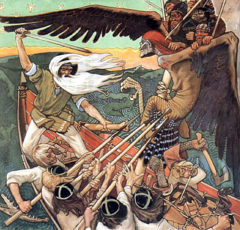
Thus, health itself created its own magical abundance, Women may have done the bark gathering, but men were probably in charge of fashioning a mill that could grind the inner bark of Scots pine. Throughout the Kalevala, the type of heroic deeds most highly praised is far less brute strength or divine breeding than wits and use of technology. In this way the Kalevala differs markedly from its Greek, Roman, or Norse literary cousins.
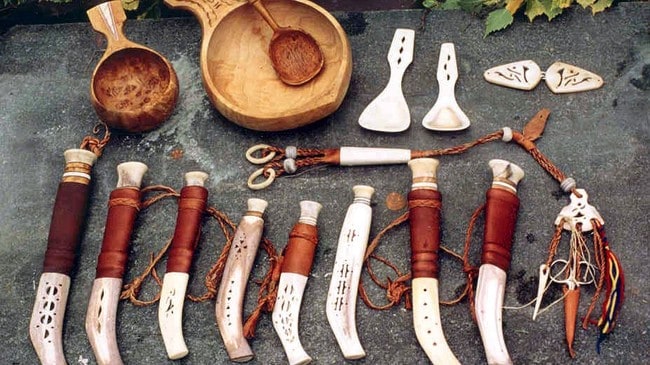 |
| Sami duodji (handicrafts) are ornamental and highly functional |
Let's look at some other women-in-the-know in this area. A vǫlva or völva (Old Norse and Icelandic respectively (the same word, except that the second letter evolved from ǫ to ö); plural vǫlvur (O.N.), völvur (Icel.), sometimes anglicized vala; also spákona or spækona) is a shamanic seeress in Norse paganism, and a recurring motif in Norse mythology. Here's a scary priestess from the History Channel's Vikings series speaking the all-important words, "Put the body on the bench." More here.
 |
| Episode 6 of Season 1 |
And here is a video on the whispering witches of Poland.
Finally, here is a site on north Scotland's Orkney Islands, known as the Witches' Haven, and below three spaewives, the "Weird Sisters" from Shakespeare's MacBeth.

 Legend tells us over and over that at one point, Europe was brimming with women trying to read, interpret, and share knowledge of the world around them. I am not saying that all the women depicted in the Voynich manuscript were Sami. Maybe not a single one was. But look at how close part of Sapmi is to a region called Pohjanmaa (Swedish: Österbotten, English: Ostrobothnia), which some have connected to Pohjola, this fabled northern land of lakes, forest, and women.
I'd go so far as to say the ancient wisdom of sauna, the use of herbs during childbirth, and the chanting during the gathering of plants and the labor and delivery, all of which can be found in the Voynich may well have origins either in the Sami or a sister culture not so far from them that has since vanished from history, leaving only whispers.
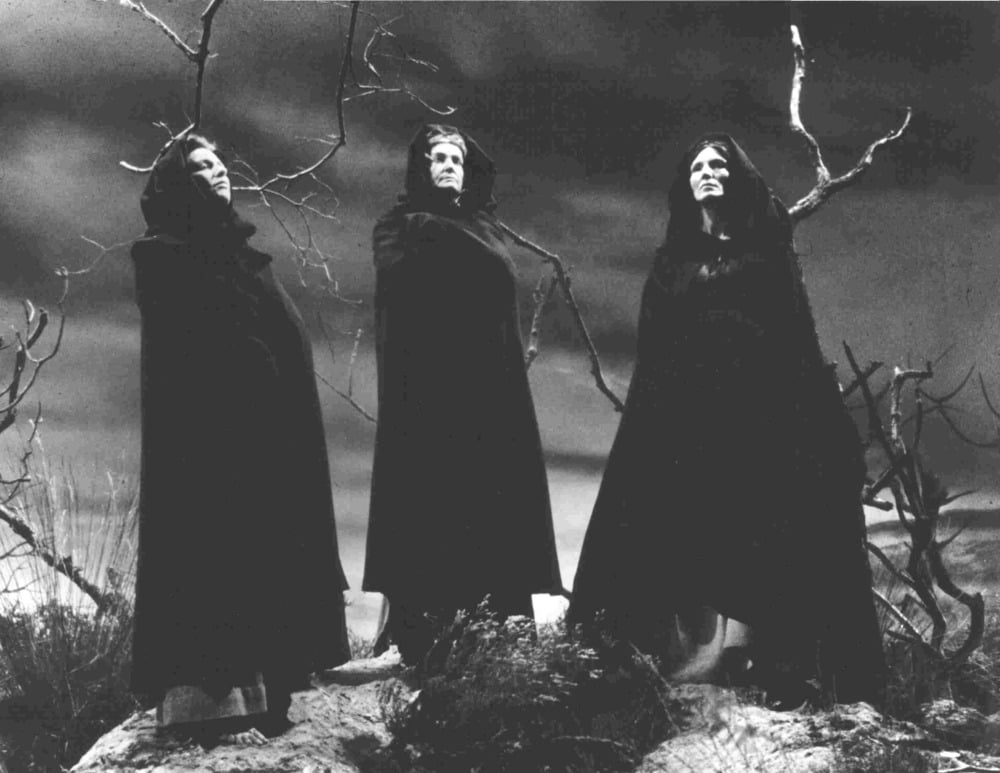
The AS wyrd is represented in English and Scots by “weird,” e.g., “he maun dree his weird” (suffer his destiny). Some link with Teutonic Fate-goddesses is therefore to be found in the “three weird sisters” of our earlier literature. Holinshed relates that three women “in straunge and ferly apparell, resembling creatures of an elder world,” met Macbeth and Banquo and foretold their destinies. “These women were either the weird sisters, that is the goddesses of destinie, or else some nimphs or feiries, endued with knowledge or prophecie by their Nicromanticall science.” They are Shakespeare’s witches or weird sisters, the Fatae or Parcae of Boece’s History. A story of “The weird Sisters” is mentioned in The Complaynt of Scotland, but it is now unknown, and the additions to Warner’s Albion’s England (106 A.D.) speak of “the weird elves,” as Spenser has “three fatal Impes” in his Ruines of Time, and Chaucer “the fatal sustrin” (sisters), akin to “the weird lady of the woods” in Percy’s ballad, who prophesied from a cave about Lord Albert’s child, then stole him away and nurtured him.
Whatever the ultimate origin of the Norns and similar dispensers of destiny may have been, they had human counterparts in actual prophetesses or magic-wielders, like the old Scots “spae-wife,” who foretold an infant’s future, or the Norse Spakona or Volva. In some references to these it is not easy to say where the human aspect ends and the supernatural begins. As Grimm says: “prophesying, inspiring and boon-bestowing women were always supposed to pass through the country, knocking at the houses of those whom they would bless,” and “tales of travelling gifting sorceresses were much in vogue all through the Middle Ages.” In the story of Nornagest the Norns are called Volor and Spakonur, and are said to travel through the land. In Viga-Glums-saga a Volva or spae-wife called Oddibjorg goes about the land, prophesying and telling stories, her prophecies depending on the kind of entertainment which she receives. Quite possibly the supernatural Norns were a reflection of such actual women who claimed and were believed to possess powers of prophecy and even of influence on human destiny. Excerpted from EDDIC MYTHOLOGY by John Arnott MacCulloch
Conclusion
Legend tells us over and over that at one point, Europe was brimming with women trying to read, interpret, and share knowledge of the world around them. I am not saying that all the women depicted in the Voynich manuscript were Sami. Maybe not a single one was. But look at how close part of Sapmi is to a region called Pohjanmaa (Swedish: Österbotten, English: Ostrobothnia), which some have connected to Pohjola, this fabled northern land of lakes, forest, and women. |
| Lappi (Sapmi) showing Pohjanmaa just to the south |


.jpg/640px-R%C3%A1n_and_the_Wave_Girls_(1831).jpg)

