Showing posts with label cipher. Show all posts

Wednesday, June 28, 2017

Introduction


The Voynich manuscript has been carbon dated to the 15th century (~1430). 
   Housed in Yale's Beinecke Library, it depicts largely middle-aged women dancing naked in the water of a cave, and also around star designs and zodiac signs. Other pages illustrate plants and herbal jars. 
   Statistical analysis of the manuscript's text reveals patterns similar to those of natural languages, in fact more complex than English, meaning that it is highly unlikely to be a codified language or a hoax. That much is scientifically proven. 
   Astonishingly, no one has been able to read the Voynich manuscript or figure out where it originated, who wrote it, or what its purpose was. 

   The theory in this blog establishes the following:
Script
A progenitor of Scottish Secretary Hand most closely akin to medieval Cornish manuscripts such as the Ordinalia and northern Scottish/Irish manuscripts, including the preserved letter from Robert the BruceThis blog contains a new and original transcription alphabet.
Language
A combination of old Finnish and Old Norse with some Slavic, the arcane Kven tongue OR a dialect that evolved where Austria, Hungary, and Croatia meet remain the best bet; however, a plethora of dialects in north Europe, many of them extinct, are viable candidates, perhaps especially dialects spoken around A) Torne Valley and northern Norway; B) the island of Kihnu, Estonia, whose language is a blend of Finno-Ugric and Old Swedish; C) the island of Naissaar, Estonia, when it was inhabited by the aibofolket, Estonian Swedes, in the 15th century; D) the medieval towns of Lohja, Porvoo, and Naantali, or E) the older villages of Karelia.
Authors
The many women drawn in it, called "nymphs" or elided altogether in other theories, are central instead of peripheral to it. They themselves actually wrote and drew it. They are possibly the legendary Huldra, participants in a Neolithic cult of tripartite Rhea (later [f]Reya), the original Finnic practitioners of what was then appropriated and dubbed by the Norse as Seiðr during the Late Scandinavian Iron Age. In Finland, Estonia, and Scandinavia, the Church later terminated the sacred HIIS and the underworld called Hiiela by substituting the hiis with the Church graveyard. They were healers, herbalists, midwives, brewers, bakers, cooks, spinners, weavers, embroiderers, well-water guards, water navigators, jewelry makers, tradespeople, land owners or birkarls, noblewomen, singers, dancers, and diviners. The manuscript celebrates these occupations. 
Literary Form
BaltoFinnoNorse poetry and song. Trochaic chant in the tradition of the great Finnish epics, possibly even in Kalevalan meter itself. Akin to Seto Leiko Hõpõhelme, leelo song, which is said to be able to bring down walls. Alliterative, repetitive, and playful with words. Nonlinear, with depth symmetry, like a joik. The manuscript could in fact be a guide (akin to the zibaldone)--songbook, calendar, and map--for these women to go south on a specific pilgrimage in the springtime, according to an ancient, pre-Christian folkloric belief system, the remnants of which can still be discovered in Europe today.
Origin Hotspots
LofotenNorway coming around the Gulf of Bothnia to Southern Finland (Naantali, Lohja) and the islands of Estonia, especially Kihnu, are definite candidates with almost as high a likelihood running from the Baltic region down to the Alpine mountains bordering Slovenia/Croatia, Austria, and Hungary. In these areas particularly, a patchwork of the oldest European belief system can be found in remnants, and the Voynich manuscript echoes them.
Geographic scope
Rosette map contains Fennoscandia, the Baltic, Danubian EuropeRussia's Golden Ring, the Black Sea, Mount Elbrus, and the Urals.
Topic
The women were depicting themselves performing a shamanistic water/cave ritual celebrating the sempiternal cycle of nature manifest in the seasons and in the span of human life from birth to death. The backdrop for this ritual is north European (Finno-Ugric) cosmology that reaches back into the Neolithic. Sauna/banya, still enjoyed today, echo these ancient rites, as do pilgrimages to sacred springs that have been in more recent times dedicated to saints, as well as several seasonal festivals, such as one known in English as Twelfth Night.

In the center of many of the star charts is a woman's face. These star charts may depict a celebrated Nordic ancestor (disir) and her descendants (represented by the smaller, surrounding stars) and not astronomical bodies or constellations. Indeed, these star charts resemble the large, circular brooches worn by Nordic women during the phase in their lives when they are fertile. These brooches are often said to represent the sun. The women's faces in the centers of the star charts often have rays like the sun. These symbols all hark back to an ancient female sky deity celebrated under various names throughout northern Europe.

The rosette map in the manuscript records an ancient pilgrimage from Fennoscandia to the Perm in the northern Urals marked by passage via waterways, many of which were subterranean. The blooming of plants on riverbanks beside castles helped pilgrims know when it was time to rendezvous. Stars with their varying numbers of rays may represent acolytes.

The belief system depicted in the Voynich manuscript was alluded to in sagas such as the Edda. In time it was subsumed under the spread of Christianity and re-emerged as the cult of Mary and Saint Birgitta, which was centered in Reval (Tallinn) though widespread throughout the Baltic region and into Germany. The murals of Saint Lawrence cathedral in Lohja, Finland, serve as a semiotic bridge between the pre-Christian Voynich Manuscript and the more classical, Judeo-Christian iconography of later churches around the Baltic region. 
Context
As with all shamanism water and caves were main metaphors for travel between life and death. The belief system played out on every folio is a remnant of the Neolithic fertility paradigm that once spanned Europe under names like Freya, Holda, Nerthus, Perchta, Holle, Akka, Rán [raun or raahn], and Frau Gauden. These former deities can be traced only vaguely in their later surrogates--the docile, vapid vessels of the Virgin Mary, Freya, and myriad saints who have taken over wells and springs, etc. In order to survive, the old belief system went deep underground and obviously at some point, and oftentimes with inhuman brutality, died out so thoroughly as to mystify us whenever any actual historical remnant of it gets unearthed.
The wisdom throughout the Voynich manuscript is that of the folk. It is not classical, not Judeo-Christian, not Hebrew, not Islamic, not Chinese, not South American, not Arabic, not scientific, not a cipher, not gibberish, and not a hoax. One of the duller attacks made on this theory is that nothing in it reflects any of the current research going on elsewhere about the Voynich manuscript. Indeed,  little to no real light has been shed on the Voynich since the statistical analysis and carbon dating. Most certainly this theory is a radical departure from the many blind alleys down which other scholars are still camped. Beautifully, none of the actual science done about the Voynich conflicts with the theory presented here in this blog--not the carbon dating of the vellum, not the consistency of the vellum (more like calf than the goat often used in more southerly locations), not the statistical analysis that suggests that it is a natural language. 
Remnants
Sauna and Banya, herbal knowledge, embroidery, folk songs, Twelfth Night traditions, lore (fairy tales, myth, and legend, including Tannhauser's), folk design (octogram and kolovrat), coracle design, the shell grotto of Margate, and, oh um, the Voynich manuscript. The herbal jars are treenware, household implements made from wood, often involving being turned on a lathe, further carved, and then painted. The containers in the Voynich most resemble wooden sewing nécessaires, needle cases, spice grinders and spice towers owned and used by women in their everyday work of cooking, brewing, healing, and sewing from the 11th to the 17th century. The plants in the Voynich are rendered by artists inured in the tradition of embroidery and other women's handicrafts. The flowers are often drawn and painted in a style reminiscent of needlework from the Kihnu and Muhu Islands of Estonia. 


Thursday, October 8, 2015

What They Sound Like: Rune Songs and Joiks

The Voynich manuscript appears to contain some sort of chanting in the tradition of the joik and the
From "Women and  Death - Karelian Laments"
Nordic Women's Literature
charm rune. Certain characteristics point strongly to this conclusion:
  1. The text appears to be largely trochaic, which is the meter of choice for such purposes.
  2. Like joiks and chant songs, the Voynich text is alliterative and repetitious, playing with sound.
  3. Several pages depict nothing but women involved in some sort of ritual, dancing and shaking torcs and possibly beating the water, so the potential for chant songs to be included is very high.
 Runes of origins and other "loihtoluvut" (charm runes) were once common in the Finno-Baltic region. The following is excerpted from "Impact of The Kalevala on Finnish Arts and Nationalism" by K. Y. Hamilton:

The word ‘rune’ means ‘a secret thing’ and was thought to have magical overtones. Through the many magic charms in the rune songs, we are able to peek at the social life surrounding the peasant community. The charms themselves were, depending on the circumstance, short, humble, and prayer-like or long, fanciful, commanding charms. The charms regarding the creation of a thing (the ocean, the trees, etc.) are imaginative and poetic narratives. By singing a charm about the origin of a thing, the people were able to conquer that thing through the power of the spoken word.

Carelia was famous for its professional lament singers, men and women
who knew long laments, songs and epical verses by heart.
In 1920 The Kalevala Society (Kalevala Seura) still found wise men and women
who also could perform magical rituals.
This video is a compilation of magical rituals
found in "Reenactment of a Carelian Wedding" shot on location in 1920.
Recording from The Estonian Literary Museum (http://www.kirmus.ee/) 

...In addition to Bride Lamentations, there are magic charms for every nuance of Finnish life. There are exorcism charms, traveling charms, huntsman’s charms, charms for times of illness and times of prosperity, charms for animals and people and natural disasters.

Charm Runes/Rune

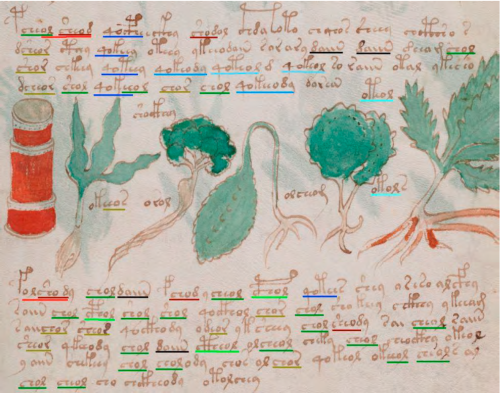
Above is the left side of a page in the Voynich. The lines are divided by a heading in the left margin. When transcribed using the alphabet in this blog, the words appear to derive from old Fenno-Norse roots along the lines of a dialect from the peoples inhabiting the coastline of the Gulf of Bothnia for thousands of years, and those eastward into the Baltic and Karelia.
The Kalevala meter was once the poetic code throughout much of the Balto-Finnic area: among the Estonians, Finns, Izori, Karelians, Livonians, and Votyans. The Balto-Finnic peoples were and continue to be a culturally diverse lot. Thus, rune-singing praxis—its institutional contexts, performing styles, performers, and their goals and poetic skills—varied, often in fundamental ways, according to the region and people in question. "Body, Performance, and Agency in Kalevala Rune-Singing" by Anna-Leena Siikala
A rune singer tradition in the north of Karelia is known to exist for ages, legends and songs were passed on from one generation to another, keeping connection between them. It was rune singers who made the Kalevala region famous: The runes performed by them were carefully recorded for the descendants by Elias Lyennrot who compiled the epos “Kalevala”.
A Karelian Rune Singer

Frans Laulainen contributed these insights:
In Finnic tradition music is the way that magic is conducted. In the Kalevala Väinämöinen uses his Kantele and sings Joukahainen into the mud. I find it interesting that in Finnic culture the women are the singers in chant groups (listen to some Värttinä for songs of Karelia, Ingria, Votia, ja niin edespain). The Saami Joik is sung by all (male and female). Music is power and wisdom.
In pre-Christian Finnic culture women perhaps had some social status as Shamen (or Shawomen) and musical status of singers of the folk songs and lore songs. It is not surprising to me that if the Voynich manuscript is Finnic (possibly Karelian) that it should be written by a woman. 

Rune Charms as opposed to Runes

In this post, we are talking solely about runes or rune charms as chant-songs. The Voynich manuscript handwriting has little to do with the written type of runes except for possibly its very strange "k" and the resemblance that some of its drawings bear to Icelandic magic staves. Karelian runic letters do exist, but they are not well studied at all. The rune song emerged some 2500-3000 years ago in the culture of the proto-Finnic groups living near the Gulf of Finland. Characteristic of this singing tradition is the use of four-footed trochaic verse, alliteration and parallelism (saying the same thing twice in successive verses but in different words). The melodies of rune songs consisted of one or two phrases, usually in 4/4 or 5/4 meter and with a melodic range of a perfect fifth. This singing style remained vital throughout Finland until the 16th century, after which it gradually disappeared, first in the south and west, and later elsewhere. https://www.erudit.org/fr/revues/is/2005-v25-n1-2-is0384/1013309ar.pdf

Other regions in northern Europe employed spells as the famous Merseburg charms evidence. Jacob Grimm in his Deutsche Mythologie, chapter 38, listed examples of what he saw as survivals of the Merseburg charm in popular traditions of his time: from Norway a prayer to Jesus for a horse's leg injury, and two spells from Sweden, one invoking Odin (for a horse suffering from a fit or equine distemper) and another invoking Frygg for a sheep's ailment. He also quoted one Dutch charm for fixing a horse's foot, and a Scottish one for the treatment of human sprains that was still practiced in his time in the 19th century. 

The Joik

A joik (also spelled yoik), luohti, vuolle, leu'dd, or juoiggus is a traditional Sami form of song that is also used in very spiritual contexts.
Through joik, noaiden (the shaman) could come into contact with the spiritual world. In the old Sami religion, it was thought that nature had a soul, and there were many gods and spiritual beings. ...Person joiks are still found to a large degree and are in living use. These are joiks which are made for a person or an animal. It is not the composer or the person who wrote the lyrics who owns the joik, but rather the one for whom the joik was made. It is not said that one joiks about someone, but that one joiks someone. A joik can therefore be connected to a person in the same way as a name is. More here.
The verb “to joik” is used in the transitive form—one does not joik about someone else; one simply joiks someone else (Sámi Instituttha 169). The joik is a unique form of cultural expression for the Sami people in Sápmi. Like the Sami people, it has been misunderstood, ridiculed, appropriated, and even threatened. According to music researchers, joik is one of the longest living music traditions in Europe, and is the folk music of the Sami people. Its sound is comparable to the traditional chanting of some Native American cultures. With the Christianization of the Sami, joiking was condemned as sinful. The traditional joik may be called the "mumbling" style, said to have resembled magic spells. Joiking’s function was both social and spiritual.  Joiks were used not only to communicate the quintessence of a person, place, or thing, to one’s audience, but were also used in the trance-inducing rituals of Saami shamans, or noadi. Lyrical joiks center around either nature (animals, plants, particular places or geographic formations) or people, the latter of which is especially common in North Sapmi.

This is Jan Ole Hermansen, winner of the Sami Grand Prix Yoik Competition.

Conclusion  

Folk wisdom has to do with the rhythms of nature, propitiousness, fertility, purification, and communication with the past or invisible. The more I read about older cultures, the more I am impressed by how central the concept of timeliness was, so that for warriors, as for farmers and priests, there was a due season, and a key to success in any venture was action at the most propitious time, whether it was to make war or sow seed or give a sacrifice. So many traditional patterns in various older cultures speak of rhythms, cycles, a sort of tempo of existence that we can hardly imagine how to appreciate (for more on the seasona``l calendar, click here). Interpreted through various manifestations, both male and female, the divine was witnessed mostly in the phenomenon of sacred timing: that is, rhythm. 

When we manipulate sound, we also affect the medium through which it passes. The ancients have used this fact to at least appear as if they were effecting change through magic.
 
The first historic use of written Finnish was 1450 and Mikael Agricola didn't translate the bible into Finnish until 1537. But that is history, and a lot never got into history. Certainly fact that the bible was translated into Finnish in 1537 would have made it into those annals. The fact that a group of women adopted a weird script in order to record their obviously non-Christian rituals would have been ignored. It is not part of the canon. A fantastic treatise on how our truths have been formed for us can be found in the works of Michel Foucault. Or you could ask any people whose traditions and language have been systematically oppressed, for example the Sami.

Facebook Page

Thursday, May 7, 2015

Transcription Alphabet


The above translation within the Voynich was yielded by using
  • A transcription derived from Scottish secretary hand (see below) 
  • A search within vocabularies found only within a certain geographic area in northern Europe. One can find borrowings from Finnish, Sami, Swedish, Norse, Estonian, and Russian. 

The beauty of this theory is that the meanings of the words and the graphics consistently, mutually support each other in a common cultural context. The who, the what, the why, the where, the how, the symbolism, and the words all work as a cohesive whole. 

The Words

With the alphabet below, I have transcribed well over 80 words, which are mentioned throughout the posts. A partial list is below. For a full list, see the Voynich Word List and the running spreadsheet. Initially, I thought that many of these were names. However, now I believe that those ending in "a" tend to be singular nouns, those ending in "er" tend to be plural nouns, and those ending in "ai" or "ei" tend to be verbs in the past tense, perhaps used as adjectives, as in the English "ed". For example, "kepka" for "cap" appears throughout the Voynich in various forms, such as "ekepker" for "caps" and "kepkei" for "capped".

Sprinkled throughout the mss are simple words, for example eiere, which has several similar meanings depending on the language: if Coptic it means a conduit; if Norwegian it means owners; if Germanic it means to wobble like an egg, as eier in German means egg. Hence, the word may be used to mean source.
The original Icelandic manuscripts which are the source of our knowledge of Norse mythology did not employ a unified system of spelling. Thus the same name might be spelled several different ways even in the original manuscripts. Letters unique to the language existed, such as a modified version of the letter Wynn called Vend that was used briefly for the sounds /u/, /v/, and /w/. In particular, the length of vowels was only sporadically marked in many manuscripts and various umlauted vowels were often not distinguished from others. Another complication is that several shortcut forms for common words, syllables, and grammatical endings developed. One example is the use of the rune named maðr (man) for the word maðr. Another is the use of a special glyph for the various r-endings so common in Old Norse. These scribal abbreviations are categorized as follows:
  • Suspension, truncation, or curtailment: Certain letters of the word are omitted, with the abbreviation indicated by a superscript stroke (esp. dropping a nasal), dot(s) beside the letter, or occasionally a colon. Examples: Ꝥ for þat (etc.), ū for um, hō for hón, þan̅ for þann; .kgr. for konungr, .s. for sonr.
  • Contraction: The first and last letters are written, and the abbreviation is indicated by a dot or superscript stroke.
  • Special signs or brevigraphs: Symbols replacing words or syllables. Examples: Tironian et (⁊) for ok, ᛘ for maðr, syllabic et (Ꝫꝫ) in mꝫ (með) for /eð/.
  • Superscript letters: Regular letters contained in the word or letters specifically for abbreviation purposes. Often with syllabic content. Examples: sᵏ (sik), a zig-zag shaped symbol mainly for er and ir in u͛a (vera).  https://en.wikipedia.org/wiki/Old_Norse_orthography
A word on consonant gradation: it has been rather difficult to discern whether a single or double "l" or a single or double "k" is being used in various places in the manuscript. The letter used as an "l" seems to automatically, invariably be a double "l," but often when you drop it down to a single consonant and look it up, the meaning of the word shows up in lexicons. Consonant gradation, where consonants alternate between various "grades" like this, is typical of Uralic languages such as Finnish, Estonian, Northern Sámi, and the Samoyed language Nganasan. Of the Finnic languages, Votic is known for its extensive set of gradation patterns. So many kk's and ll's ending in a and i certainly give the Voynich manuscript a distinctly Finnish look.

Listed below are words found in the manuscript, which appear in specific languages in northern Europe:

Norwegian/Swedishsom
ikke
ei
eller
Estonian
ilusam
ikka
ei
aga
siis

Finnish
samalla
apara
taikuus
Teit - Finnish - Second-person singular past indicative form of tehdä, to do, to perform
Elä - Possibly various older forms of "elä" (Finnish) meaning "live" (be alive). "Minä elän" = I am alive, "Sinä elät" = you are alive.

Russiankepka - cap
I found these loan words because these languages are prevalent in contemporary times, so they were easy to look up. But the Voynich language itself--whether Seto, Livvi, Votyak, Southern Sami, Ume Sami, Pite Sami, Lule Sami, Northern Sami, Skolt Sami, Inari Sami, Ingrian, Ludic, Permyak, Karelian, or some other tongue spoken in north Europe--is far more difficult to find.
More gleanings from manuscript 

Alkeisa - basic


Allekksa Aleksa Alusa
Apai - aunt Apaiis aunt in Udmurt (Zyrian/Votyak).
Apara - upper body
Epais, which is French for chubby.
Eparlasai - fixative for liver of sulfur

Esaikkaisa Isogaisa = superb
Jór - horse
Kela - coil

Leiks - dock/sorrel
Para - Finnish witchcraft - being created to bring milk and butter
Pekka, Peko, Pekko

Perheit - to have a family
Samalla - in the same way or at the same time as
Sara - wounds
Sareiaia - wound treatment
Taikkusai - taikuus = magic
Tait - enchantment
Teit - Finnish - Second-person singular past indicative form of tehdä, to do, to perform
Ukko-Pekka meaning approximately "(respected) Grandpa Pekka”

The Transcription Alphabet
Below are some of the letters found in the Voynich manuscript transcribed.

"dearest sister" reverse-transcribed in English

Transcription Examples 

Below is a typical text analysis using the commonly cited transcription alphabet (not mine).
And now is a paragraph from the plants section with some early spotty translation using my transcription alphabet. Below, vowels appear to do what we would expect of them and so do consonants, and there appears to be a certain syntax at work. The meaning at least sketchily garnered appears to have to do with the pictures instead of some secretive voyage or love letter, etc.
I do believe that instead of looking for the esoteric, looking instead at natural languages would yield more accurate results. I do believe it will be located on this tree.

If this is an old dialect then even a modern person of that origin might have to spend some time on it. Here's a bit of English in an old dialect (16th c. Scots), and I can't say I breeze through it: He leuis to his barne gif his wyf hes ane man barne his haill armour … And gif it beis ane woman barne the foirsaid geir to be sauld.

So with the Voynich you've got a weird script on top of an obscure dialect on top of what is an apparently extinct language. HOWEVER, someone who knows Old Norse, proto-Finnic, and perhaps proto-Slavic should be able to translate the Voynich at last if they use the transcription alphabet furnished in this post.


Wednesday, May 14, 2014

The Sami influence

I do not believe that the Voynich manuscript is Sami but rather from a neighboring people (Kvens, Seto, Karelians, Orcadians, Veps?) influenced by the Sami. You might say that the manuscript is woven on a Sami loom. Here is a list of reasons why.

The old Kvens exploited and to some extent culturally appropriated the Sami

The birkarls who ruled northern Norway during the Middle Ages exacted taxes from the indigenous Sami and enslaved them, perhaps even committing genocide against them. That is the dark side of Kven history. They were also culturally and linguistically influenced heavily by the Sami and may have in some cases intermarried.

Sami culture is ancient 

The Sami have inhabited the northern regions of Europe for thousands of years. With Basque they are the only living non-Indo-European European languages whose origins are prehistoric. Their culture and traditions are aboriginal. Even though the Sami (or Saami) have a distinctly different language from Finnish, studies suggest that the two groups of people have intermingled throughout their history, the Sami being somewhat older perhaps (actually with ancient DNA ties to the Berbers), the Finns being a Europeanized offshoot that strayed, returned, and grew independent from the Sami once more.

Sami culture has been seminal

Among the Sami were nomadic traders who traveled at least as far south as Orkney, Scotland. In exchanging goods with their neighbors (Finns, Slavs, Norse), they spread their ideas, symbols, and words.  Thus, most of the peoples neighboring the Sami have been influenced by them, adopting Sami lore and adapting Sami deities to their own culture.
"The position of the Sami between Russians and Orcadians (from north of Scotland) is probably attributable to the fact that the Sami share much genetically with other Scandinavians, who are closer to British populations than the Russians are." From The men of the north: the Sami by Razib Khan

Sami shamanic influence

The Voynich manuscript depicts many women performing some ritual. The Sami noaidi, meaning the one who sees, appears to be a prototypic shaman/wise person/community leader. The noaidi could be either female or male. Legends of sorceresses among neighboring peoples (Baba Yaga, Louhi, volva, seikona) hark back to the Sami noaidi. The origin of the legendary Baba Yaga (her house is said to be on chicken legs, as typical Sami storehouses seem to be) may be couched in the memory of various Slavic peoples encountering the Sami culture, especially the noaidi, as they pushed westward.

 The woman inside the sun (below right) looks like she is blowing out air. Here is an excerpt from Vladimir Napolskikh's "Seven Votyak Charms" from Estonian Folklore.
The common Votyak word for the healer (or witch-doctor) is emjas'kis' "healer" - a participle (= nomen agentis) from emjany; "to heal" - or pel'l'as'kis' "blower" - a participle from pel'l'as'kyny "to blow"; the last word describes one of the main ways of magic treatment, well-known throughover all the Europe, when the healer blows upon the water with charming and gives it to the patient to drink. 
Below left is a scene from the movie "The Cuckoo." In it, the Sami widow Anni blows on near-death Finnish Soldier Veiko to turn him back to the land of the living. 
Below is Veiko's soul being beckoned toward the land of the dead.

Sami and Sacred Places

The holy place, called a seita, is a central idea in the ancient north-European culture of the Sami. The Voynich manuscript may in fact depict such a setting (a cave with hot springs) to which a yearly pilgrimage was made by people from a far wider area. Hence the variety of head-dresses, held objects, and hair color. Like nothing else during the 15th c., pilgrimages gave women freedom to travel.

Sami and the sauna

For thousands of years, the sauna has been a tradition among the Sami. The Voynich manuscript depicts images of sauna: birch, bucket, scoop...

Sami tradition of female solar deity

At the center of several of the star charts in the Voynich manuscript is a female sun. The myth about a heavenly maiden is known in the mythology of the Sami, Estonians, Mari, Komi-Permyaks.
Many Sami drums have the symbol of the sun in the center. Beaivi (above is her symbol) is the spring and sun goddess of fertility and sanity. She was worshiped by the Sami, one of the indigenous peoples of Fennoscandia. ...She travels with her daughter Beaivi-nieida through the sky in an enclosure covered by reindeer bones, bringing green plants back to the winter earth for the reindeer to eat. More about Beaivi here.

Sami borrowings in Finnish and in the Voynich Manuscript

 Here is a list of Saami Loanwords in Finnish and Karelian.

The Voynich manuscript is overwhelmingly Finno-Ugric with Old Norse and Slavic borrowings. Being Finno-Ugric, it contains words of Sami origin.

For example, Esaikkaisa, a word found on f23r could be an old spelling of the Sami word Isogaisa meaning superb.

Head-dresses with a possible Sami influence


The Sami risku or sun brooch

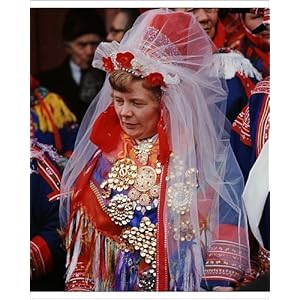
Women in many parts of Europe would have been particularly familiar with radial, circular designs. Some of them would have worn the brooches (solde, solju, risku) that are found throughout this region of the globe, from Norway to Setumaa, Estonia, where only those women could wear the big brooch who were able to give birth to a child. When a girl was wearing a heaped brooch this signified the onset of menstruation and women who were not wearing brooches anymore had already passed their menopause. As you can see, these brooches were circular and big. At least for the Sami, the risku represents the sun. The star charts with the women in the center, with light radiating from her, are reminiscent of a risku.

A drawing reminiscent of a Sami drum

Compare this Voynich page with a heliocentric Sami drum. 
They both give you that sensation of lying on your back and staring up into the sky. 6/16: I came across this article in the Journal of Voynich Studies, J.VS : Voynich f67v2 and Sami Noaidi (shaman) drum symbols in which Berj N. Ensanian speculates on a Sami influence.

Sami deities surrounding pregnancy and childbirth

Much of the Voynich manuscript is concerned with childbirth, especially that performed in sauna/spa/banya, which may well be originally a Sami tradition.
Uksahkka ("Door Wife"): midwife helper of newborns and protector of menstruating women and of children from illnesses and other dangers. In homes she stood near the door.
Sarahkka: a well-respected goddess who molds an unborn baby's body around a soul. She also helps the mother give birth and sat near the hearth. Drinks were offered to her by women, who also ate a special gruel in her honor. Similar to Artemis/Diana.
Juksahkka ("Bow Woman"): goddess who can make an unborn child male; also an instructor of boys. She lived near the entrance of the home. In some ways reminiscent of Athena/Minerva.
When the original Baba Yaga was explaining what she was, could she have used Samigiella: Baahpa-Akka to designate herself as a minister of the Akka, that is, a female Sami shaman (Northern Sami: noaidi, Lule Sami: noajdde, Southern Sami: nåejttie, Skolt Sami: nōjjd, Ter Sami: niojte, Kildin Sami: noojd/nuojd)? Or might that be how other Sami described her to foreigners: the sage woman?

Names in the Voynich echo Sami names

Many of the names of present-day Sami people look as if they had been lifted straight out of the Voynich manuscript:
Eira
Sara
Silje
Ailo
Heaikka
Ailu
Elen
Pulska
Ella
Eilen

Plants familiar to the Sami

Pedicularis Flammea

Range of Pedicularis Flammea

Bog Rosemary

This is andromeda polifolia suokukka showing pink bud clusters. Andromeda polifolia, common name bog rosemary, is a species of flowering plant native to northern parts of the Northern Hemisphere. It is the only member of the genus Andromeda, and is only found in bogs in cold peat-accumulating areas. In Samigiella it is known as Alášrássi.  Prevalent in Finland's Muddus National Park, bog rosemary contains grayanotoxin, which when ingested lowers blood pressure, and may cause respiratory problems, dizziness, vomiting, or diarrhoea.


Buckbean

I challenged myself to find buckbean, because I knew the Sami have used it (Muoskkáš) in various ways, including making a bread (missen) out of it. So I looked for clusters of flowers shooting up from a long sole stem with a group of three leaves sort of cupping it, plus a generous, single root. Here is what I found.

Voynich Syntax reminiscent of the Joik

The verb “to joik” is used in the transitive form—one does not joik about someone else; one simply joiks someone else (Sámi Instituttha 169). The joik is a unique form of cultural expression for the Sami people in Sápmi. Also spelled yoik, luohti, vuolle, leu'dd, or juoiggus it is a traditional Sami form of song. Like the Sami people, the yoik has been misunderstood, ridiculed, appropriated, and even threatened. According to music researchers, joik is one of the longest living music traditions in Europe, and is the folk music of the Sami people. Its sound is comparable to the traditional chanting of some Native American cultures. With the Christianization of the Sami, joiking was condemned as sinful. The traditional joik may be called the "mumbling" style, said to have resembled magic spells. Joiking’s function was both social and spiritual.  Joiks were used not only to communicate the quintessence of a person, place, or thing, to one’s audience, but were also used in the trance-inducing rituals of Saami shamans, or noadi. Lyrical joiks center around either nature (animals, plants, particular places or geographic formations) or people, the latter of which is especially common in North Sapmi. A yoik does not even need to have words. As you listen to the typical joik below, you probably won't be able not to hear the repetitions, the slight variations, and the short syllables that make of this chant-like song.
Recording from The Estonian Literary Museum (http://www.kirmus.ee/)
Another fine example of the joik is one by Nils-Aslak Valkeapää, called the central author of the Sami people and defender and developer of the yoik-music. His "Eanan, Eallima Eadni" is well worth a listen if you can get past the regrettable seagull calls and really bugging synthesizer. But note how the song title plays with words with a similar beginning. This is very common in the Voynich manuscript, and no mistake. Finno-Ugric languages appear to form words by taking a root prefix and varying it at the end. This can be seen also in Estonian and perhaps other Baltic languages. 
Now let's take a look at a sample from the Voynich.
And here are lyris to a modern day joik by Sami singer Mari Boine.
Gáhtašiid gákti ii guhko
Ja gáhtašiid gárri ii dieva
Giehkalas olmmoš
Velggolaš olmmoš
Giehkalas olmmoš
Velggolaš olmmoš
Bálvalusaid
Bálvalusat
Bálvalusaid
Bálvalusat
It's obviously a different language, but how words play off each other with root prefixes is similar. Ánde Somby, a noted Sami and scholar and yoiker, describes the differences in form between Western song and the Sami yoik tradition:
The regular concept of a western European song is that it has a start, a middle and an ending. In that sense, a song will have a linear structure. A yoik seems to start and stop suddenly. It hasn't a start or neither an ending. Yoik is definitively not a line, but it is perhaps a kind of circle. Yoik is not a circle that would have Euclidian symmetry although it has maybe a depthsymmetry. That emphasizes that if you were asking for the start or the ending of a yoik, your question would be wrong. From The Sami Yoik by Kathryn Burke
Now let's look at a theory about the Voynich manuscript held by Torsten Timm, who 
demonstrates the partially complete lines seem to copy each other, always slight modifications were woven into the copying process, so that never or very rarely arose same, but only similar strings. At first glance, it may seem a far-fetched as too simple or too - who the hell are you to sit down and fill more than a hundred pages on this senseless way? However, the hoax hypothesis for VMS (the characters bear no content, it was not for exchange or for the preservation of information made) of many VMS researchers assumed as obvious. These Timm has his suspicions by a number of indicators in the paper itself, and especially in its annex, which one sees that someone has carefully dealt with the matter. From blog post on Jürgen Hermes theory on the Voynich. (Blame Google for the rugged translation.)
Timm and Hermes are picking up the patterning of a joik (play with the prefix roots and depth symmetry) or some related musical form and calling it either a cipher or gibberish created by an Autokopisten. 

Conclusion

I am not saying that all these women in these hot springs birthing centers were Sami. Maybe not a single one was. But I'd go so far as to say the ancient wisdom of sauna, the use of herbs during childbirth, and the chanting during the gathering of plants and the labor and delivery may well have Sami origins, and a few of these women just might have been descended from the Sami or had similar traditions in their culture.


Blog Table of Contents