Showing posts with label seiðr. Show all posts

Friday, October 28, 2016

Sauna Banya Bastu Spa

The oldest known saunas in Finland were made from pits dug in a slope in the ground and primarily used as dwellings in winter. The sauna featured a fireplace where stones were heated to a high temperature. Water was thrown on the hot stones to produce steam and to give a sensation of increased heat. This would raise the apparent temperature so high that people could take off their clothes. The first Finnish saunas are what nowadays are called savusaunas, or smoke saunas. These differed from present-day saunas in that they were heated by heating a pile of rocks called kiuas by burning large amounts of wood about 6 to 8 hours, and then letting the smoke out before enjoying the löyly, or sauna heat. A properly heated "savusauna" gives heat up to 12 hours. Although the culture of sauna nowadays is more or less related to Finnish culture, the evolution of sauna happened around the same time both in Finland and the Baltic countries sharing the same meaning and importance of sauna in daily life, shared still to this day.

Sauna/Banya is utterly central to understanding the Voynich manuscript and the culture that engendered it.
The picture above shows women in what appears to be either a sauna or a hot spring.

Why?

1. The women are blushing but not making any attempt to cover themselves, which suggests that they are hot, not bashful.
2. They appear to be in an underground cave.
3. Europe has a long tradition of bayna/sauna/spa, in some places even giving birth in the sauna.
In some nordic countries, such as quite obviously Finland, sauna is a big deal and treated with as much reverence as a trip to church. Most certainly, sauna was (and is even still) seen as paramount to one's health and well-being.
Sauna spoon and Sami women in film "Pathfinder/Ofelaš/Veiviseren" set in 1000 AD

Other countries as well know and enjoy the benefits of hot spring water, for example, the Czech Republic.

This is a photo showing similar arches of SPA Rajecké Teplice 

Certainly the US loves its heated pools.
The Voynich ladies swim with the Zacharias Ganey Health Institute's Arthritis Water Aerobics Class in the States.
But consider what Klaus Magnus wrote in the 1500s: 
Nowhere on earth is the use of the bath so necessary, as it is in the Northern lands. There you find both private and public baths extremely well equipped. Private baths belong to highly placed persons and are built in the vicinity of fresh running water and beautiful gardens and herbs. Public baths are built in towns and villages and in such a large quantity as the number of people living there make necessary. It is not as Poggio claims in a letter to Leonardo Aretino: that naked people of both sexes meet with inappropriate notions. He probably means the people in northern Germany, especially near the Baden area, who are rather loose with their morals. Among these people there are some who are so loose and degenerate in the hot baths that they even drink and sleep and allow themselves all kinds of evil and other foolishness in the baths. If such immodest creatures were found with their customs in Nordic bathing places, they would immediately be carried out and thrown into the deep winter snow drifts with the risk of being smothered. In the summer they would be thrown in ice cold water and left some time without food.  
Some people firmly believe that the primary purpose of the sauna was to warm up the body. A bath would prevent colds, soften up tense muscles and alleviate any pain, exhaustion or depression. At the earliest stages water was used sparingly; the skin was supposed to become clean through perspiration. 
Gradually, though, the sauna’s function as a place where the body was thoroughly cleaned by washing and flushing became important. 
The basic sauna ritual is the same as it always was: warming up, sweating, taking löyly vapour and whisking, washing and cooling off. Cooling off nowadays often includes swimming. Many people like to cool off in the open air, and there are also brave ones who want to roll in the snow or take a dip in the sea or lake through a hole in the ice. 
A sauna bath without a birch whisk is like food without salt as the saying goes. The bather uses the whisk to beat himself lightly; this raises the blood circulation in the skin, speeds up perspiration and produces a pleasant aroma in the hot room. The whisk is normally made of young birch twigs which are aromatically superior to all other trees. Out of season this birchy smell of summer can he reproduced by using dried or frozen whisks. 
Sauna bathing does not only clean the body but also purifies the mind. The bather’s frame of mind after a leisurely relaxed sauna ritual could be best described as euphoric. It is like a rebirth; all unpleasant feelings fall away and you feel at peace with the whole world. This is what Finns mean by the care of the soul received in the sauna.  http://www.sauna.fi/in-english-2/finnish-sauna-culture-2/

Meanwhile back in Britain, 
As Thomas Becket, the murdered Archbishop of Canterbury, was laid out for viewing in all his woolen clothes, his body cooled and the parasites began to depart. As one chronicler reports, "The vermin boiled over like water in a simmering cauldron, and the onlookers burst into alternate weeping and laughter." 
It was an age when cleanliness was viewed with suspicion as a thing almost "uncanny" and, ironically, unhealthy, that is, outside of the Northern lands.

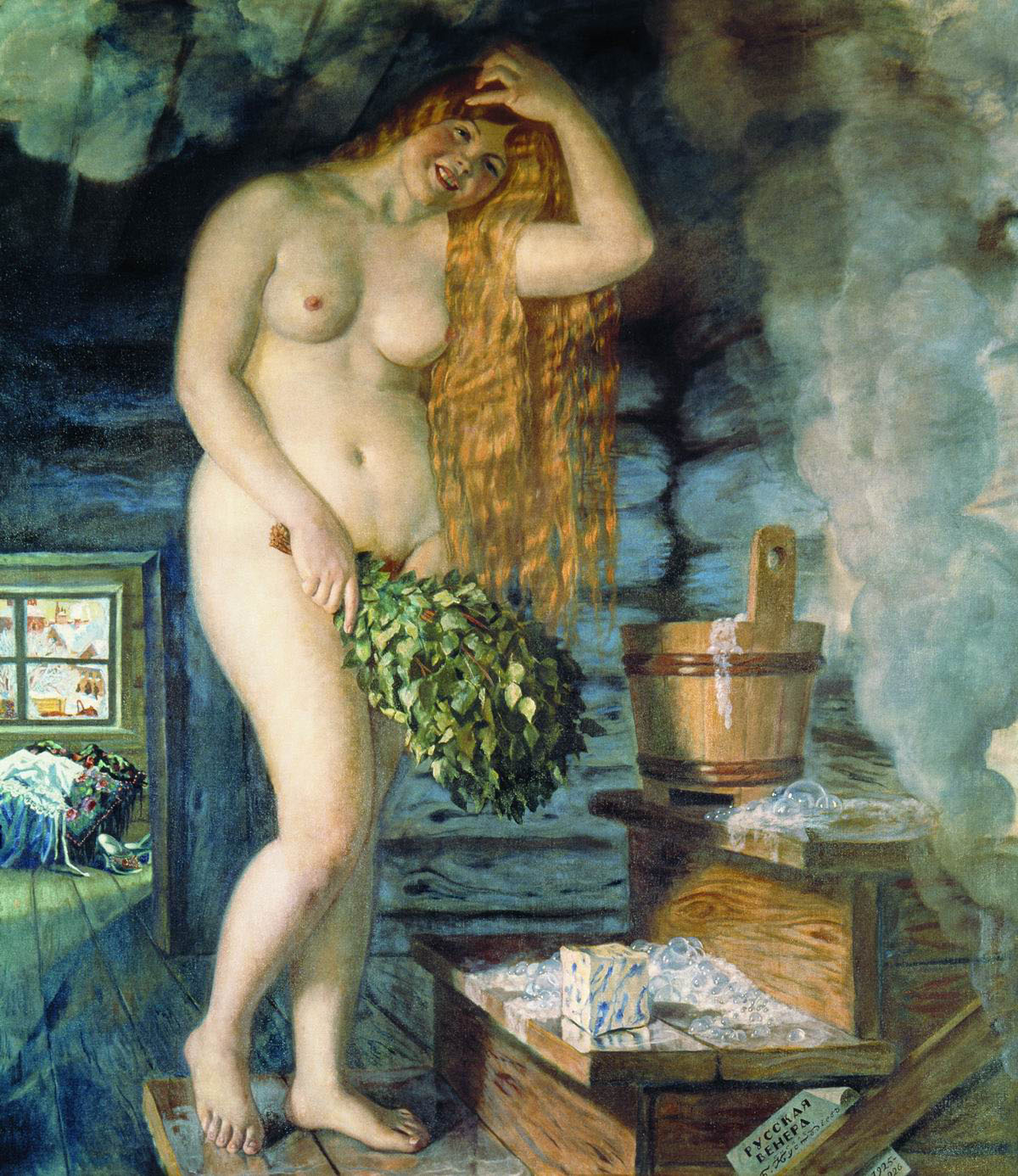
Implements for the Banya/Sauna
Ahhh, sauna

Birch

‘Inmala’ is a tribal patron deity worshipped by the Slobodsky Udmurts and the Besermyans (the Slobodsky district, the Kirov region). No detailed description of how it looked like has remained till the present day. However, Inmala is known to be connected with heaven. The birch was the symbol of the deity. Public praying took place on a small height at the spring well, deep in the forest. On the glade there was a place for fire and a sacred birch with double top. Its trunk was wound round with sacrificed things: head scarves, pieces of cloth, braid, towels, duck’s feathers.

Banya or sauna bucket


Water and Birth

Below are depictions of typical medieval and Roman births with the squatting stool, someone behind for support, and someone in front with a bucket of water.
Or you might, like me, be unfortunate to be forced to lie flat on your back. This is a painful, uncomfortable way to give birth that works against gravity instead of with it. Note the massive washtub with, one might guess, the ubiquitous, proverbial hot water.

Below is an illustration from the Voynich mss. showing gravid women relaxing in the water.

Compare this to some modern water-birthing/prenatal course scenes below.

Blog Table of Contents

Sunday, May 10, 2015

Seidr Staffs and the Voynich

Voynich woman processing into cave with staff
Seiðstaffs of the völur (Old Norse seeresses) are based on the design of distaffs. This symbolism ties in the shamanic staffs with the Spinning of the Norns, with fate-weirding actions, and it also helps to explain the intense female gendering of seiðr, the entranced ceremonies referred to in the Edda and sagas.
Photos by Max Dashu
Ynglingasaga says that Freyja "was a blótgyðja [sacrificial priestess]; she was the first to teach seiðr to the Æsir, as it was practiced among the Vanir.” [Ynglingasaga 4] In the same poem, Snorri claims this "greatest power" for Odinn; “But this sorcery [fjolkyngi], as is known, brings with it so much ergi that manly men thought it a shame to perform, and so this skill was taught to the priestesses.” [Ynglingasaga 7]  --Max Dashu, Witches and Pagans, forthcoming
From Old Norse Vǫluspá, from völu-, vǫlv-, genitive of vǫlva ‎(“truth-sayer, staff-carrier, prophetess”) (cognate with the Gothic walus ‎(walus), Old English wala, walu, Old Frisian walu), from vǫlr ‎(“rounded staff”), from Proto-Germanic *waluz ‎(“staff, stick”), possibly from Proto-Indo-European *wel- ‎(“to turn”).

German engraving (1450-1467) of a tournament between man and woman; to the left, a naked man rides a unicorn, holding a rack as his armour; his opponent is a woman on a horse to the right, equipped with distaff; the entire background is covered by ornamental foliage, on which three birds are placed.


Wednesday, May 14, 2014

The Sami influence

I do not believe that the Voynich manuscript is Sami but rather from a neighboring people (Kvens, Seto, Karelians, Orcadians, Veps?) influenced by the Sami. You might say that the manuscript is woven on a Sami loom. Here is a list of reasons why.

The old Kvens exploited and to some extent culturally appropriated the Sami

The birkarls who ruled northern Norway during the Middle Ages exacted taxes from the indigenous Sami and enslaved them, perhaps even committing genocide against them. That is the dark side of Kven history. They were also culturally and linguistically influenced heavily by the Sami and may have in some cases intermarried.

Sami culture is ancient 

The Sami have inhabited the northern regions of Europe for thousands of years. With Basque they are the only living non-Indo-European European languages whose origins are prehistoric. Their culture and traditions are aboriginal. Even though the Sami (or Saami) have a distinctly different language from Finnish, studies suggest that the two groups of people have intermingled throughout their history, the Sami being somewhat older perhaps (actually with ancient DNA ties to the Berbers), the Finns being a Europeanized offshoot that strayed, returned, and grew independent from the Sami once more.

Sami culture has been seminal

Among the Sami were nomadic traders who traveled at least as far south as Orkney, Scotland. In exchanging goods with their neighbors (Finns, Slavs, Norse), they spread their ideas, symbols, and words.  Thus, most of the peoples neighboring the Sami have been influenced by them, adopting Sami lore and adapting Sami deities to their own culture.
"The position of the Sami between Russians and Orcadians (from north of Scotland) is probably attributable to the fact that the Sami share much genetically with other Scandinavians, who are closer to British populations than the Russians are." From The men of the north: the Sami by Razib Khan

Sami shamanic influence

The Voynich manuscript depicts many women performing some ritual. The Sami noaidi, meaning the one who sees, appears to be a prototypic shaman/wise person/community leader. The noaidi could be either female or male. Legends of sorceresses among neighboring peoples (Baba Yaga, Louhi, volva, seikona) hark back to the Sami noaidi. The origin of the legendary Baba Yaga (her house is said to be on chicken legs, as typical Sami storehouses seem to be) may be couched in the memory of various Slavic peoples encountering the Sami culture, especially the noaidi, as they pushed westward.

 The woman inside the sun (below right) looks like she is blowing out air. Here is an excerpt from Vladimir Napolskikh's "Seven Votyak Charms" from Estonian Folklore.
The common Votyak word for the healer (or witch-doctor) is emjas'kis' "healer" - a participle (= nomen agentis) from emjany; "to heal" - or pel'l'as'kis' "blower" - a participle from pel'l'as'kyny "to blow"; the last word describes one of the main ways of magic treatment, well-known throughover all the Europe, when the healer blows upon the water with charming and gives it to the patient to drink. 
Below left is a scene from the movie "The Cuckoo." In it, the Sami widow Anni blows on near-death Finnish Soldier Veiko to turn him back to the land of the living. 
Below is Veiko's soul being beckoned toward the land of the dead.

Sami and Sacred Places

The holy place, called a seita, is a central idea in the ancient north-European culture of the Sami. The Voynich manuscript may in fact depict such a setting (a cave with hot springs) to which a yearly pilgrimage was made by people from a far wider area. Hence the variety of head-dresses, held objects, and hair color. Like nothing else during the 15th c., pilgrimages gave women freedom to travel.

Sami and the sauna

For thousands of years, the sauna has been a tradition among the Sami. The Voynich manuscript depicts images of sauna: birch, bucket, scoop...

Sami tradition of female solar deity

At the center of several of the star charts in the Voynich manuscript is a female sun. The myth about a heavenly maiden is known in the mythology of the Sami, Estonians, Mari, Komi-Permyaks.
Many Sami drums have the symbol of the sun in the center. Beaivi (above is her symbol) is the spring and sun goddess of fertility and sanity. She was worshiped by the Sami, one of the indigenous peoples of Fennoscandia. ...She travels with her daughter Beaivi-nieida through the sky in an enclosure covered by reindeer bones, bringing green plants back to the winter earth for the reindeer to eat. More about Beaivi here.

Sami borrowings in Finnish and in the Voynich Manuscript

 Here is a list of Saami Loanwords in Finnish and Karelian.

The Voynich manuscript is overwhelmingly Finno-Ugric with Old Norse and Slavic borrowings. Being Finno-Ugric, it contains words of Sami origin.

For example, Esaikkaisa, a word found on f23r could be an old spelling of the Sami word Isogaisa meaning superb.

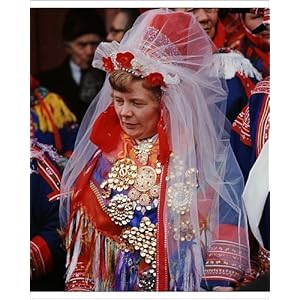
Head-dresses with a possible Sami influence


The Sami risku or sun brooch

Women in many parts of Europe would have been particularly familiar with radial, circular designs. Some of them would have worn the brooches (solde, solju, risku) that are found throughout this region of the globe, from Norway to Setumaa, Estonia, where only those women could wear the big brooch who were able to give birth to a child. When a girl was wearing a heaped brooch this signified the onset of menstruation and women who were not wearing brooches anymore had already passed their menopause. As you can see, these brooches were circular and big. At least for the Sami, the risku represents the sun. The star charts with the women in the center, with light radiating from her, are reminiscent of a risku.

A drawing reminiscent of a Sami drum

Compare this Voynich page with a heliocentric Sami drum. 
They both give you that sensation of lying on your back and staring up into the sky. 6/16: I came across this article in the Journal of Voynich Studies, J.VS : Voynich f67v2 and Sami Noaidi (shaman) drum symbols in which Berj N. Ensanian speculates on a Sami influence.

Sami deities surrounding pregnancy and childbirth

Much of the Voynich manuscript is concerned with childbirth, especially that performed in sauna/spa/banya, which may well be originally a Sami tradition.
Uksahkka ("Door Wife"): midwife helper of newborns and protector of menstruating women and of children from illnesses and other dangers. In homes she stood near the door.
Sarahkka: a well-respected goddess who molds an unborn baby's body around a soul. She also helps the mother give birth and sat near the hearth. Drinks were offered to her by women, who also ate a special gruel in her honor. Similar to Artemis/Diana.
Juksahkka ("Bow Woman"): goddess who can make an unborn child male; also an instructor of boys. She lived near the entrance of the home. In some ways reminiscent of Athena/Minerva.
When the original Baba Yaga was explaining what she was, could she have used Samigiella: Baahpa-Akka to designate herself as a minister of the Akka, that is, a female Sami shaman (Northern Sami: noaidi, Lule Sami: noajdde, Southern Sami: nåejttie, Skolt Sami: nōjjd, Ter Sami: niojte, Kildin Sami: noojd/nuojd)? Or might that be how other Sami described her to foreigners: the sage woman?

Names in the Voynich echo Sami names

Many of the names of present-day Sami people look as if they had been lifted straight out of the Voynich manuscript:
Eira
Sara
Silje
Ailo
Heaikka
Ailu
Elen
Pulska
Ella
Eilen

Plants familiar to the Sami

Pedicularis Flammea

Range of Pedicularis Flammea

Bog Rosemary

This is andromeda polifolia suokukka showing pink bud clusters. Andromeda polifolia, common name bog rosemary, is a species of flowering plant native to northern parts of the Northern Hemisphere. It is the only member of the genus Andromeda, and is only found in bogs in cold peat-accumulating areas. In Samigiella it is known as Alášrássi.  Prevalent in Finland's Muddus National Park, bog rosemary contains grayanotoxin, which when ingested lowers blood pressure, and may cause respiratory problems, dizziness, vomiting, or diarrhoea.


Buckbean

I challenged myself to find buckbean, because I knew the Sami have used it (Muoskkáš) in various ways, including making a bread (missen) out of it. So I looked for clusters of flowers shooting up from a long sole stem with a group of three leaves sort of cupping it, plus a generous, single root. Here is what I found.

Voynich Syntax reminiscent of the Joik

The verb “to joik” is used in the transitive form—one does not joik about someone else; one simply joiks someone else (Sámi Instituttha 169). The joik is a unique form of cultural expression for the Sami people in Sápmi. Also spelled yoik, luohti, vuolle, leu'dd, or juoiggus it is a traditional Sami form of song. Like the Sami people, the yoik has been misunderstood, ridiculed, appropriated, and even threatened. According to music researchers, joik is one of the longest living music traditions in Europe, and is the folk music of the Sami people. Its sound is comparable to the traditional chanting of some Native American cultures. With the Christianization of the Sami, joiking was condemned as sinful. The traditional joik may be called the "mumbling" style, said to have resembled magic spells. Joiking’s function was both social and spiritual.  Joiks were used not only to communicate the quintessence of a person, place, or thing, to one’s audience, but were also used in the trance-inducing rituals of Saami shamans, or noadi. Lyrical joiks center around either nature (animals, plants, particular places or geographic formations) or people, the latter of which is especially common in North Sapmi. A yoik does not even need to have words. As you listen to the typical joik below, you probably won't be able not to hear the repetitions, the slight variations, and the short syllables that make of this chant-like song.
Recording from The Estonian Literary Museum (http://www.kirmus.ee/)
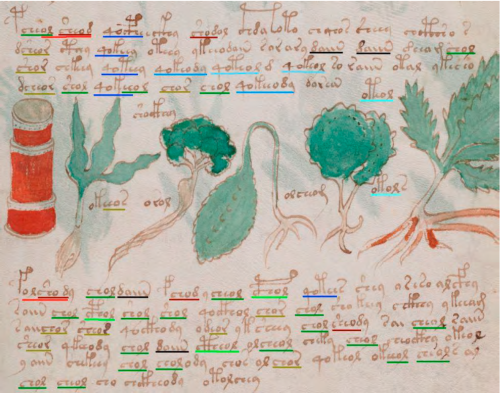
Another fine example of the joik is one by Nils-Aslak Valkeapää, called the central author of the Sami people and defender and developer of the yoik-music. His "Eanan, Eallima Eadni" is well worth a listen if you can get past the regrettable seagull calls and really bugging synthesizer. But note how the song title plays with words with a similar beginning. This is very common in the Voynich manuscript, and no mistake. Finno-Ugric languages appear to form words by taking a root prefix and varying it at the end. This can be seen also in Estonian and perhaps other Baltic languages. 
Now let's take a look at a sample from the Voynich.
And here are lyris to a modern day joik by Sami singer Mari Boine.
Gáhtašiid gákti ii guhko
Ja gáhtašiid gárri ii dieva
Giehkalas olmmoš
Velggolaš olmmoš
Giehkalas olmmoš
Velggolaš olmmoš
Bálvalusaid
Bálvalusat
Bálvalusaid
Bálvalusat
It's obviously a different language, but how words play off each other with root prefixes is similar. Ánde Somby, a noted Sami and scholar and yoiker, describes the differences in form between Western song and the Sami yoik tradition:
The regular concept of a western European song is that it has a start, a middle and an ending. In that sense, a song will have a linear structure. A yoik seems to start and stop suddenly. It hasn't a start or neither an ending. Yoik is definitively not a line, but it is perhaps a kind of circle. Yoik is not a circle that would have Euclidian symmetry although it has maybe a depthsymmetry. That emphasizes that if you were asking for the start or the ending of a yoik, your question would be wrong. From The Sami Yoik by Kathryn Burke
Now let's look at a theory about the Voynich manuscript held by Torsten Timm, who 
demonstrates the partially complete lines seem to copy each other, always slight modifications were woven into the copying process, so that never or very rarely arose same, but only similar strings. At first glance, it may seem a far-fetched as too simple or too - who the hell are you to sit down and fill more than a hundred pages on this senseless way? However, the hoax hypothesis for VMS (the characters bear no content, it was not for exchange or for the preservation of information made) of many VMS researchers assumed as obvious. These Timm has his suspicions by a number of indicators in the paper itself, and especially in its annex, which one sees that someone has carefully dealt with the matter. From blog post on Jürgen Hermes theory on the Voynich. (Blame Google for the rugged translation.)
Timm and Hermes are picking up the patterning of a joik (play with the prefix roots and depth symmetry) or some related musical form and calling it either a cipher or gibberish created by an Autokopisten. 

Conclusion

I am not saying that all these women in these hot springs birthing centers were Sami. Maybe not a single one was. But I'd go so far as to say the ancient wisdom of sauna, the use of herbs during childbirth, and the chanting during the gathering of plants and the labor and delivery may well have Sami origins, and a few of these women just might have been descended from the Sami or had similar traditions in their culture.


Blog Table of Contents