Showing posts with label naissaar. Show all posts

Friday, September 5, 2014

The Baba Yaga and dappled others

"Do you arrive from a doughty deed or do you strive for a doughty deed?"
This is the question a strange and formidable old woman asks in an old Russian fairy tale. "Doughty" means intrepid, dauntless--that is, brave and persistent. The question is so phrased as to leave no room for the person being asked to be doing anything but performing heroic acts. And who is this hero that is being asked? Hercules? Achilles? Siegfried? Kullervo?
Nah, not at all. It's a girl who has struck out into the forest to find her beloved after her sisters played a trick that wounded him and made him flee--well, fly, actually, since he's sometimes a falcon. This is the story called "The Feather of Finist" or "Bright-hawk's Feather," and the old woman figures prominently again and again in traditional Russian and Slavic lore.

She goes by the name of Baba Yaga, and like Morgan le Fay, she's imbued with strange, numinous powers. She's cryptic, tricky, sometimes working for the good of the hero, sometimes not, and always somehow "in the know." After reading a few of these tales, you get the sense that you'd be an idiot not to do exactly what she tells you to do, regardless of whether you understand it. She's obviously not Russian because she objects to how Russians smell, and she complains about how the Russians are encroaching on what she calls "the free world." Time and again, Baba Yaga is found on a trek into dense, dark forest before the trees thin out and we come to a deep blue ocean.

There are many theories using Russian and Slavic terminology to explain the quixotic name of Baba Yaga. But what if the actual person who inspired such a character originally named herself, and when she did she wasn't using Russian or Slavic but rather her own tongue?

Female Sami deities 

These three have to do with pregnancy and childbirth:

Uksahkka ("Door Wife"): midwife helper of newborns and protector of menstruating women and of children from illnesses and other dangers. In homes she stood near the door.
Sarahkka: a well-respected goddess who molds an unborn baby's body around a soul. She also helps the mother give birth and sat near the hearth. Drinks were offered to her by women, who also ate a special gruel in her honor. Similar to Artemis/Diana.
Juksahkka ("Bow Woman"): goddess who can make an unborn child male; also an instructor of boys. She lived near the entrance of the home. In some ways reminiscent of Athena/Minerva.
Then there is Yambe-Akka or Jabme-akka the Sami Goddess of the Underworld. Her name means 'The Old Woman of the Dead'.

Finally, there are Beaivi, the sun, and her daughter, both of whom are discussed in the decorative arts post.

You may have noticed that the top four of these end in the same word: Ahkka or Akka, meaning wife, woman, female deity/spirit. Together, they were worshipped as the Akka--the combined feminine force in nature as it is interpreted by the Sami. These female spirits appear in both Sami shamanism and Finnish mythology. Worship of the akka was common and took the form of sacrifices, pleas for help and various rituals. Some Sámi believed the akka lived under their tents.

"Minister" in Sami language is baahpa. Click the word to hear it pronounced. It's very, very close to Baba.

When the original Baba Yaga was explaining what she was, could she have used Samigiella: Baahpa-Akka to designate herself as a minister of the Akka, that is, a female Sami shaman (Northern Sami: noaidi, Lule Sami: noajdde, Southern Sami: nåejttie, Skolt Sami: nōjjd, Ter Sami: niojte, Kildin Sami: noojd/nuojd)? Or might that be how other Sami described her to foreigners: the sage woman?

Bába means "midwife" in modern Hungarian, and originally they were wise old women, later equated with witches as Christianity became widespread.)

Heeeeeeeeeere's Baba!


Party animal, frightful hag, capital Bad-a**, and man's best foe--this is Baba Yaga taking a chest-high left peeler with the insane bottom turn and a righteous tube before kick-out. Let's get to know this woman better.

Over the river and through the dark, dismal forest, to Baba's House we go...

Left below is a rendering of Baba Yaga's dwelling, the infamous revolving hen's leg house. Below right is a Sami storehouse, the comparison of which is variously made elsewhere, so no sense in rehashing. More here.

Baba's Decor

Below is another intrepid hero, this one named Vasilisa, coming to grips with Baba's choice of lighting.
Below is a depiction of a Sami dwelling in the film The Cuckoo. The yellow circle highlights three reindeer skulls. The red circle highlights the hen-legged storehouse. The blue circle indicates the little door slanting back into which a person on entering descends. All of these are characteristics of Baba Yaga's legendary abode. How easily these dwellings might suggest the fabulous and terrible to a visitor unfamiliar with Sami ways.
Here is the skull of a reindeer without the antlers. Beside it, another Sami dwelling.


The skulls on the poles in the story of Finist's feather are said to be human. Skulls did historically (still do) adorn many a nordic forest dwelling, whether of Sami or other people. Typically, they are from reindeer and/or bear. If you read this article about the ritual surrounding the Sami bear hunt, you will get a sense of how elaborate and exceedingly careful and reverent is the Sami's relation to the bear. Though I'll link this video, I don't actually recommend it (Brownbear hunting and the Sami traditions and mythology) except as a quick, albeit clumsy, overview of that relationship. In the video the bear skull beside the woman (above left) does a weird, unnatural floating movement when the camera moves. I suspect it was not originally there but rather got doctored into the film at a later date. Superimposing the bear skull may have been the only way to get this woman to sit and joik beside a thing so powerful in her belief system. The scene is obviously terribly contrived. True to their reverence for the bear, the Sami appear to adhere to the tradition of burying its entire skeleton in a lifelike position. Whether that is true for all Sami tribes, I don't know. 

The Finns on the other hand apparently hung the skulls on pine posts. Below is an explanation of Finnish belief and tradition regarding the bear skull:
Kallohonka (Finnish) is pine, which bears skulls placed the feast after. Bear's bones are buried under the oak tree. The skulls are usually placed in the middle of the tree to look to the east. Together, the tree may have several bear skulls. The kallohoka may have stood for the world's wood (Maailmanpuu) symbol--that is, the tree of life--and raising the skull onto the tree is thought to return the bear to the sky, from which it was born.
Below is an excerpt from Notes on the Finnish Tradition by Anssi Alhonen:
The belief that spiritual power is received from the dead is very apparent in the Finnish tradition. A Tietäjä, for example, might drink from a human skull in order to gain excellent memory, or use other rituals related to the dead to gain the increased mental powers which would help him in his work. Most importantly, the tietäjä always drew his power from the underworld before doing healing.
All of this skull imagery to be found in the landscape of Fennoscandia may have melded inside the imagination with another item that certainly would have held the fire that Vasilisa is after in the fairy tale. These to an already-spooked mind might appear a charnel aglow. 
Sauna rocks
I still greatly doubt it, but having put forth these speculations, I'll admit a real Baba or two may have gone for the gold on this one. After all, nothing says "Go away" like a human skull used as a lamp. In a future post called The Beauties of Bad Press, I'll explain the reason it might have been to Baba's advantage to cultivate terror and distaste. 

Go, Baba, go!--Baba's wheels

Here we have Baba Yaga again depicted flying in her mortar, this time with a broom instead of a pestle. 


Beside her is a Voynich woman sitting in a similar bucket-like contraption. Beside them is a woman paddling a coracle, which is a small one-person boat shaped like a mortar with a paddle for its pestle. Coracles are very well known throughout the British Isles. 
Albert Edelfelt's painting of Finnish girls in their boat


The question is, did the Sami or other nordic peoples have coracles or anything like them? The Kvens were said to have small, fast boats. Kvenland, Pohjala, Karelia--these are lands with great stretches of forests heavily brocaded with lakes and waterways. It would make sense for boats to be the main form of transport, but how big they were and whether they resembled the coracle waits for more research.
Pohjola-River by Antti Sorva

Now you see her...

The Flying Dutchman effect is when a ship at sea appears to fly. When such a mirage changes shape to where it is not even recognizable, it is called a Fata Morgana. A Fata Morgana is most commonly seen in polar regions, especially over large sheets of ice which have a uniform low temperature. It can however be observed in almost any area. In polar regions the Fata Morgana phenomenon is observed on relatively cold days, however in deserts, over oceans, and over lakes, a Fata Morgana can be observed on hot days. Here is an example:


Fata Morgana is an Italian phrase derived from the vulgar Latin for "fairy" and the Arthurian sorceress Morgan le Fay, from a belief that these mirages, often seen in the Strait of Messina, were fairy castles in the air or false land created by her witchcraft to lure sailors to their death.

So here we have a natural phenomenon named after a legendary witch who knew and took advantage of it to trick her enemies. She may not have been the only witch to do so. Baba Yaga manages to speed off in her little container looking as if she were flying.

Just before Baba Yaga arrives at her dwelling, goes the story, the trees rustle. Perhaps it's not Baba Yaga's arrival upsetting the trees but rather some headwind  or evening breeze she's taking advantage of to ride home on. 

Baba's Way

A large part of this sort of magic, it would seem, is about propitiousness. It's about knowing intimately one's environment and taking such brilliant advantage of its rhythms and secrets that one appears to command nature when in fact one simply knows the whens, wheres, and hows. In this way, concentrating on exactly what is, these early practitioners of native wisdom could be viewed as having more in common with the rudiments of science than with religion. I'll discuss the reason for all the smoke and mirrors in the future Beauties of Bad Press post.

Baba's Not Alone

This (the red-head to the right) is a famous rendering of Louhi, the Witch of the North, mistress of Pohjola, who features prominently in Finland's national epic, The Kalevala. It is a story about a culture's pride but also, like the Russian fairy tales, about the meeting and merger of various cultures in northern Europe. Like Baba Yaga, Louhi is old, ugly, exacting, and expert at flying. Neither Finnish nor Russian, she rules Pohjola, a dark and misty north land of forest and lake. She has three beautiful daughters and one son, and the old man Väinämöinen, is a Finn (deity) trying to marry one of her daughters. She's not making it easy for him.
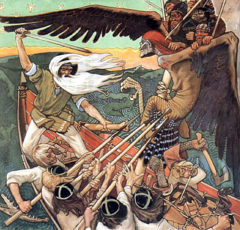
The central task she gives him is to make the Sampo, a magical contraption that can grind out abundance. Brushing aside for the moment the myth's fantastic overtones, Louhi's demand makes perfect sense. The crux of the question any mother would want answered is this: Do you have the technology, old man, to keep my daughter alive during the winter? Väinämöinen's stance is antagonistic, then, because his future mother-in-law is challenging his know-how. During particularly harsh times, the Sami make what they call bark bread or starvation bread. Harvested from the inner bark of Scots pine, this flour prevented tapeworms and afforded vitamin C to ward scurvy. This was a landscape that demanded heartiness for survival. Health freed people up to make more of their surroundings than merely putting their minds to day-to-day subsistence.
Thus, health itself created its own magical abundance, Women may have done the bark gathering, but men were probably in charge of fashioning a mill that could grind the inner bark of Scots pine. Throughout the Kalevala, the type of heroic deeds most highly praised is far less brute strength or divine breeding than wits and use of technology. In this way the Kalevala differs markedly from its Greek, Roman, or Norse literary cousins.
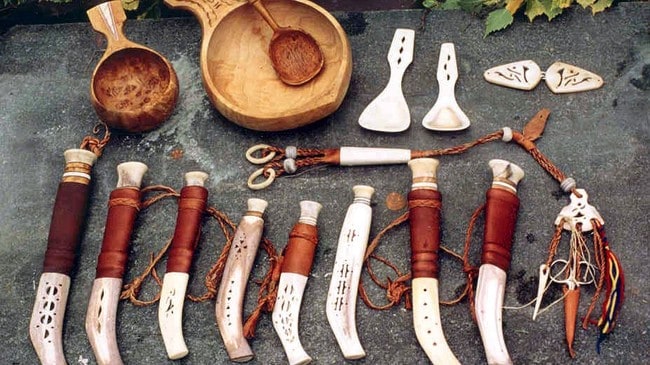
Sami duodji (handicrafts) are ornamental and highly functional
Let's look at some other women-in-the-know in this area. A vǫlva or völva (Old Norse and Icelandic respectively (the same word, except that the second letter evolved from ǫ to ö); plural vǫlvur (O.N.), völvur (Icel.), sometimes anglicized vala; also spákona or spækona) is a shamanic seeress in Norse paganism, and a recurring motif in Norse mythology. Here's a scary priestess from the History Channel's Vikings series speaking the all-important words, "Put the body on the bench." More here.
Episode 6 of Season 1
Here's a modern interpretation of a viking volva spelling a guy's future with runes.
And here is a video on the whispering witches of Poland.
Finally, here is a site on north Scotland's Orkney Islands, known as the Witches' Haven, and below three spaewives, the "Weird Sisters" from Shakespeare's MacBeth.
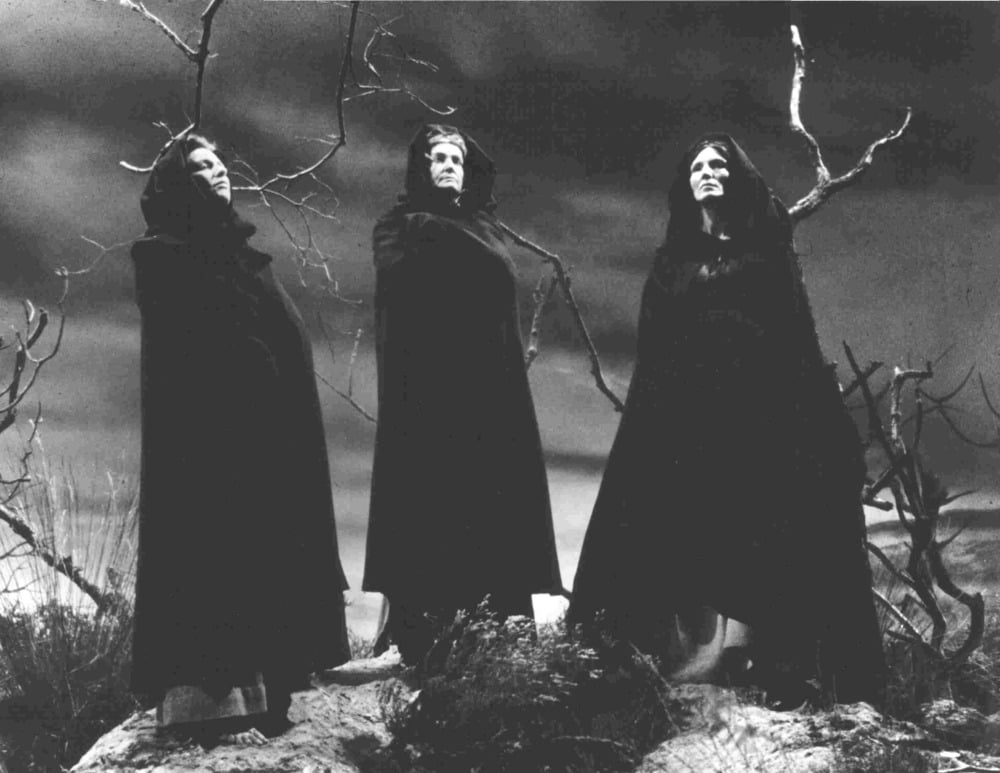
The AS wyrd is represented in English and Scots by “weird,” e.g., “he maun dree his weird” (suffer his destiny). Some link with Teutonic Fate-goddesses is therefore to be found in the “three weird sisters” of our earlier literature. Holinshed relates that three women “in straunge and ferly apparell, resembling creatures of an elder world,” met Macbeth and Banquo and foretold their destinies. “These women were either the weird sisters, that is the goddesses of destinie, or else some nimphs or feiries, endued with knowledge or prophecie by their Nicromanticall science.” They are Shakespeare’s witches or weird sisters, the Fatae or Parcae of Boece’s History. A story of “The weird Sisters” is mentioned in The Complaynt of Scotland, but it is now unknown, and the additions to Warner’s Albion’s England (106 A.D.) speak of “the weird elves,” as Spenser has “three fatal Impes” in his Ruines of Time, and Chaucer “the fatal sustrin” (sisters), akin to “the weird lady of the woods” in Percy’s ballad, who prophesied from a cave about Lord Albert’s child, then stole him away and nurtured him.
Whatever the ultimate origin of the Norns and similar dispensers of destiny may have been, they had human counterparts in actual prophetesses or magic-wielders, like the old Scots “spae-wife,” who foretold an infant’s future, or the Norse Spakona or Volva. In some references to these it is not easy to say where the human aspect ends and the supernatural begins. As Grimm says: “prophesying, inspiring and boon-bestowing women were always supposed to pass through the country, knocking at the houses of those whom they would bless,” and “tales of travelling gifting sorceresses were much in vogue all through the Middle Ages.” In the story of Nornagest the Norns are called Volor and Spakonur, and are said to travel through the land. In Viga-Glums-saga a Volva or spae-wife called Oddibjorg goes about the land, prophesying and telling stories, her prophecies depending on the kind of entertainment which she receives. Quite possibly the supernatural Norns were a reflection of such actual women who claimed and were believed to possess powers of prophecy and even of influence on human destiny. Excerpted from EDDIC MYTHOLOGY by John Arnott MacCulloch

Conclusion

Legend tells us over and over that at one point, Europe was brimming with women trying to read, interpret, and share knowledge of the world around them. I am not saying that all the women depicted in the Voynich manuscript were Sami. Maybe not a single one was. But look at how close part of Sapmi is to a region called Pohjanmaa (Swedish: Österbotten, English: Ostrobothnia), which some have connected to Pohjola, this fabled northern land of lakes, forest, and women.
Lappi (Sapmi) showing Pohjanmaa just to the south
I'd go so far as to say the ancient wisdom of sauna, the use of herbs during childbirth, and the chanting during the gathering of plants and the labor and delivery, all of which can be found in the Voynich may well have origins either in the Sami or a sister culture not so far from them that has since vanished from history, leaving only whispers.


Monday, September 1, 2014

Terra Feminarum and the Venusbergs

"How many?"

Cave Ritual and Abduction in the Venusberg

What is a Venusberg? A more accurate question is, what are Venusbergs. They were caves inside mountains where waterfalls roared and women sang and, well, partied, every so often abducting a man for insemination purposes, creating a sort of uber-harem, except he was the one kept. 

You think I'm kidding.

This polygyny is akin to that of a certain seed-eating savanna species of African weaver bird. They live in a habitat of such superabundant resources that competition is eschewed as a waste of time, so that when it comes to finding a mate, the females' mantra is share and share alike. What can I tell you? It appears to work for dexterous little birds and women living it up inside mountains.

The tale of the Venusberg, with its legendary Mountain of Venus, recurs throughout Europe and throughout the centuries.


Germany

Perhaps the most familiar tale in this tradition is that of Tannhäuser, the minnesinger knight who wanders into the Venusberg, partakes of Venus’ charms, repents and then makes a pilgrimage to Rome to ask forgiveness of the man who is presumably the most unacquainted with experiences of this ilk. The pope refuses absolution, saying that his rather Freudian dry wooden staff would have to sprout leaves and blossom before Tannhäuser could be forgiven, at which point the knight returns to the arms of Venus. This being a morality story, of course, the staff does indeed burst into flower, the pope sends his minions to find Tannhäuser in order to offer him forgiveness, but it is too late: he is doomed (?) to stay with Venus now forever.


Rarely has there been a more subversive morality play.

About the Mountain Hörsel

There exists a thing called "Hörselloch" in the Mountain Hörsel. This mountain is from limestone and has a grotto or cave, which is narrow but very high. It ends up in a small stone chamber. A myth is combined with this grotto that it was the love sanctuary of the goddess Venus, where she invited and seduced Tannhäuser, a famous Medieval poet. Therefore, this cave is called the "Venus grotto", which is the proper name.
"Matriarchale Landschaftsmythologie. Von der Ostsee bis Süddeutschland", Stuttgart (Germany) 2014, Kohlhammer Verlag,  p. 75-60.

Scandinavia

In Scandinavia, tales abound of abduction into caverns by beings called the Huldra.

So what?

Now that the myth is described, let's talk reality. To my knowledge, there has never been a scrap of archeological evidence proving the actual existence of a Venusberg anywhere in all of history. Even were we to unearth such a find, I doubt we'd know what we were looking at, as we have no scholarly context within which to understand or even recognize such a system of belief or behavior. 

In addition, if experts from all fields of study were to stare at such a piece of evidence even for 600 years, it would remain an enigma because professional training occurs in so radically different a system of thought that the artifact's significance would get lumped in with the preposterous--tales of cannibals, men whose heads grow beneath their shoulders, trolls...and dismissed as apocryphal--surely error...surely misnomer... It would most likely be deemed a hoax.

Be that as it may, one field of science, biology, to a certain extent reinforces the logistical workability of a Venusberg. Here's how:
  1. For a female, procreation takes a commitment of nine months, whereas for a man an investment of maybe an hour or two with a bit of a rest in between partners.
  2. Women who live together menstruate together (Sapolsky's worth the watch on this). This means they ovulate together. That is, they are most fertile at the same time of the month, so nabbing a stud for a week or two could generate excellent results.

Here's an especially dark side, however: for such a system to perpetuate, only the female offspring would be kept. If such a system ever did exist, it could have given rise to Perchta's preoccupation with unbaptized infants, the Krampus, and why in so many fairy tales, the girl's brother fares far worse than she does. That is, a female who stumbled on such a society had a chance to be assimilated and earn a place and a voice. A boy, however, would have been summarily dispensed with or kept for one purpose only and then, most likely, dispensed with. That Tannhäuser escaped at all to tell anyone where he had been would have been the rarest exception.

Being anathema to every culture outside of it, such a society would have won unprecedented vitriol from church and state to the point of inviting an open season on such women, even if at times it meant all women. Various popes did indeed, interestingly, decree something of a slash-and-burn policy by the mid-15th century. In these hunts, perhaps officials were just going after the odd hag. Or perhaps there was a little bit more to it.

But let's leave off with speculation and return to reality. Certainly nowhere in the annals of history is there any mention made of such a society of women. 

Terra Feminarum

Terra Feminarum. Woman's Land.


"In the nations of the Sitones a woman is the ruling sex." Tacitus, Germania
Tacitus, Ohthere of Hålogaland (a Viking Age Norwegian seafarer living about 890 AD), and Adam von Bremen (a German medieval chronicler) all mention a land east of Sweden that was not just ruled by women, as in having an occasional queen, but very vividly run by women. These women are likened to Amazons, the ancient Greek staple concept of a female warrior. Lore has it they defended their territory possibly using dogs, boats that were small and fast, and, oh well, poison in the water, which killed the son of a Swedish king. 

In the meantime Swedes (Sueones), that had expelled their bishop, got a divine revenge. And at first King's son called Anund, whose father had sent him to enlarge his kingdom, after arriving to Woman Land (patriam feminarum), whom we consider to be Amazons, was killed along with his army from poison, that they had mixed to the spring water. Terra Feminarum
The women could also apparently kick up a wicked storm, and they may have consigned their men (if there were any) to some sort of subordinate role. Tacitus just goes ahead and calls it slavery. These same women were supposed to have gotten pregnant not via coitus but somehow through water. (...Ya, I don't know how that works.)

I was about to tell you about Jenny McIntosh's Facebook posting that expounds on Kvenland when in fact I came across her expounding on my own research, adding to it the meanings of several words revealing a common construction in Finnish based on: "ellukka," And it rather stunned me, because I didn't know any of that.

McIntosh goes on to say:
The emphasis in femininity featured in pictures of the Voynich manuscript, including a picture of what appears to be a queen wearing a crown, point to the ancient Finno-Ugric nation of Kvenland as the origin. Based on medieval texts, Kvenland was at least in some part/s of history dominated and/or ruled by women.
Voynich Manuscript, #f72r3 and #f72v1

Tarja Parkkila provides a summary of the historic significance of women in Kvenland in her post called Sithonia ... Terra Feminarum .. More information can also be found here: Terra Feminarum.

Here are some of the historical mentions of it:

"In the meantime, reached the vengeance of God Sveans, who were expelled bishop. And first, the king's son called Anund , whose father had sent an empire, then it came to women in the country , which we consider to be the Amazon, got the same when the army killed by the poison, which these had confused the source of the water. " (Adam von Bremen Hamburgische Kirchengesichte III, 16, 1075 AD). 
"Then come Sveans, who ruled large tracts of land always Womens ground up. To the east of these is called a resident Vepsians, merja types, residues, Chudes and Turku all the way to Russia." (Adam von Bremen Hamburgische Kirchengesichte IV, 14, 1075 AD). 
"Besides, we are told that the ocean has many other islands, one of which is said to great Eestiksi, ... And this island is said to be quite close to the Ladies of land, where the latter is not far from Birka svealaisten." (Adam von Bremen Hamburgische Kirchengesichte IV, 17, 1075 AD).
"In the ocean there are also many other islands, all full of ferocious savages, and therefore seafarer avoid them. Similarly, multiplied by amazons in the Baltic sea at these beaches, which is why it is called Women's land . Some will argue that they will become pregnant by drinking water" (Adam von Bremen : Hamburgische Kirchengesichte IV, 19, 1075 AD). 
Before champion Adam was Tacitus :
"Svionien (= svealaisten) neighbors are SITHONIA tribes. In other respects they resemble svioneja alone except for the fact that they are dominated by a woman. To the extent they have fallen not only freedom, but even from slavery." (Tacitus: Germania, in AD 98, Edwin Linkomiehen suomennos, Helsinki 1955 AD, p.45...)
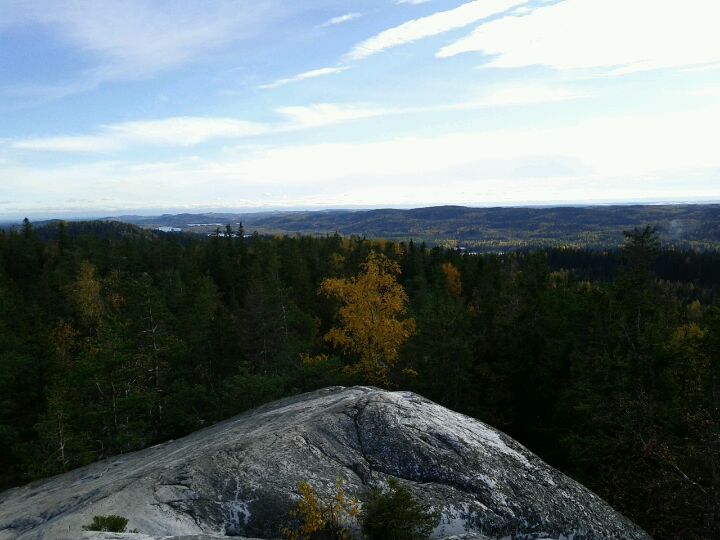
Below is a photo from atop Akka-Koli, one of the peaks in Koli, North Karelia. Koli was originally named Mustarintanen, meaning Black Chest, a euphemism for bear, which had been previously worshipped in this area.

Koli has several caves, one of which is known as PIRUNKIRKKO, the Church of the Devil, known to be a favorite haunt of, you guessed it, witches.

Retkippaika is a great site to explore all the caves, lakes, and wilderness of this area.

A portion of the scant surviving information on Kvenland comes from Finland's national epic, the Kalevala, as follows:

The above was extracted from Juha Pentikäinen's Kalevala Mythology.

The Roots of Legend

Many dismiss the idea of a land of women as either bosh, piffle, or clap-trap. All myth and legend, no tie to reality whatsoever. Those of this opinion assert that Terra Feminarum is simply a mistranslation of Kvenland. Adam von Bremen and Tacitus, they suggest, were letting their imaginations run ahead of fact. In Descriptive Ethnology, R. G. Latham summarily dismisses Kvenland being a "Terra Feminarum" as an etymological blunder--too much free-association with the word "kven," he insists. King Alfred of England in his "A Description of Europe, and the Voyages of Ohthere and Wulfstan" lumps word of a woman's land with tales of cannibals, men whose heads grow beneath their shoulders, and trolls. The same scholars who make no argument against Terra Feminarum being pure myth are yet ready to put faith in Ohthere's tale of six men killing sixty walruses in two days. In fact they even "correct" the man's plotted course to push him up to the White Sea so that he can get into some walruses where they are actually found. They'd rather do this than wonder whether his Baltic course was the correct part after all and what he and his men hunted were the numerous and far more easily killed ringed seal (see King Alfred's Anglo-Saxon Version of the Compendium History of the World by Paulus Orosius, Robert Thomas Hampson, p. 41; Ohthere's "horse whales" were 7 ells. The Viking ell was the measure from the elbow to the tip of the middle finger, about 18 inches. That puts the quarry at 10.5 feet, not the cited 14 feet for a walrus. The ringed seal grows up to about 5 ft. Add an ancient habit called the fish tale, and you've got an ell of a horse whale--sixty of them).
Amazons were also thought to be solely mythological until archaeologists unearthed Scythian burials of real women warriors, says Mayor, a visiting scholar at Stanford University and author of the just-released The Amazons: Lives and Legends of Warrior Women Across the Ancient World.
"Amazons were clearly exotic and exciting to the Greeks. Clearly there is respect and admiration mixed with ambivalence," says Mayor. "Women lived much more separate and unequal lives in the Greek world, so the notion of women who dressed like men and fought like them was pretty exciting to them."

Myth in Medicine

An example of how legend can have threads of scientific fact is illustrated in this folk story from Kainuu, excerpted from The Upper Kainuu Story Atlas. The storytellers chalk up the bizarre behavior of a man to a curse spelled by a witch.

The condition exhibited by Saara's son Jussi is an actual historical phenomenon. Here is an excerpt describing the cause of this condition:
About 400 years ago a new gene arose in the Kainuu district, an allele with no ill effect on its bearer, who was either a man named Matti or possibly Matti’s wife. In later generations, when a child received a copy of the gene from each parent, it seeded a disease called Northern epilepsy. Reijo Norio, a physician who has chronicled the Finnish Disease Heritage, refers rather fondly to Northern epilepsy as “an extremely Finnish disease.” Its symptoms were first described in a 1935 novel that takes place in Kainuu. A character, a beautiful and intelligent boy, developed “falling sickness” and “lost his wits.” Excerpted from Finland's Fascinating Genes.
Today, we know the medical cause of such a condition: an allele on chromosome 8. Genetically-speaking, the Finns are the cheetahs of the human race. Saara's condition as described in the tale actually happened to a portion of the population in Kainuu. It is in fact still a challenge being addressed by Finland's medical community.

But notice what legend did with this phenomenon. It blamed witchcraft practised by two powerful, rather irascible women. Myriad other tales include just such an element, leading to the conclusion that the people in Kainuu may not have been unacquainted with just such persons and their practices.

Finland's fascinating genes are overwhelmingly blamed on isolation. But there may be an unexplored reason for such a concentration of the same genetic material. If the same man impregnated fifty women during some synchronized ovulatory spree, that's a lot of half-brothers and half-sisters with whom to share a birthday  and genes.

The Finnish Huuhta Swidden Culture

But is there any cultural tradition that would make for the possibility of an abduction of a viable man? Shifting cultivation means the cultivation of hominids and crops for human consumption on freshly burned vegetation area or forest within a fewer number of years than the time that area is left to natural regeneration. Shifting cultivation means change of place, and the cultivation refers most often in older literature to a simpler agriculture than the meaning of the word "agriculture" today. A swidden is an area of land cleared for cultivation by slashing and burning vegetation. The two main types of swidden are the huuhta, produced in an old spruce forest, and the pykälik- kökaski, produced in a forest of deciduous trees. The Huuhta burnbeating method of agriculture was the most extensive form of the agricultural strategies yielding only one substantial crop per burnbeating cycle. On the best land a new generation of spruce made huuhta possible again after eighty to a hundred years. The abandoned field gave good hay production for livestock.

Per Martin Tvengsberg writes interestingly about the Forest Finns and the Huuhta swidden culture, some of which is excerpted below.
Noita [what Tvengsberg describes as "a magic guy and/or signings woman"] chose flawless young men, who were sent out in late autumn (lähteä eriin) to find and mark the best forest (eräpühä) for his clan. The wooded area was marked with the clan's personal mark (puumerkki) on the most visible trees. The woven band/stripe of the clan was fastened to a tree (kirjavainen puu). The young man flashed trees around the area to inform any other clans that the place was occupied. From now on, others respected the selected area; it was taboo (pühä) for them to go beyond their borders, no matter how far the young man had traveled to find this woodland. When people from his own clan returned (tulla erästä) early in the spring, they were prepared and able to describe the marked places by means of poetic runes. Runes performed by the young man made it easier for the rest of the clan to remember how to find their way there and back.
...These young men were selected if they were without fault. It is often mentioned that they had to have flawless teeth. This may be because they needed perform the desired sound (screatus / scritobini), sound, song (kirjua, huutaa, seid lätir, galdr) to vibrate the drumskin.
There is a regrettable bias rife throughout Tvengsbert's scholarship. As his interpretations of Huuhta swidden culture heavily color it as a mecca for male homosexuality, so women undergo wholesale marginalization in his treatment. Accordingly, he speaks minimally of women (5 mentions to men's 19+) conjures the old sorcerer consistently as "he," rhetorically converts all wise women to lesbians, and declares that it is the male assuming the feminine role who is considered the powerful shaman. Finally he often equates the noida with a sort of all-powerful high priest within some hierarchy and in almost the same breath equates the noida with the Sami noaidi. Although highly respected and sought after, the Sami noaidi took on more of a community servant role than any role of a ruler.  Here is Anssi Alhonen in Notes on the Finnish Tradition:
The Sámi Noaidi and the Inuit Angakoq (also spelled Angakok, Angakkuit, Angalkuq…) held many similarities regarding their functional roles within their society and the forms of influence they wielded over the inhabitants of their villages. As previously stated, the Noaidi of the Sámi siida was not an appointee into a position of established power, and his position as Noaidi did not necessarily confer influence over the people within the siida. His influence depended primarily on his success and accuracy as a healer/diviner/contactor, his charisma within social interactions and rituals, or sometimes, his ability to scare people into submission, such as enemies or nonbelievers. “He is a manifester, a mediator…He is a storyteller, of the tale that wags the dog (his community). He is the messenger that is the message. He gains power only through the tacit consensus of his people, and yet he has thereby ultimate power over them” (Harkrader, paragraph 7). The Noaidi served as a pathfinder, or guide, for individuals on a personal level and for the community as a whole, giving him multiple dimensions of influence. He was the primary contact between the spiritual realms and the human realm. 
We have to look yet elsewhere to even out the pronoun:
A number of sources show that women too could be noaidis.
Just like the male noaidis, the female noaidis could have different abilities and powers. Legends tell of female noaidis who could move islands. Others could bring bad weather or heal. According to the missionary Hans Skanke, women used knives, axes, stones and belts to foretell the future or to contact gods and spirits. But several sources state that women also used drums. This contradicts other sources which maintain that women were not supposed to touch the drum, nor go behind or into boaššu, the sacred part of the dwelling where the drum is kept. Neither should women travel along the same route as the drum until at least three days had passed. This conflicting information is probably due to traditions and customs having varied from place to place and over the course of time.
Sources:
Bäckman, Louise, 2003: Noajdens initiation, i Erikson, Jørgen: Samisk shamanism.
Lilienskiold, Hans H., 1998: Trolldom og ugudelighet i 1600-tallets Finnmark.
Lundmark, Bo, 1987: Rijkuo-Maja and Silbo-Gåmmoe – towards the question of female shamanism in the Saami area, i Ahlbäck, Tore: Saami Religion.
Ottar 4,1997: Noaidier og trommer.
Pollan, Brita, 1993: Samiske sjamaner: Religion og helbredelse.
Rydving, Håkan, 2003: Traditionell nordsamisk religion omkring år 1700, i Sveen, Arvid: Mytisk landskap.
From  Female noaidis in Sami Faith and Mythology, VARANGER SAMISKE MUSEUM.

Tangible Indicators

There are some tangible indicators in this region that legend may have some basis in fact.

The first of them is the ancient name of an island in this vicinity, specifically northwest of Tallinn (now belonging to Viimsi Parish) in Estonia. It is called Naissaar (German: Nargen; Swedish: Nargö), which means "island of women." That much is a pretty hard fact.

Another is found in the nativization of loan words as researched by Ulla-Maija Kulone, who notes an absence of certain words related to traditional marriage among the Baltic Finns and the later adaptation of others. It appears that historically it was the norm for a Finnish man marrying into a Baltic family to settle in with his wife's family, per their tradition.  This could have led a medieval male chronicler from anywhere outside that culture to conclude subjugation or enslavement on the part of the male, especially if he was also required to pick up after himself.

Moreover, place names give away some interesting history about Karelia.

Albert Edelfelt's painting of Finnish girls in their boat

Here is another illuminating folk tale from Kainuu, a region in Finland that is speculated to be the seat of ancient Kvenland. It suggests the men in this area were out fishing, hunting, harvesting timber, and every now and then catching up with their wives.
Then there is the Voynich manuscript itself, which no one can figure out but which would spring from none other than just such a land.

So now that we have looked at all sorts of circumstantial evidence about a women's land. What about historic documentation?

Livonia to the southeast, it turns out, was known as the land of the Mother.
The Clash of Cultures on the Medieval Baltic Frontier edited by Alan V. Murray
Back in Karelia, we come at last to a king's decree granting a land to women and protecting them under his rule.

The Letter of Protection by King Birger Magnusson for womankind in Karelia on Oct. 1, 1316.

The original parchment letter was until the end of 19th century kept in the Viipuri (Viborg) city archives. Now it has been moved to the National Archives in Helsinki. The backside of the document contains a writing: Privilege to womankind, wives widows maidens, in Viborg and the whole of Karelia given by King Birger Anno 1316 and similarly confirmed by King Albrecht Anno 1360.

All who will see this letter, we Birger, by the grace of God King of the Swedes and the goths, Salute wishing eternal Salvation in Lord. Through this note we will for both those to come as well for those living now, following the advice and consent of the Noble men Gentlemen Canute Jonsson, the judge (lagman) of the ostrogoths, Thor Kætilsson, and Johannes Brunckow, our high chancellor (drots) and other members of our council, firmly pass a statute, to be obeyed as a law, that all wives and women who live subjected to our castle of Vyborg or in the land of Karelia be they married, widows, nuns or virgins, shall enjoy peace and security like in our realm Sweden herself for both in property and person, so that our royal punishment will most severely meet the transgressors. Therefore all and everyone are strictly prohibited from burdening the foregoing wives and women with any kind of injustice or molesting, or inflicting on them any kind of corporal violence, if he wants in our kingdom to avoid the punishment, which is what is in our Swedish realm told in the due law. Date Yninge Anno Domini 1316, on the first of October. 
(Seal) Translation by Pauli Kruhse
In the year 1316, Karelia became by a king's decree and seal a land of women.